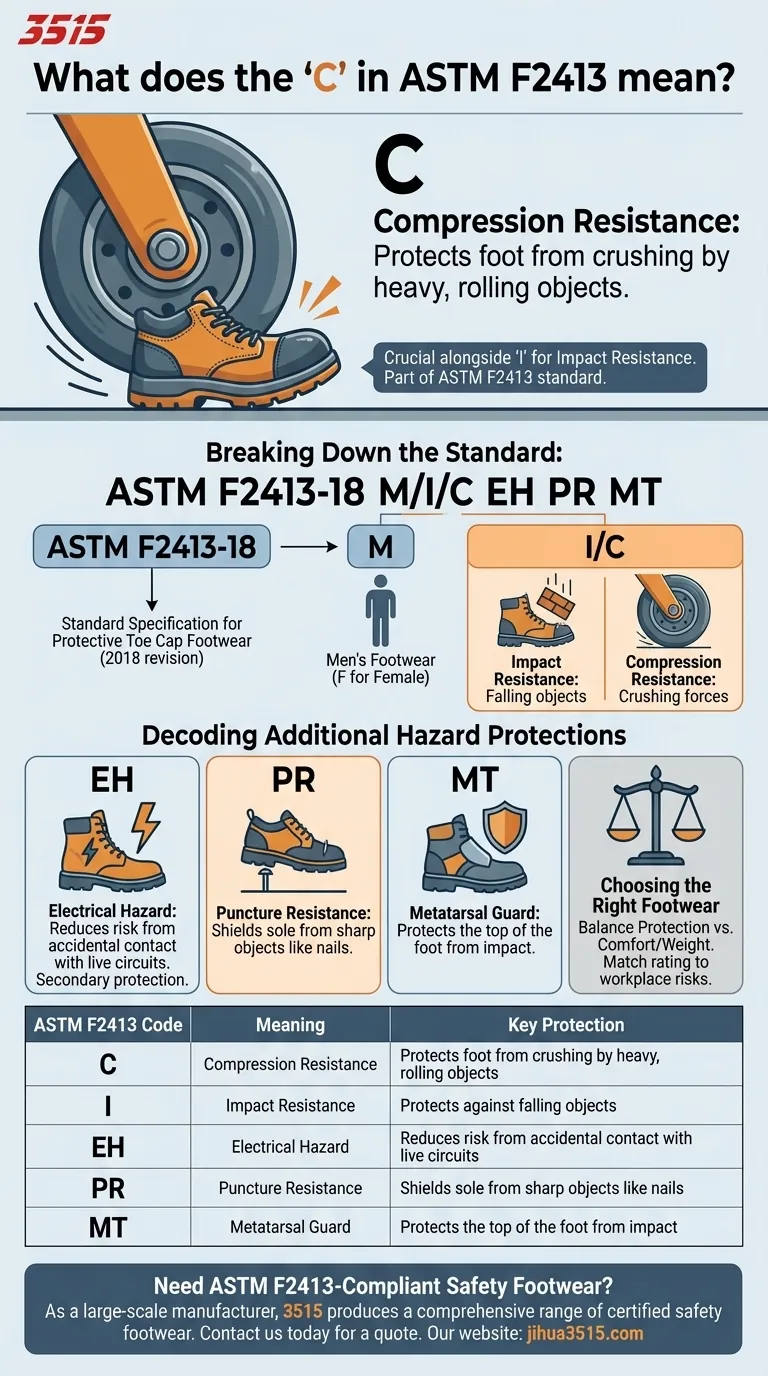
The 'C' in an ASTM F2413 rating signifies compression resistance. This certifies that the safety toe cap in the footwear is designed to protect your foot from being crushed by heavy, rolling objects. It is a critical rating alongside its counterpart, 'I' for impact resistance.
While the 'C' indicates protection from crushing forces, understanding the entire ASTM F2413 code is crucial. Each letter represents a specific type of protection, and knowing how to read them allows you to select footwear that precisely matches the hazards of your job.
Breaking Down the ASTM F2413 Standard
The full line on your safety footwear, such as ASTM F2413-18 M/I/C EH PR MT, tells a complete story about its protective capabilities. It's not just a model number; it's a safety specification.
The Standard Itself: ASTM F2413-18
This first part establishes the foundation. ASTM F2413 is the standard specification for performance requirements for protective (safety) toe cap footwear. The -18 indicates the year the standard was last revised, in this case, 2018.
The Core Safety Toe Ratings: I/C
The most fundamental protections for any safety toe boot are impact and compression resistance. They are always listed together.
Impact Resistance ('I')
The 'I' rating certifies protection against falling objects. It ensures the toe cap can withstand a heavy object being dropped on it from a specific height without collapsing.
Compression Resistance ('C')
The 'C' rating certifies protection against rolling or static crushing forces. This tests the toe cap's ability to resist a heavy load, like a forklift wheel rolling over the foot.
Decoding Additional Hazard Protections
Beyond the safety toe, a boot can be rated for numerous other specific hazards, each represented by a code.
M - Men's Footwear
The 'M' simply indicates that the footwear is built on a men's last. The female equivalent would be 'F'.
EH - Electrical Hazard
An 'EH' rating signifies the boot is designed to reduce the hazard of accidental contact with live electrical circuits. It is considered a secondary source of protection, not a primary defense for electricians.
PR - Puncture Resistance
Footwear marked with 'PR' has a puncture-resistant plate built into the sole. This is essential for protecting your foot from sharp objects on the ground, such as nails or scrap metal.
MT - Metatarsal Guard
The 'MT' rating indicates the footwear includes a metatarsal guard. This component protects the top of your foot (the metatarsal bones) from impact, offering a much larger area of protection than a standard safety toe.
Understanding the Trade-offs
Choosing safety footwear is about matching the protection to the risk. Adding more features isn't always the best solution.
Protection vs. Comfort and Weight
Each additional protective feature, such as a metatarsal guard (MT) or puncture-resistant plate (PR), adds weight and can reduce the flexibility of the boot. Over-specifying your footwear can lead to unnecessary fatigue.
Know Your Site's Requirements
Do not simply buy the boot with the most letters. Your workplace has a specific risk assessment that dictates the minimum required protection. Always start there and select a boot that meets or exceeds those standards without being excessive.
The Limits of EH Protection
It is critical to remember that EH footwear is a secondary defense. It should never be used as the primary source of protection in environments where you are directly working with high-voltage circuits.
How to Choose the Right Rated Footwear
Use the hazard ratings to make an informed decision based on your specific work environment.
- If your primary risk is from falling tools or materials: Ensure your boot has a high 'I' (Impact) rating.
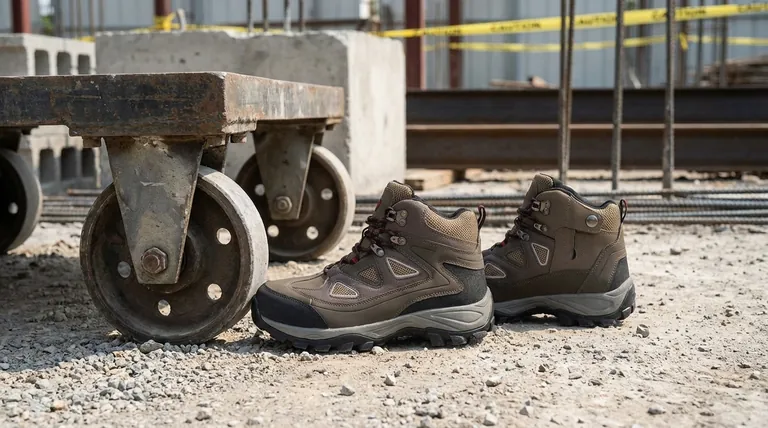
- If you work around heavy rolling equipment like carts or vehicles: A high 'C' (Compression) rating is absolutely essential.
- If you are an electrician or work near potential live circuits: An 'EH' rating provides a crucial layer of secondary protection against shock.
- If your site has sharp debris like nails or rebar: A 'PR' (Puncture Resistant) rating is non-negotiable for underfoot safety.
- If you face risks from objects dropping onto the top of your foot: An 'MT' (Metatarsal) guard offers vital protection beyond the standard safety toe.
By understanding each code, you can move beyond compliance and confidently choose footwear that provides the exact protection you need.
Summary Table:
| ASTM F2413 Code | Meaning | Key Protection |
|---|---|---|
| C | Compression Resistance | Protects foot from crushing by heavy, rolling objects |
| I | Impact Resistance | Protects against falling objects |
| EH | Electrical Hazard | Reduces risk from accidental contact with live circuits |
| PR | Puncture Resistance | Shields sole from sharp objects like nails |
| MT | Metatarsal Guard | Protects the top of the foot from impact |
Need ASTM F2413-Compliant Safety Footwear?
As a large-scale manufacturer, 3515 produces a comprehensive range of certified safety footwear for distributors, brand owners, and bulk clients. We can manufacture boots with the precise combination of ratings—like I/C, EH, PR, and MT—that your workforce requires, ensuring optimal protection without compromising on comfort.
Let us help you equip your team with the right safety solution.
Contact us today for a quote to discuss your specific needs and volume requirements.
Visual Guide
Related Products
- Wholesale Durable Safety Boots | Custom Steel Toe & Puncture-Resistant Manufacturing
- Puncture-Resistant Velcro Safety Boots for Wholesale & Custom Manufacturing
- Premium Suede Sport Safety Shoes for Wholesale & Bulk Orders
- Heavy-Duty Waterproof Nubuck Safety Boots Safety Shoes for Bulk Supply
- Wholesale Durable Breathable Safety Boots Custom OEM Manufacturer
People Also Ask
- What are the key features of safety boots? Essential Protection for Hazardous Workplaces
- What are the risks of using ordinary rubber boots in forest clearing? Why professional safety boots are essential
- What are the consequences of not wearing safety boots? Protect Your Finances and Career
- How should safety boots be cleaned to avoid damage? A Gentle Guide to Preserve Your Boots
- What makes durable safety boots? The Ultimate Guide to Long-Lasting Work Footwear