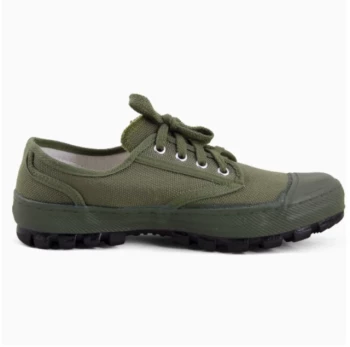
To maintain athletic continuity on irregular artificial turf, training shoes and sneakers must function as a sophisticated interface between the athlete and the ground. The essential design characteristics required are optimized grip, specific sole hardness, and robust upper protection, which collectively allow the footwear to compensate for surface imperfections such as moisture or uneven patches.
Core Insight: High-performance footwear for irregular turf does not just provide traction; it provides the biomechanical support necessary for athletes to make conscious, real-time adjustments—such as cautious turning or controlled sliding—ensuring performance consistency despite environmental fluctuations.
The Mechanics of Surface Compensation
Optimized Grip and Traction
The primary function of the shoe is to act as a stabilizing interface. The outsole must feature optimized grip designed to handle the unique friction coefficients of artificial turf.
This design compensates for sudden interruptions in the surface, such as slippery moisture patches or worn areas. By integrating slip-resistant properties, the shoe ensures that power transfer remains efficient even when the footing is inconsistent.
Specific Sole Hardness
To navigate irregular terrain effectively, the density of the sole unit is critical. It requires a specific sole hardness that balances shock absorption with responsiveness.
If the sole is too soft, energy is lost; if it is too hard, it lacks the necessary compliance for uneven patches. The correct hardness provides a stable platform that adapts to minor ground undulations without destabilizing the foot.
Robust Upper Protection
The upper material serves as a shield against the environment. It must be robust enough to handle the abrasion typical of artificial surfaces.
This protection ensures that surface irregularities do not compromise the structural integrity of the shoe. It also secures the foot during high-intensity movements, preventing internal sliding that could lead to loss of control.
Biomechanical Support and Adaptability
Enabling Conscious Adjustment
A key aspect of maintaining continuity is the athlete's ability to adapt. High-performance design provides the feedback required for conscious movement adjustments.
When an athlete senses a change in the surface, the footwear must support modified actions, such as a more cautious turn or a deliberate slide. This responsiveness allows the athlete to navigate hazards without coming to a complete stop.
Lateral Stability
Irregular surfaces increase the risk of joint misalignment. To counter this, footwear often incorporates design elements found in tactical gear, such as reinforced ankle support.
This feature provides lateral stability, which is essential for preventing ankle rollovers. It ensures that the foot remains aligned with the leg during sharp, reactive movements on unpredictable turf.
Understanding the Trade-offs
Sensitivity vs. Protection
There is a delicate balance between a shoe that protects the foot and one that allows you to "feel" the turf.
Heavily reinforced uppers and stiff soles offer maximum protection against rolls and uneven patches. However, they may dampen the sensory feedback needed to make those conscious micro-adjustments mentioned earlier.
Traction vs. Mobility
While high-abrasion, slip-resistant outsoles prevent falls, excessive grip can be detrimental on artificial turf.
If a shoe grips too aggressively without allowing for controlled rotation or sliding, it transfers torque to the knees and ankles. The design must optimize grip to prevent slipping while still permitting the necessary rotational release.
Making the Right Choice for Your Goal
To select the right footwear for irregular artificial turf, you must prioritize based on your specific movement patterns.
- If your primary focus is Agility and Speed: Prioritize optimized grip and moderate sole hardness to ensure responsive traction that allows for quick, conscious adjustments during sprints.
- If your primary focus is Safety and Stability: Prioritize reinforced ankle support and robust upper protection to minimize the risk of rollovers on uneven or worn patches.
True athletic continuity is achieved when your footwear renders the surface irregularities irrelevant to your performance.
Summary Table:
| Feature | Design Requirement | Performance Benefit |
|---|---|---|
| Outsole Grip | Optimized friction & slip-resistance | Ensures efficient power transfer on wet or worn patches |
| Sole Hardness | Balanced density (Specific Hardness) | Provides shock absorption while maintaining responsiveness |
| Upper Material | Robust, high-abrasion resistance | Protects structural integrity against turf friction |
| Support System | Reinforced ankle & lateral stability | Prevents rollovers and joint misalignment on uneven surfaces |
| Bio-Feedback | Sensory-sensitive construction | Enables athletes to make conscious, real-time micro-adjustments |
As a large-scale manufacturer serving distributors and brand owners, 3515 offers comprehensive production capabilities for all footwear types. Our flagship Safety Shoes series and high-performance training line are engineered to handle the toughest irregular surfaces. Whether you need tactical-grade lateral stability or high-abrasion sneakers for bulk distribution, our expertise ensures your brand delivers unmatched athletic continuity. Contact us today to explore our manufacturing solutions for training shoes, outdoor boots, and professional sneakers.
References
- Yasin Sahhar, Raymond Loohuis. Characterizing the spaces of consumer value experience in value co-creation and value co-destruction. DOI: 10.1108/ejm-04-2020-0313
This article is also based on technical information from 3515 Knowledge Base .
Related Products
- Custom OEM Training Shoes Wholesale Manufacturer Durable & Breathable
- Wholesale Breathable Training Shoes Custom Athletic Footwear Manufacturer
- Wholesale Breathable & Cushioned Training Shoes Custom Factory Production
- Lightweight Breathable Training Shoes for Wholesale & Custom OEM Manufacturing
- Wholesale Training Shoes with Dial Lacing System Custom OEM Manufacturing
People Also Ask
- Why is specialized athletic footwear necessary for ankle rehab? Unlock Safety and Stability in Recovery
- Why is sole stiffness testing using a force gauge necessary? Build Superior Training Shoes with Precision
- Why is the integration of advanced cushioning in training shoes necessary for athletes? Boost Recovery and Performance
- Why is it necessary for participants to wear professional training shoes? Ensuring Data Accuracy & Patient Safety
- Why is the use of flat-soled or professional training shoes essential for WBV? Maximize Vibration Energy Transfer