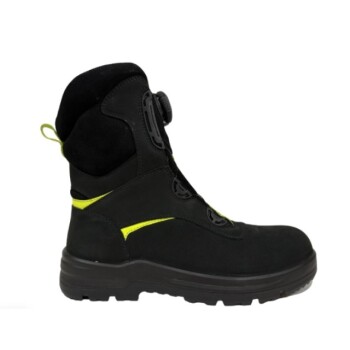
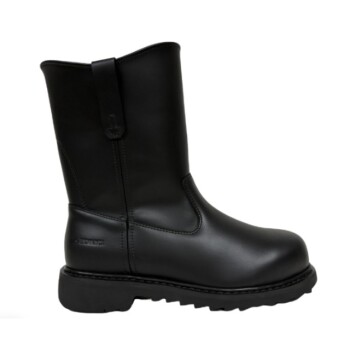
The mandatory safety certification for protective motorcycle boots in Europe is EN 13634. This standard ensures that any boot sold as protective equipment has passed a specific set of rigorous tests for abrasion, impact, and crush resistance. If a boot is advertised for motorcycling, it must carry this CE (Conformité Européenne) marking to be legally sold in the EU.
The EN 13634 label is not just a sticker; it is a guarantee of tested performance. Understanding the numbers on that label allows you to match the level of protection directly to your real-world riding needs.
What Does EN 13634 Actually Test?
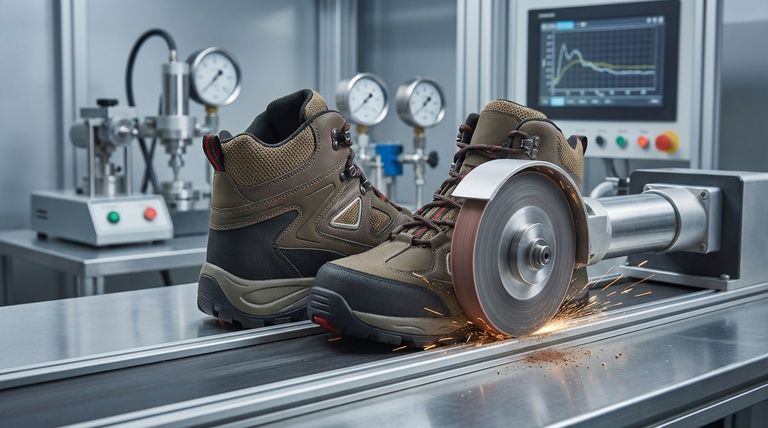
The standard is designed to verify a boot's ability to protect your feet and ankles from the specific injuries common in motorcycle accidents. It focuses on three primary mechanical risks.
Abrasion Resistance
This test simulates the boot sliding across an abrasive surface, like asphalt. The material is subjected to a moving abrasion belt, and the time it takes to wear through is measured. This directly relates to how well the boot will hold up and protect your skin in a slide.
Impact Cut Resistance
This evaluates the boot's ability to resist being cut by a sharp object during an impact. A blade attached to a mounting block is dropped onto the boot sample, and the depth of the cut is measured. This is critical for protecting against impacts with road debris or parts of a vehicle.
Transverse Rigidity (Crush Protection)
This is one of the most important tests. The boot is compressed laterally between two plates until a target force is reached, measuring how much it deforms. This test determines the boot's ability to protect your foot from being crushed if the bike falls on it.
How to Read the Certification Label
Finding the label, usually sewn inside the boot's tongue, is the first step. Understanding the codes and pictograms is what empowers you to make an informed choice.
The Core Pictogram and Standard
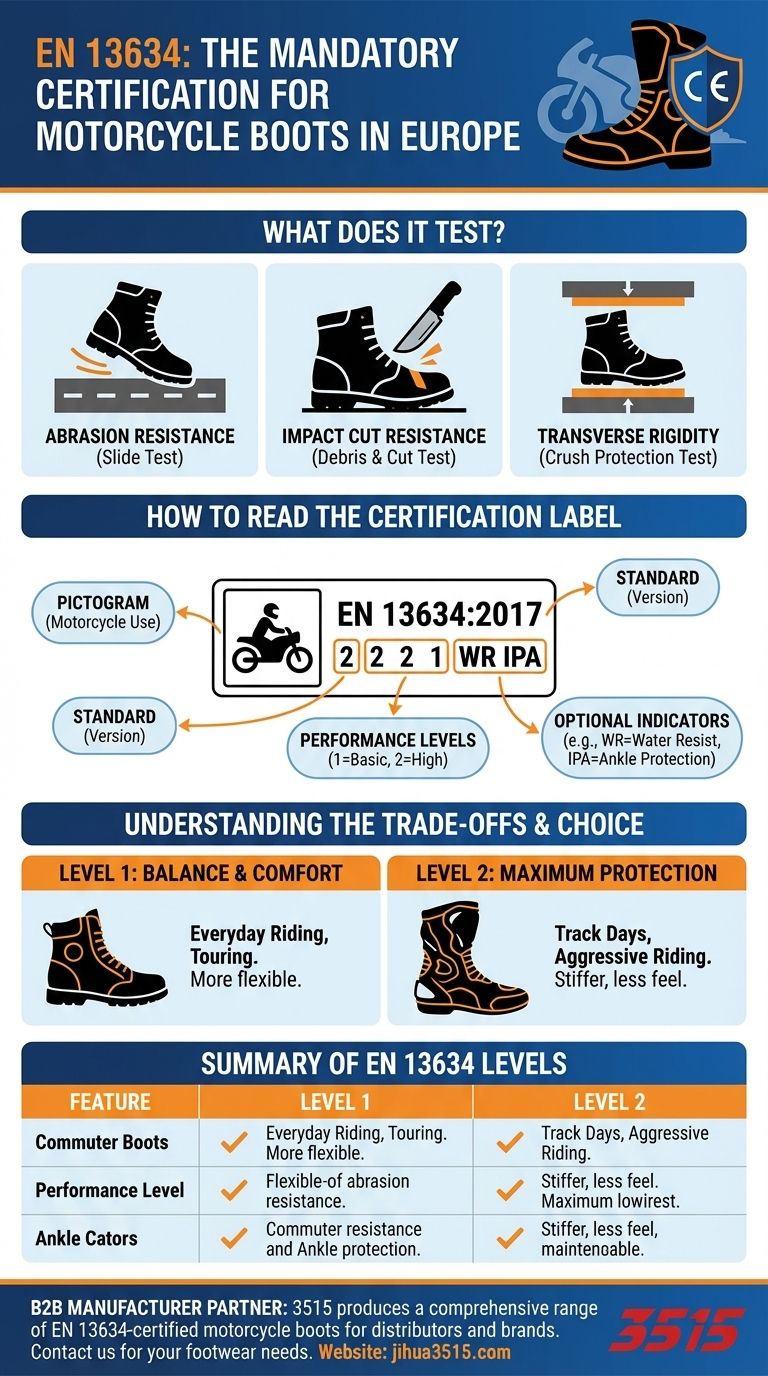
You will always see a pictogram of a motorcyclist, which signifies the product is for that use. Directly beside or below it will be the standard number: EN 13634:2017. The "2017" indicates the version of the standard used.
The Four-Digit Code: Performance Ratings
Below the standard number, you will find a sequence of four digits. Each of these is either a 1 or a 2.
- Level 1 indicates the boot meets the basic safety standard.
- Level 2 indicates the boot meets a higher performance standard, offering significantly more protection.
The four digits correspond to specific tests in a set order:
- Boot Height: (This is a pass/fail, often not shown with a number, but taller boots offer more shin protection).
- Abrasion Resistance: Level 2 lasts much longer in the abrasion test than Level 1.
- Impact Cut: Level 2 allows for significantly less penetration from the test blade.
- Transverse Rigidity: Level 2 boots are far more rigid and resist crushing forces much more effectively.
A boot with a rating of 2 2 2 offers the highest level of certified protection in these key areas.
Optional Test Indicators
You may also see letters below the four-digit code, indicating the boot has passed optional tests for specialized protection.
- IPA / IPS: Indicates certified impact protection for the ankle (IPA) and/or shin (IPS).
- WR: The boot is certified for water resistance.
- FO: The sole provides resistance to degradation from fuel and oil.
- SRA, SRB, SRC: The sole has passed specific slip-resistance tests.
Understanding the Trade-offs
Choosing a boot isn't just about picking the highest numbers. Protection, comfort, and usability exist in a delicate balance.
Level 2: Maximum Protection, Reduced Feel
A boot with all Level 2 ratings, especially in transverse rigidity, will be very stiff. This is excellent for crush protection on a track but can make walking and delicate control of the brake or shifter more difficult during a daily commute.
Level 1: A Balance for Everyday Riding
Level 1 boots provide a tested, certified baseline of safety that is worlds beyond a standard work boot or sneaker. They are often more flexible, lighter, and more comfortable for walking, making them an excellent choice for touring, commuting, and general street riding.
The "Protective Shoe" Problem
Be aware of shorter, sneaker-style riding shoes. While many are fully certified to EN 13634, their low height inherently offers no protection for the shin or ankle against impact or torsion. Always consider boot height in addition to the performance ratings.
Making the Right Choice for Your Goal
Your selection should be based on a realistic assessment of the risks you are most likely to face.
- If your primary focus is track days or aggressive canyon riding: Seek out boots with a "2 2 2" rating and certified ankle/shin protection (IPA/IPS) for maximum safety at high speeds.
- If your primary focus is daily commuting or long-distance touring: A boot with a mix of Level 1 and Level 2 ratings, perhaps with a "WR" for water resistance, offers a fantastic blend of safety and all-day comfort.
- If your primary focus is casual, short-distance urban riding: Do not compromise on safety. A certified Level 1 boot provides a critical and proven baseline of protection that non-motorcycle footwear simply cannot offer.
Ultimately, understanding the EN 13634 standard transforms you from a consumer into an informed rider who can select the right tool for the job.
Summary Table:
| EN 13634 Performance Ratings | Level 1 (Basic) | Level 2 (High) |
|---|---|---|
| Abrasion Resistance | Meets standard | Superior durability |
| Impact Cut Resistance | Basic protection | High penetration resistance |
| Transverse Rigidity (Crush) | Standard rigidity | Maximum crush protection |
| Typical Use Case | Commuting, touring | Track days, aggressive riding |
As a large-scale manufacturer, 3515 produces a comprehensive range of EN 13634-certified motorcycle boots for distributors, brand owners, and bulk clients. Our production capabilities ensure top-tier safety, durability, and comfort for every riding style. Ready to equip your customers with certified protection? Contact us today to discuss your footwear needs!
Visual Guide
Related Products
- Premium Wholesale Tactical Style Safety Shoes Boots with Quick Lacing
- Premium Grain Leather Safety Boots for Bulk Supply
- High Performance Fire-Retardant Waterproof Safety Boots
- Wholesale Durable Safety Boots | Custom Steel Toe & Puncture-Resistant Manufacturing
- Wholesale Safety Boots Manufacturer for Custom & Private Label Orders
People Also Ask
- How are gait analysis research findings applied to the functional design of safety shoes and tactical boots?
- How does anthropomorphic design influence material selection? Enhance Footwear Performance through Biological Alignment
- Why is the synchronization of craftsmanship and UX development emphasized for bulk customization of safety shoes?
- How can specialized footwear mitigate safety risks? High-Volume OEM/ODM Solutions since 1951
- How do quality certification standards for safety shoes reduce perceived risk? Buy Online with Technical Certainty