
The most critical features in motorcycle boots are those that protect you from the specific dangers of a crash. This means focusing on three core areas: comprehensive ankle protection to prevent twists, impact and abrasion resistance for slides and collisions, and a secure closure system that ensures the boot stays on your foot when you need it most.
Your riding boots are not footwear; they are a critical piece of safety equipment. Their primary job is to protect your feet and ankles from being crushed, twisted, and abraded in an accident. All other features, including style and even all-day comfort, are secondary to this core mission.
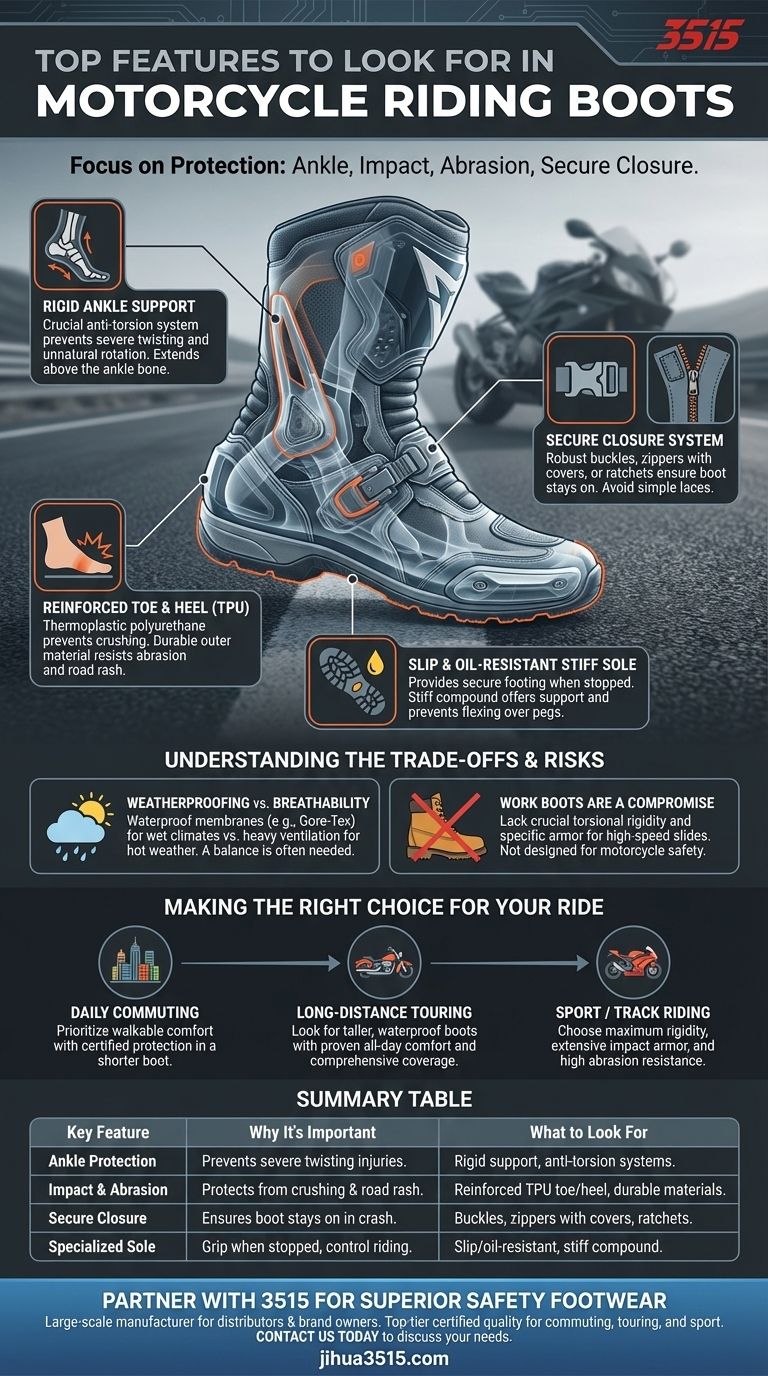
The Anatomy of a Proper Riding Boot
A purpose-built motorcycle boot is engineered with specific layers of protection that sneakers, hiking boots, and even sturdy work boots lack. Understanding these components is key to making an informed choice.
Non-Negotiable: Ankle Protection
The human ankle is not designed to withstand the violent twisting forces of a motorcycle accident. This is the single most important area a boot must protect.
Look for rigid ankle support or anti-torsion systems. This internal or external bracing prevents the ankle from flexing sideways or rotating unnaturally, which is a common cause of severe, long-term injury.
A proper boot should extend well above the ankle bone, providing physical coverage and leverage for the support system to work effectively.
Essential: Impact and Abrasion Resistance
During a fall, your feet can be caught between the bike and the road or slide across the pavement at high speed.
Your boots must have reinforced toe boxes and heel counters. These are often made of thermoplastic polyurethane (TPU) to prevent your foot from being crushed by the weight of the bike.
The boot's main material, whether leather or advanced synthetic textile, must offer high abrasion resistance to prevent the road from grinding through to your skin. Many boots also include hard sliders on the outer toe and heel.
Critical for Control: The Sole
The sole of a riding boot serves two functions: providing grip when stopped and transmitting feedback from the footpegs while riding.
It must be made of a slip-resistant and oil-resistant compound. This ensures you have a secure footing on unpredictable road surfaces when you put your foot down.
The sole should also be stiff and supportive. This prevents it from flexing over the footpeg on long rides and helps support the weight of the bike when you are stopped.
The Weakest Link: Secure Closures
A boot is useless if it comes off during a crash. The closure system is what keeps the armor in place.
Look for robust systems like buckles, zippers with a Velcro cover, or a combination. These are far more secure than simple laces.
While some boots use laces, they should be a secondary system or include a "lace garage" or strap to prevent them from getting caught on the bike's controls.
Understanding the Trade-offs
No single boot is perfect for every situation. You will often be balancing maximum protection against off-the-bike comfort and weather suitability.
Weatherproofing vs. Breathability
A boot with a waterproof membrane (like Gore-Tex) is excellent for touring or commuting in wet climates, but it will be less breathable in hot, dry weather.
Conversely, a heavily perforated or ventilated boot will keep you cool in the summer but offers no protection from rain. Your choice depends entirely on your typical riding conditions.
What About Work Boots?
Many riders consider heavy-duty work boots as a starting point. While they are significantly better than sneakers, they are a compromise, not a solution.
Most work boots lack the crucial torsional rigidity to prevent ankle twisting. They may have a steel toe for impact protection but offer little to no specific armor for the heel, ankle, or shin. Their construction is for job sites, not high-speed slides.
Making the Right Choice for Your Ride
Select your boots based on your primary type of riding. Acknowledge that the best boot for the track is often not the best one for a cross-country tour.
- If your primary focus is daily commuting: Prioritize certified protection in a shorter, more walkable boot that still covers the ankle and has reinforced areas.
- If your primary focus is long-distance touring: Look for a taller, waterproof boot with proven comfort features and comprehensive protection for long days in the saddle.
- If your primary focus is track days or sport riding: Choose a boot that offers the absolute maximum in rigidity, impact armor, and abrasion resistance.
Ultimately, invest in the best purpose-built motorcycle boots you can afford, as they are your first and last line of defense for your feet and ankles.
Summary Table:
| Key Feature | Why It's Important | What to Look For |
|---|---|---|
| Ankle Protection | Prevents severe twisting injuries in a crash. | Rigid ankle support or anti-torsion systems. |
| Impact & Abrasion Resistance | Protects feet from crushing and road rash. | Reinforced toe/heel (TPU), durable leather/textile. |
| Secure Closure System | Ensures the boot stays on during an accident. | Buckles, zippers with Velcro covers, not just laces. |
| Specialized Sole | Provides grip when stopped and control while riding. | Slip-resistant, oil-resistant, and stiff compound. |
Ready to equip yourself with superior protection?
As a large-scale manufacturer, 3515 produces a comprehensive range of certified safety footwear for distributors, brand owners, and bulk clients. Whether you need durable boots for daily commuting, touring, or sport riding, our production capabilities ensure top-tier quality, comfort, and protection.
Contact us today to discuss your specific needs and discover how 3515 can be your trusted partner in safety footwear.
Visual Guide
Related Products
- Wholesale Tactical Boots High-Traction & Reflective for Bulk & Brand Orders
- High Performance Fire-Retardant Waterproof Safety Boots
- Durable Goodyear Welt Leather Work Boots for Wholesale & Private Label
- Wholesale High-Traction Camo Boots - Custom Manufacturer for Brands
- Heavy-Duty Waterproof Nubuck Safety Boots Safety Shoes for Bulk Supply
People Also Ask
- How do tactical boots protect against injuries? Discover the Integrated Safety System
- Why is the footwear standardization essential in ambient temperature studies? Ensure Scientific Data Accuracy
- Why is the management of Initial Inventory (II) critical in the production and supply of tactical boots?
- What are the weight and breathability characteristics of the boots? Find the Perfect Fit for Your Mission
- What boots do navy SEALs run in? Discover the Mission-Driven Footwear Philosophy



















