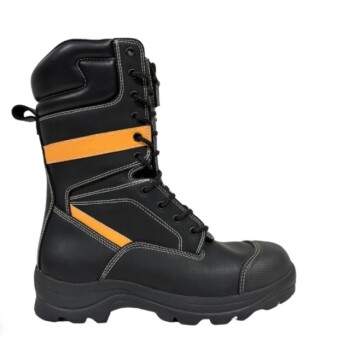
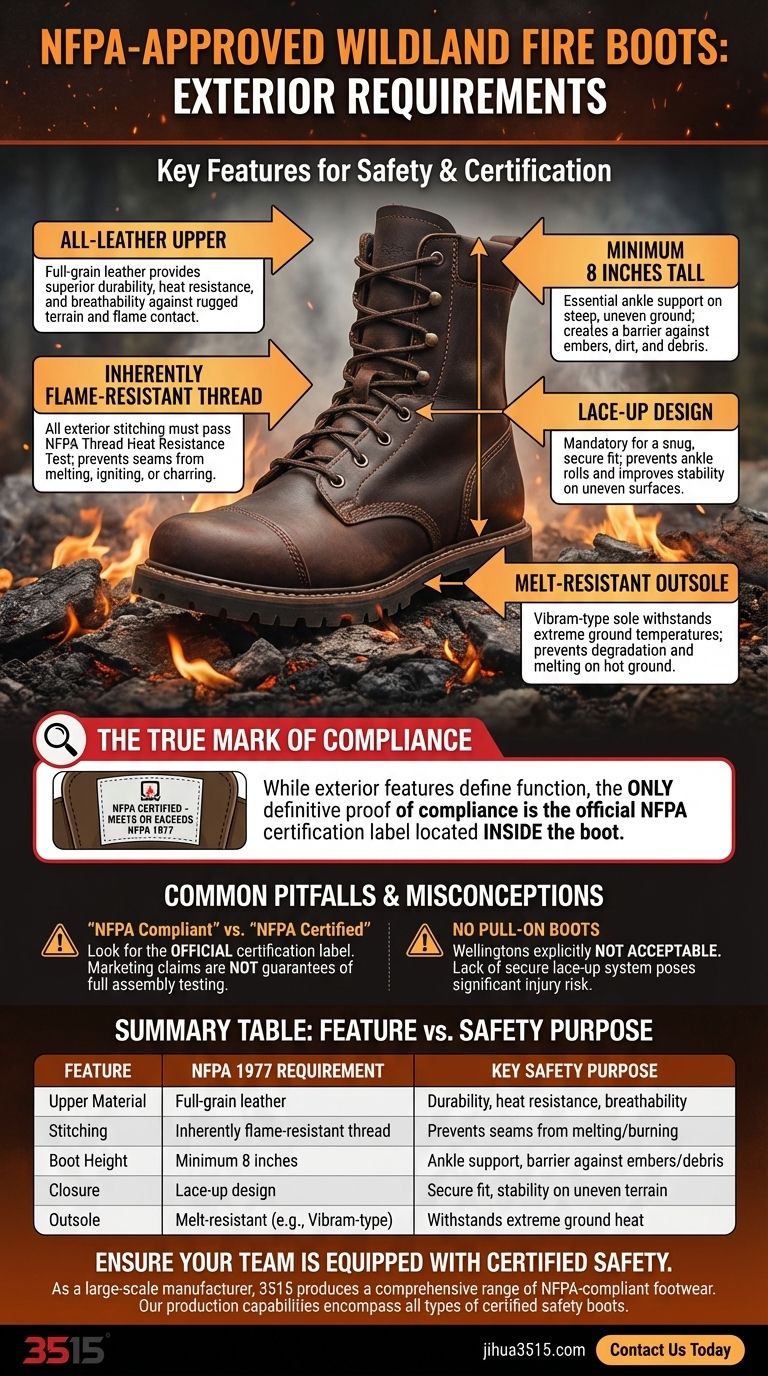
To be NFPA-approved, wildland fire boots must have an exterior constructed entirely of leather, sewn with inherently flame-resistant thread. They are required to be a minimum of 8 inches tall, feature a lace-up design for a secure fit, and be equipped with a melt-resistant, Vibram-type outsole to withstand extreme ground temperatures.
While the external features define the boot's function, the true mark of compliance is not on the outside at all. The only definitive proof that a boot meets every rigorous standard is the official NFPA certification label located inside the boot.
Deconstructing the Exterior Requirements
Each external component of an NFPA-certified boot is specified for a critical safety reason. These requirements work together as a system to protect the firefighter from the unique hazards of the wildland environment.
The All-Leather Upper
The requirement for an all-leather exterior is foundational. Leather provides a superior combination of durability, heat resistance, and breathability that synthetic materials cannot match in this application. It resists punctures and abrasions from rough terrain while shielding the foot from ambient heat and brief flame contact.
Inherently Flame-Resistant Thread
A boot is only as strong as its seams. All exterior stitching must use inherently flame-resistant fiber. This thread must pass the NFPA's Thread Heat Resistance Test, which ensures it will not melt, ignite, or char when exposed to high temperatures, preventing the boot from falling apart at a critical moment.
Minimum Height and Lace-Up Design
NFPA-certified boots must measure at least 8 inches from the bottom of the heel to the top of the boot. This height provides essential ankle support on steep, uneven ground and creates a barrier to keep out hot embers, dirt, and debris.
The mandatory lace-up design ensures a snug, secure fit. This is a non-negotiable safety feature that prevents ankle rolls and improves stability.
The Melt-Resistant Outsole
The sole of the boot must be made from a melt-resistant material, often specified as a Vibram-type sole. This is crucial for firefighters who walk over hot ground and smoldering ash, as it prevents the sole from degrading or melting, which would compromise the boot's integrity and protection.
Common Pitfalls and Misconceptions
Understanding the nuances of the NFPA standard is key to ensuring you are properly equipped and protected. Misinterpreting the rules can lead to purchasing non-compliant and unsafe gear.
"NFPA Compliant" vs. "NFPA Certified"
Be wary of boots marketed as "compliant with" or "meeting" NFPA standards. The only guarantee of safety is a boot that is officially NFPA certified, which is verified by a label. This means the entire boot as a complete assembly has passed rigorous third-party testing.
The Prohibition of Pull-On Boots
Pull-on boots, such as Wellingtons, are explicitly not acceptable under the NFPA standard for wildland firefighting. They lack the necessary ankle support and secure fit provided by a lace-up system, posing a significant risk of injury on rugged terrain.
The Ultimate Proof: The Internal Label
While you can visually inspect a boot for its external features, the definitive proof of compliance is the official certification label sewn inside the boot. This label states that the footwear meets or exceeds the testing requirements of the specific NFPA standard (e.g., NFPA 1977). Without this label, a boot is not considered certified, regardless of its appearance.
Making the Right Choice for Your Safety
Your choice of footwear is one of the most important safety decisions you will make. Use these guidelines to ensure you are properly protected.
- If your primary focus is purchasing new boots: Ignore marketing claims on the box and look directly for the permanent NFPA certification label inside the boot.
- If your primary focus is verifying existing boots: Locate the internal NFPA label and inspect the exterior for compromised stitching, excessive sole wear, or damage to the leather upper.
- If your primary focus is maximum safety on the fireline: Ensure your certified boots are properly broken in, securely laced, and well-maintained, as certification is the baseline for safety, not the end of it.
Ultimately, your safety depends on trusting that every component of your gear will perform under pressure, and official certification is the only true guarantee.
Summary Table:
| Feature | NFPA 1977 Requirement | Key Safety Purpose |
|---|---|---|
| Upper Material | Full-grain leather | Durability, heat resistance, breathability |
| Stitching | Inherently flame-resistant thread | Prevents seams from melting/burning |
| Boot Height | Minimum 8 inches | Ankle support, barrier against embers/debris |
| Closure | Lace-up design | Secure fit, stability on uneven terrain |
| Outsole | Melt-resistant (e.g., Vibram-type) | Withstands extreme ground heat |
Ensure your team is equipped with certified safety. As a large-scale manufacturer, 3515 produces a comprehensive range of NFPA-compliant footwear for distributors, brand owners, and bulk clients. Our production capabilities encompass all types of certified safety boots, ensuring durability and protection that meets rigorous standards. Contact us today to discuss your specific needs and secure reliable, high-performance footwear for your frontline personnel.
Visual Guide
Related Products
- High Performance Fire-Retardant Waterproof Safety Boots
- Premium Flame-Retardant Waterproof Safety Boots and Shoes
People Also Ask
- Why are waterproof safety boots recommended for certain work environments? Essential Protection for Wet & Hazardous Jobs
- What roles do 3D vision systems and industrial robots play in the manufacturing of fire safety boots? Smart Automation
- How does boot construction affect waterproofing? The Science Behind Truly Dry Feet
- What's the difference between waterproof and water-resistant boots? Choose the Right Footwear for Your Environment
- What should you look for to ensure boots are fully waterproof? The Essential 2-Part System