
The right fit for a cowboy boot is about more than just your shoe size. Unlike traditional footwear, a proper fit is defined by a snug feeling around your instep and the ball of your foot, with adequate room for your toes to spread. Crucially, a small amount of slippage in the heel is not only acceptable but expected in a new pair.
The core principle of cowboy boot sizing is that the boot should grip your foot at the instep, not the ankle or calf. This unique construction means that initial heel slip is a sign of a good fit, which will diminish as the stiff new sole breaks in and conforms to your foot.
Why Cowboy Boot Sizing is Different
Understanding the unique anatomy of a cowboy boot is the first step to finding a perfect fit. They are designed to hold your foot in a fundamentally different way than a sneaker or a laced work boot.
The Critical Role of the Instep
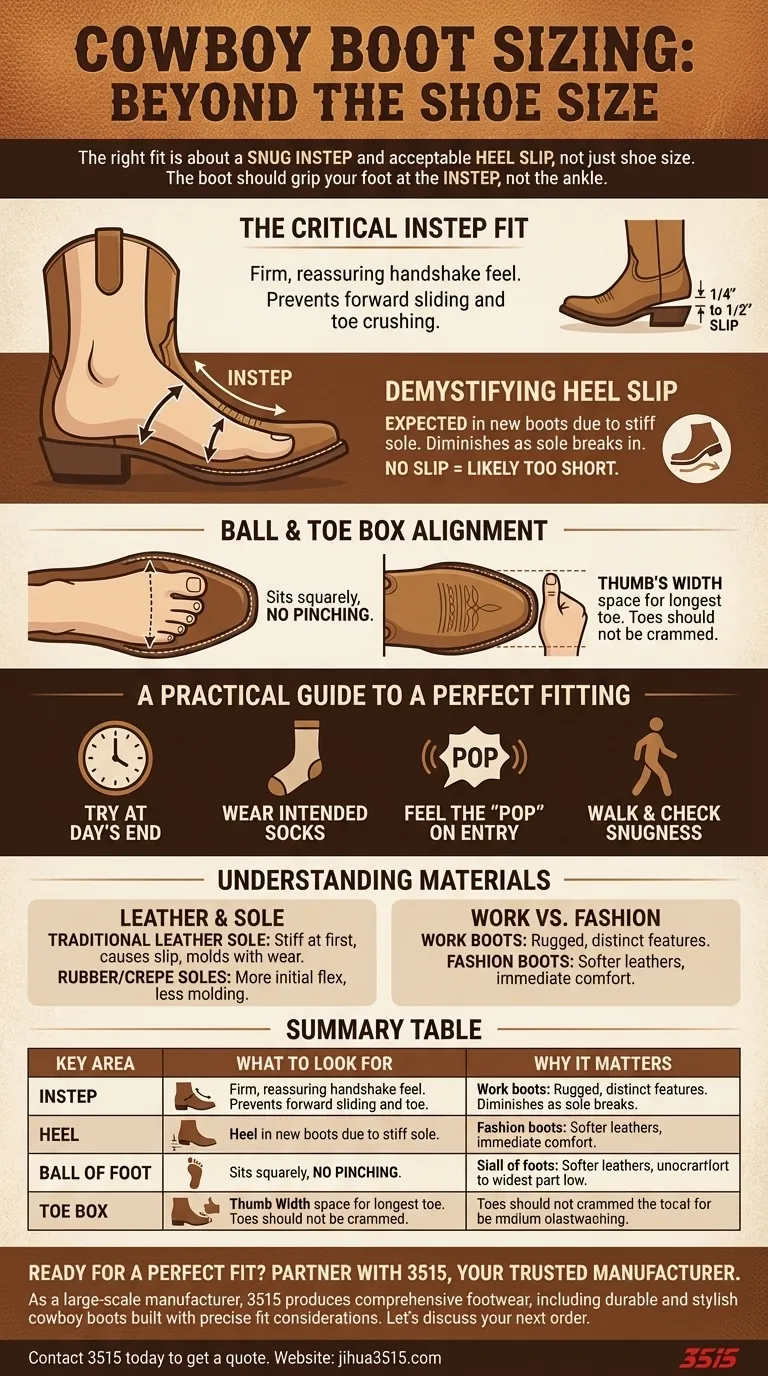
The most important point of contact in a cowboy boot is the instep—the arched top part of your foot. A correct fit feels like a firm, reassuring handshake over this area.
This snugness at the instep is what holds your foot securely in place, preventing it from sliding forward and crushing your toes.
Demystifying Heel Slip
The most common point of confusion is heel slip. A brand-new cowboy boot has a stiff leather or rubber sole that hasn't been broken in yet.
When you walk, your heel needs to lift slightly because the sole doesn't yet bend with your foot. A slip of about a quarter to a half-inch is the sign of a properly sized boot.
As you wear the boots, the sole will soften and flex, and this slippage will naturally decrease to a comfortable, barely noticeable level. No slip at all means the boot is likely too short.
The Ball and the Toe Box
The ball of your foot—the widest part—should sit squarely in the widest part of the boot. You should not feel any pinching or cramping in this area.
Regardless of whether the boot has a pointed, round, or square toe, you should have about a thumb's width of space between your longest toe and the end of the boot. Your toes should never be crammed against the front.
A Practical Guide to a Perfect Fitting
Trying on boots is a physical process. Follow these steps to ensure you are accurately assessing the fit.
Prepare for Success
Always try on boots at the end of the day when your feet are slightly swollen to their largest size.
Crucially, wear the same type of socks you plan to wear with the boots regularly. A thick wool sock will create a much different fit than a thin dress sock.
The Signature "Pop"
When you slide your foot into the boot, you should feel a distinct "pop" as your heel settles into place. This indicates the boot is the correct size to go over your instep.
The In-Store Test
Walk around the store for several minutes. The boot should feel snug, but not painfully tight. Pay attention to any rubbing or pinching, as these issues will only worsen with time.
Check the fit at the ball and the instep, and confirm the slight, comfortable slip in the heel.
Understanding the Trade-offs and Materials
Not all boots are created equal. The materials and intended purpose play a significant role in how a boot will feel and break in over time.
Leather Type and Break-in
Traditional cowhide is durable and will mold to your foot over time, offering a custom fit after a break-in period.
Exotic leathers like caiman or ostrich may be softer and require less break-in, but can also have different stretch characteristics.
Sole Construction
A traditional leather sole is stiff at first and is the primary reason for initial heel slip. It will flex and become incredibly comfortable with wear.
Rubber or crepe soles often offer more day-one flexibility and traction but may not mold to your foot in the same way as leather.
Work vs. Fashion
Boots designed for ranch work may have a more rugged construction and features like slip-resistant soles or protective toes, which can affect the overall feel and volume inside the boot. Fashion boots often prioritize softer leathers for immediate comfort.
Making the Right Choice for Your Goal
Your intended use for the boots should guide your final decision.
- If your primary focus is fashion or daily wear: Prioritize the snug instep fit and trust that the initial stiffness will give way to exceptional comfort as the leather molds to your foot.
- If your primary focus is work or riding: Ensure the heel slip is minimal but present for flexibility, and confirm the ball of your foot is perfectly aligned for balance in stirrups or on varied terrain.
- If you are buying your first pair: Resist the common urge to get a boot that is too large to avoid heel slip. Trust the firm handshake on your instep as the true indicator of a correct size.
By focusing on the instep and understanding the break-in process, you can confidently select a cowboy boot that offers a lifetime of comfort and style.
Summary Table:
| Key Fitting Area | What to Look For | Why It Matters |
|---|---|---|
| Instep | A firm, snug "handshake" feel | Holds foot securely, prevents toe crunching |
| Heel | 1/4" to 1/2" of slip in new boots | Allows sole to flex; slip decreases as boot breaks in |
| Ball of Foot | Sits comfortably in boot's widest part | Ensures proper alignment and prevents pinching |
| Toe Box | A thumb's width of space for longest toe | Provides room for toes to spread naturally |
Ready for a Perfect Fit? Partner with 3515, Your Trusted Manufacturer.
As a large-scale manufacturer, 3515 produces a comprehensive range of footwear for distributors, brand owners, and bulk clients. Our production capabilities encompass all types of shoes and boots, including durable and stylish cowboy boots built with the precise fit considerations detailed above.
We help you deliver superior comfort and quality to your customers. Let's discuss your next order.
Contact 3515 today to get a quote and learn more about our manufacturing solutions.
Visual Guide
Related Products
- High-Traction Suede Tactical Boots Wholesale & Custom Manufacturing
- Wholesale High-Traction Camo Boots - Custom Manufacturer for Brands
- Wholesale Lightweight Tactical Boots Custom Manufacturer for Desert & Combat Use
- Durable Leather Tactical Boots Wholesale & Custom Manufacturing for Brands
- Wholesale Durable Mid-Cut Tactical Boots for Custom & Private Label Brands
People Also Ask
- Why is sequential analysis utilized to evaluate tactical boots? Master Dynamic Boot Development and Ergonomic Performance
- How does the material of tactical boots affect their performance? Choose the Right Material for Your Mission
- How do tactical boots differ from regular boots? Performance, Durability & Design Explained
- How do military uniforms and tactical boots impact the prediction of thermal risk? Essential Safety Insights
- What are the benefits of integrating FES and sEMG into tactical boots? Safety, Reliability & Field-Ready Performance


















