
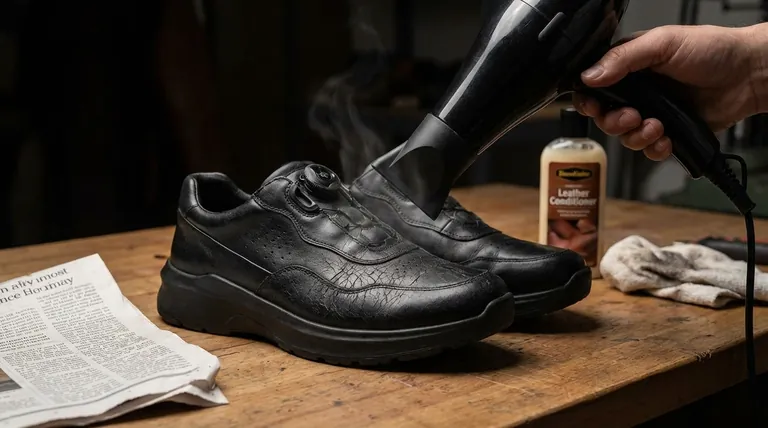
In short, never use a hair dryer on your boots. This common shortcut inflicts irreversible damage by aggressively stripping the leather of its essential natural oils. The intense, direct heat causes the leather fibers to become brittle and weak, leading to permanent cracking and fundamentally shortening the life of your footwear.
The core issue is that a hair dryer's concentrated heat "cooks" the leather. This not only removes the natural oils that keep it supple but can also weaken adhesives, compromising the boot's entire structure for a quick but damaging fix.
The Science Behind the Damage
To understand the risk, you need to think of leather not as a static material, but as a skin that requires moisture and oil to remain flexible and strong.
Stripping Essential Oils
Leather contains a matrix of fibers interwoven with natural oils. These oils lubricate the fibers, allowing them to flex and bend without breaking. A hair dryer's high heat effectively boils these oils out of the leather, leaving the fibers exposed and dry.
The Cycle of Brittleness and Cracking
Once the oils are gone, the leather fibers lose their suppleness and become rigid. Every step you take puts stress on this now-brittle material. Instead of flexing, the fibers begin to tear and break, quickly leading to visible cracks, especially in high-flex areas like the vamp (where the boot bends at your toes).
Damaging Glues and Adhesives
Modern boots rely on powerful adhesives to bond the sole to the upper. This glue is not designed to withstand high temperatures. The heat from a hair dryer can easily soften and weaken these bonds, potentially causing the sole to separate from the rest of the boot.
Common Pitfalls and Misconceptions
The desire for a quick fix often leads to poor decisions. Understanding the false economy of using a hair dryer is key to protecting your investment.
The "Break-In" Myth
Some people mistakenly believe that heating new boots helps break them in faster. While heat can temporarily make leather more pliable, the damage it causes far outweighs any short-term benefit. The leather becomes brittle and is more likely to crack rather than conform to your foot.
Wasting Your Conditioner
After you've heat-damaged the leather, you might try to fix it with a quality leather conditioner. Unfortunately, the "cooked" and hardened fibers can no longer absorb the conditioner effectively. The product will mostly sit on the surface, unable to penetrate and restore the material.
The Correct Way to Dry Your Boots
Patience is the most important tool for safely drying wet boots. The goal is to remove moisture slowly and evenly, allowing the leather to dry without stress.
1. Remove Surface Water and Laces
Start by wiping off any excess mud and water from the exterior with a cloth. Remove the laces and insoles to open up the boot and allow air to circulate more freely.
2. Stuff the Boots to Absorb Moisture
Pack the inside of the boots loosely with newspaper or paper towels. This material will draw moisture out from the inside. Replace the paper every few hours as it becomes saturated.
3. Ensure Gentle Air Circulation
Place the boots in a dry, well-ventilated area at room temperature. Position them away from direct heat sources like radiators, fireplaces, or direct sunlight, as these create the same problems as a hair dryer. A small fan in the room can help improve airflow.
Making the Right Choice for Your Goal
If your primary focus is drying soaking wet boots: Rely on the slow, safe method of stuffing them with newspaper and allowing them to air dry at room temperature for 24-48 hours.
If your primary focus is breaking in new boots: Wear them around the house for short periods and apply a quality leather conditioner to soften the material naturally.
If your primary focus is speed and convenience: Invest in a dedicated boot dryer, which uses low-temperature, gently circulating air specifically designed to dry footwear safely overnight.
Proper care is the single most important factor in the longevity of your boots.
Summary Table:
| Risk Factor | Consequence |
|---|---|
| Stripping Natural Oils | Leather becomes dry, brittle, and loses flexibility. |
| Causing Cracks | Brittle fibers break under stress, leading to permanent damage. |
| Weakening Adhesives | Heat can soften glue, causing the sole to separate from the boot. |
| Wasting Conditioner | Damaged leather cannot effectively absorb conditioners for repair. |
Protect Your Investment with Properly Manufactured Footwear
As a large-scale manufacturer, 3515 produces a comprehensive range of durable boots and shoes for distributors, brand owners, and bulk clients. Our expertise ensures every pair is crafted with quality materials and construction techniques built to last, reducing the risk of damage from improper care.
Let us help you provide your customers with superior footwear. Contact 3515 today to discuss your manufacturing needs and explore our full catalog.
Visual Guide

Related Products
- High-Traction Suede Tactical Boots Wholesale & Custom Manufacturing
- Durable Leather Work Boots Wholesale Manufacturer & Custom Factory
- Durable Leather Work Boots for Wholesale & Custom Manufacturing
- Durable Leather Work Boots for Wholesale & Custom OEM Manufacturing
- Durable Leather Tactical Boots Wholesale & Custom Manufacturing for Brands
People Also Ask
- Why is sequential analysis utilized to evaluate tactical boots? Master Dynamic Boot Development and Ergonomic Performance
- How does the material of tactical boots affect their performance? Choose the Right Material for Your Mission
- How do tactical boots differ from regular boots? Performance, Durability & Design Explained
- How do military uniforms and tactical boots impact the prediction of thermal risk? Essential Safety Insights
- What are the benefits of integrating FES and sEMG into tactical boots? Safety, Reliability & Field-Ready Performance


















