
Beyond their iconic style, the enduring popularity of cowboy boots as work attire is rooted in their exceptionally practical design. They are favored for their unparalleled durability from high-quality leather, built-in protective features like a high shaft and strong toe box, and functional elements like a heel designed for stability in demanding environments.
The core reason for the cowboy boot's success as workwear is that its original design, perfected for the harsh realities of a rider's life, provides the exact combination of protection, durability, and support needed for many modern physical jobs.
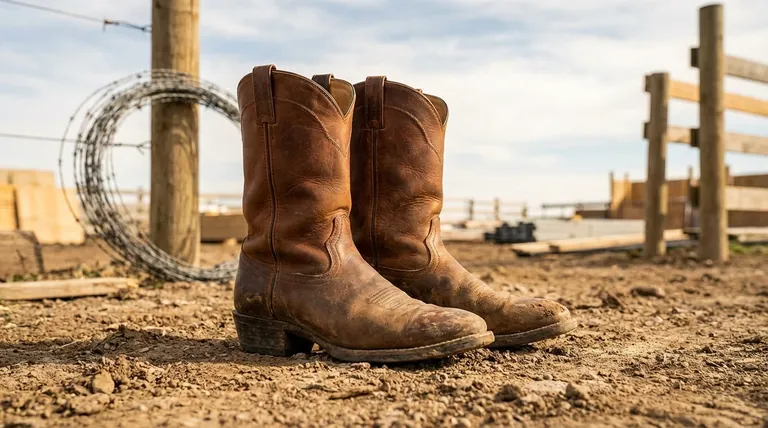
The Foundation: Unmatched Durability
The longevity of a quality cowboy boot is not an accident; it's the result of specific materials and construction methods designed for relentless use.
Full-Grain Leather Construction
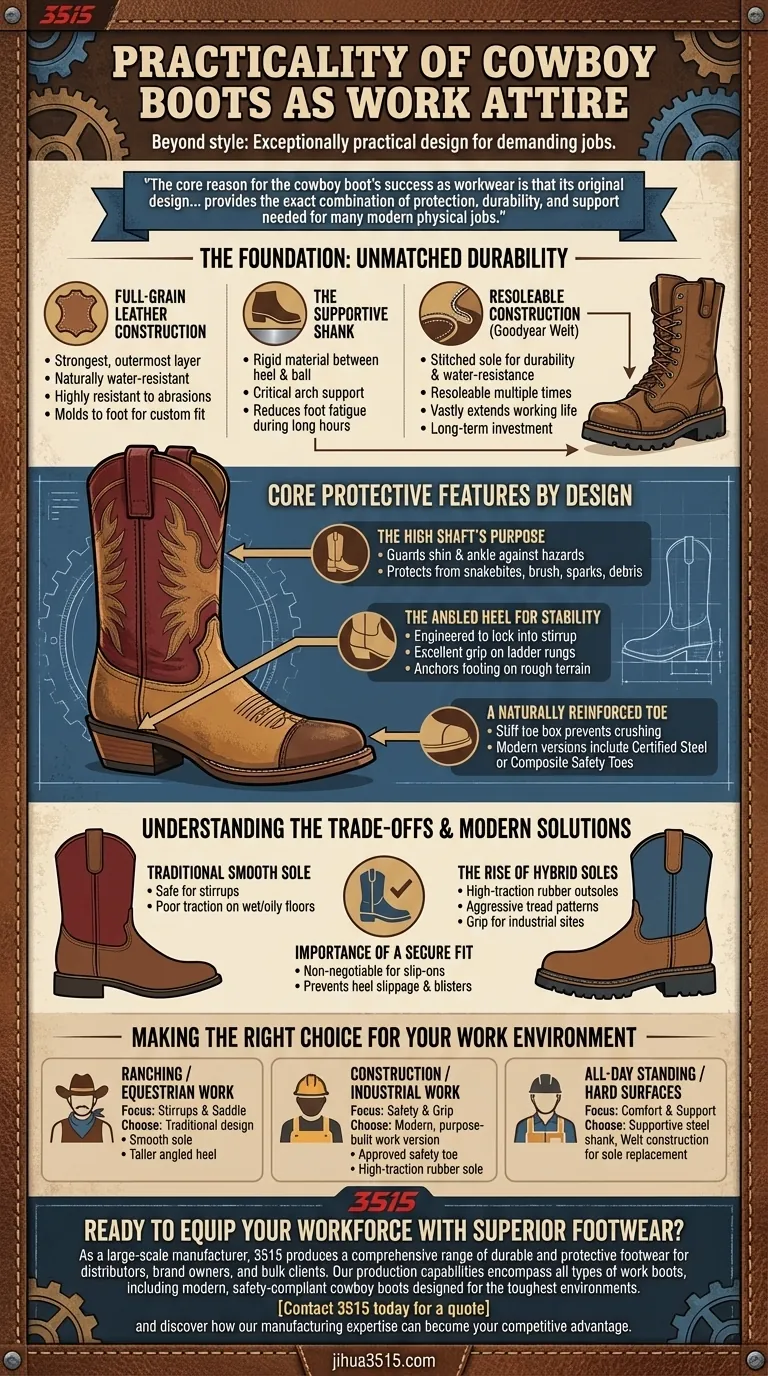
Unlike cheaper leathers, full-grain leather uses the strongest, outermost layer of the hide. This makes the boot naturally water-resistant, highly resistant to abrasions, and capable of molding to the wearer's foot over time for a custom fit.
The Supportive Shank
A crucial, unseen component is the shank, a strip of rigid material (often steel) placed in the sole between the heel and the ball of the foot. This provides critical arch support, reducing foot fatigue during long hours of standing or walking on uneven ground.
Resoleable Construction
Many high-quality boots use a Goodyear welt, a method of stitching the sole to the upper that creates a highly durable and water-resistant seal. Crucially, this allows the boots to be resoled multiple times, vastly extending their working life and making them a long-term investment.
Core Protective Features by Design
Every classic element of a cowboy boot's silhouette serves a distinct, protective purpose that translates directly from the saddle to the job site.
The High Shaft's Purpose
The tall leather shaft is the boot's most obvious feature and one of its most functional. It guards the shin and ankle against snakebites, thorny brush, barbed wire, and workplace hazards like welding sparks, chemical splashes, or flying debris.
The Angled Heel for Stability
The distinct, angled "Cuban" heel was engineered to lock into a stirrup, preventing a rider's foot from dangerously sliding forward. In a modern work context, this design provides excellent grip on ladder rungs and helps anchor your footing on rough, uneven terrain.
A Naturally Reinforced Toe
The traditional construction already includes a stiff toe box to prevent the boot from being crushed in a stirrup. Modern work-specific cowboy boots build on this by incorporating certified steel or composite safety toes to meet official workplace safety standards.
Understanding the Trade-offs
While highly functional, the traditional design has limitations that are important to consider for specific work environments.
The Traditional Smooth Sole
A classic cowboy boot has a smooth leather sole. This is intentional, designed to allow a rider's foot to slide easily and safely out of the stirrup if they fall. However, this same feature offers poor traction on wet or oily surfaces like concrete floors.
The Rise of Hybrid Soles
Manufacturers of modern work boots have addressed this trade-off directly. Many work-focused cowboy boots now feature high-traction rubber outsoles with aggressive tread patterns, providing the grip needed for industrial sites while retaining the boot's core benefits.
The Importance of a Secure Fit
Because they are slip-on, a proper fit is absolutely non-negotiable. Unlike a lace-up boot that can be tightened, a poorly fitting cowboy boot will cause heel slippage, leading to blisters and a lack of support.
Making the Right Choice for Your Work Environment
Choosing the right boot depends entirely on matching its specific features to the demands of your job.
- If your primary focus is ranching or equestrian work: A traditional design with a smooth leather sole and a taller, angled heel offers the best performance and safety for work with stirrups.
- If your primary focus is construction or industrial work: Look for a modern, purpose-built work version with an approved safety toe and a high-traction rubber sole.
- If your primary focus is all-day standing on hard surfaces: Prioritize a boot with a supportive steel shank and a welt construction that allows for sole replacement or modification for optimal comfort.
By understanding the functional origins of its design, you can select a cowboy boot that is not just a style choice, but a highly effective tool for your work.
Summary Table:
| Feature | Key Benefit for Work |
|---|---|
| Full-Grain Leather | Superior abrasion resistance & water resistance. |
| High Shaft | Protects shins and ankles from workplace hazards. |
| Angled Heel | Provides stability on ladders and uneven terrain. |
| Supportive Shank | Reduces foot fatigue during long hours of standing. |
| Resoleable Construction | Extends boot life, making it a long-term investment. |
Ready to Equip Your Workforce with Superior Footwear?
As a large-scale manufacturer, 3515 produces a comprehensive range of durable and protective footwear for distributors, brand owners, and bulk clients. Our production capabilities encompass all types of work boots, including modern, safety-compliant cowboy boots designed for the toughest environments.
We can help you provide your customers with the perfect blend of iconic style and worksite functionality. Let's discuss your specific needs.
Contact 3515 today for a quote and discover how our manufacturing expertise can become your competitive advantage.
Visual Guide
Related Products
- High-Traction Suede Tactical Boots Wholesale & Custom Manufacturing
- Wholesale High-Traction Camo Boots - Custom Manufacturer for Brands
- Wholesale Lightweight Tactical Boots Custom Manufacturer for Desert & Combat Use
- Durable Leather Tactical Boots Wholesale & Custom Manufacturing for Brands
- Wholesale Durable Mid-Cut Tactical Boots for Custom & Private Label Brands
People Also Ask
- Why is sequential analysis utilized to evaluate tactical boots? Master Dynamic Boot Development and Ergonomic Performance
- How does the material of tactical boots affect their performance? Choose the Right Material for Your Mission
- How do tactical boots differ from regular boots? Performance, Durability & Design Explained
- How do military uniforms and tactical boots impact the prediction of thermal risk? Essential Safety Insights
- What are the benefits of integrating FES and sEMG into tactical boots? Safety, Reliability & Field-Ready Performance


















