
At its core, the world of equestrian footwear is divided into two primary categories: short boots and tall boots. The main types include ankle-high paddock boots for daily use, and knee-high tall boots—which are further divided into flexible field boots for jumping and rigid dress boots for dressage—along with distinct Western boots for that specific discipline.
The fundamental choice a rider makes is not just about style, but about function. You must decide between the everyday versatility of a short boot and the discipline-specific performance and protection offered by a tall boot.
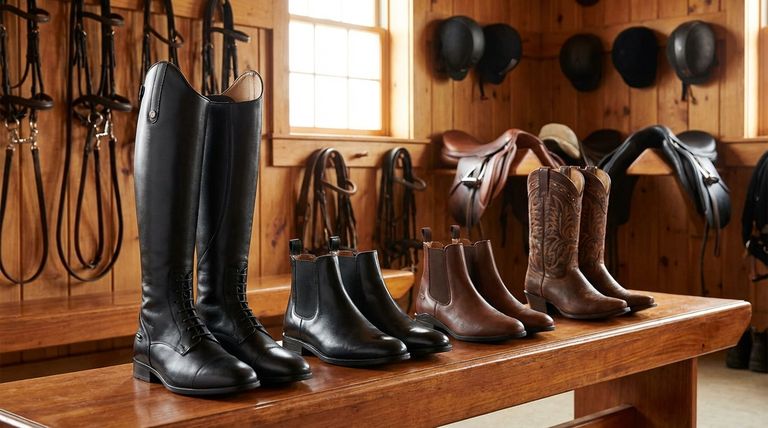
The Fundamental Divide: Short vs. Tall Boots
Understanding the primary distinction between short and tall boots is the first step in selecting the right footwear for your needs. Each is designed with a different context and purpose in mind.
Short Boots: The Everyday Workhorse
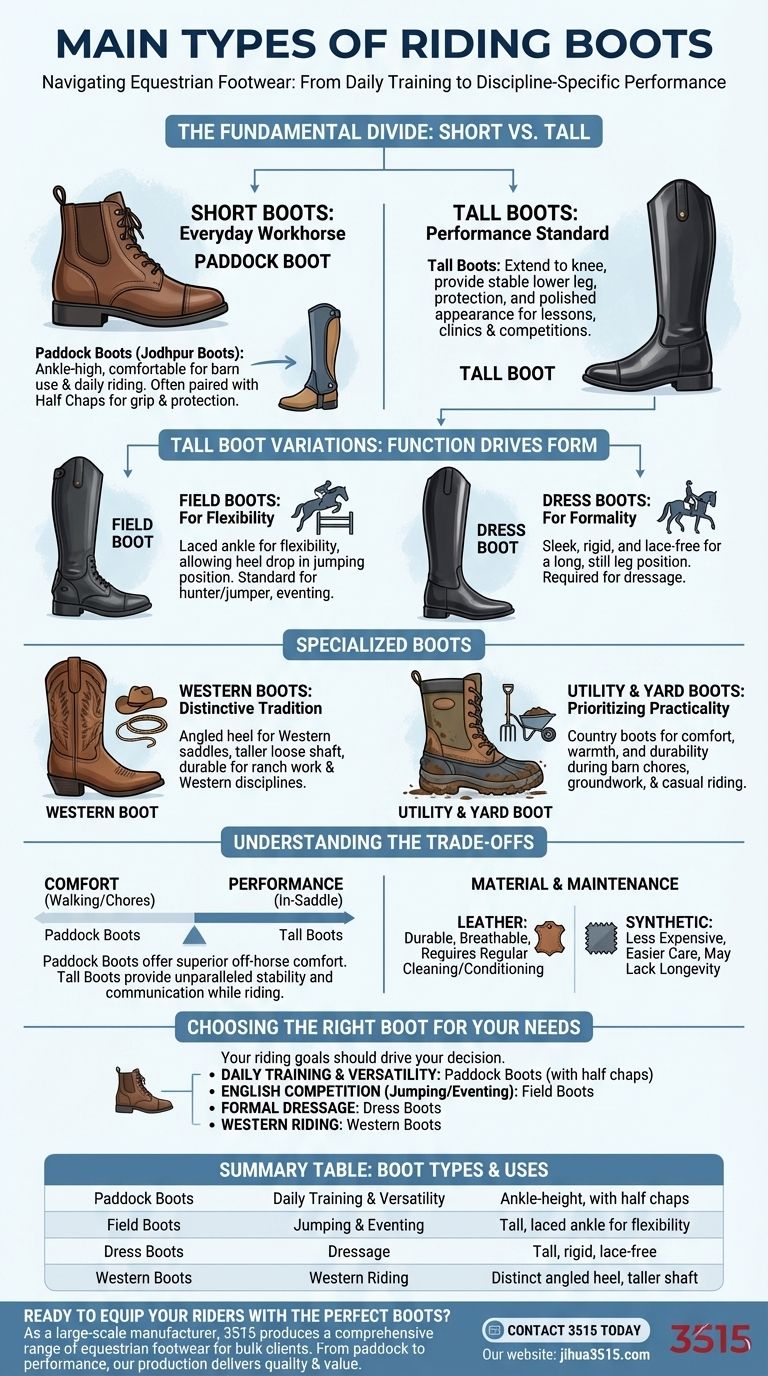
The most common type of short boot is the paddock boot, also known as a jodhpur boot. These ankle-high boots are the workhorse of the equestrian world.
They are comfortable for walking around the barn and practical for daily training. For riding, they are almost always paired with half chaps (leather or synthetic leg coverings) to provide the grip and leg protection of a tall boot.
Tall Boots: The Performance Standard
Tall boots, which extend to just below the knee, are the standard for formal lessons, clinics, and competitions.
Their primary function is to provide a stable lower leg position, protect the rider's leg from the saddle, and create a polished, traditional appearance. They eliminate the need for separate half chaps.
A Closer Look at Tall Boot Variations
While all tall boots share a similar height, their design varies significantly based on the specific English riding discipline they are intended for.
Field Boots: Designed for Flexibility
Field boots are easily identified by the laces at the ankle. This design provides crucial flexibility, allowing the rider's heel to drop comfortably when in a jumping position.
These are the standard for hunter/jumper disciplines, eventing, and general English riding where a forward stirrup position is common.
Dress Boots: The Epitome of Formality
Dress boots (or dressage boots) are sleek, elegant, and lack laces. They are traditionally more rigid than field boots to encourage a long, still leg position.
As the name implies, they are the required footwear for the discipline of dressage and are considered the most formal type of English riding boot.
Specialized Boots for Specific Disciplines
Beyond the foundational English styles, other boots are purpose-built for different traditions and environments.
Western Boots: A Distinctive Tradition
Western boots are characterized by a higher, often angled heel designed to prevent the foot from slipping through a Western saddle's wider stirrup.
They feature a taller, looser shaft than English boots and are built for the durability required for ranch work and Western riding disciplines.
Utility & Yard Boots: Prioritizing Practicality
Often called yard boots or country boots, these are designed for comfort and durability during barn chores rather than optimal performance in the saddle.
While some are suitable for casual riding, their primary focus is on warmth, waterproofing, and support for groundwork.
Understanding the Trade-offs
Choosing a boot involves balancing comfort, performance, and cost. No single boot is perfect for every situation.
Comfort vs. In-Saddle Performance
Paddock boots offer superior off-horse comfort for walking and daily chores. Tall boots, while less comfortable for groundwork, provide unparalleled stability and communication with the horse while riding.
Material and Maintenance
Traditional leather boots offer excellent durability and breathability but require regular cleaning and conditioning. Modern synthetic boots are often less expensive and easier to care for but may not offer the same longevity or custom fit.
Versatility vs. Specialization
A paddock boot and half chap combination is extremely versatile, suitable for everything from lessons to local shows. A highly specialized boot, like a stiff dress boot, excels at its specific job but is less practical for other forms of riding or daily wear.
Choosing the Right Boot for Your Needs
Your riding goals should be the primary driver of your decision.
- If your primary focus is daily training and versatility: Choose a quality pair of paddock boots to wear with or without half chaps.
- If your primary focus is English competition in jumping or eventing: A pair of field boots is the correct and necessary choice for both function and formal appearance.
- If your primary focus is formal dressage: A well-fitting pair of dress boots will provide the specific support and aesthetic required for the discipline.
- If your primary focus is Western riding: Invest in a purpose-built Western boot with the appropriate heel and shaft height for safety and tradition.
Ultimately, your boots are a critical piece of equipment that connects you to your horse, so select the type that best supports your specific journey.
Summary Table:
| Boot Type | Primary Use | Key Features |
|---|---|---|
| Paddock Boots | Daily Training & Versatility | Ankle-height, often worn with half chaps |
| Field Boots | Jumping & Eventing | Tall, laced ankle for flexibility |
| Dress Boots | Dressage | Tall, rigid, lace-free for a formal look |
| Western Boots | Western Riding | Distinct angled heel, taller shaft |
Ready to equip your riders with the perfect boots?
As a large-scale manufacturer, 3515 produces a comprehensive range of equestrian footwear for distributors, brand owners, and bulk clients. Whether you need durable paddock boots, performance field boots, elegant dress boots, or authentic Western styles, our production capabilities deliver quality, consistency, and value.
Contact 3515 today to discuss your specific needs and discover how we can be your trusted partner in footwear.
Visual Guide
Related Products
- Premium Wholesale Tactical Style Safety Shoes Boots with Quick Lacing
- Wholesale High-Traction Camo Boots - Custom Manufacturer for Brands
- Durable Goodyear Welt Leather Work Boots for Wholesale & Private Label
- Wholesale Tactical Boots High-Traction & Reflective for Bulk & Brand Orders
- High-Traction Suede Tactical Boots Wholesale & Custom Manufacturing
People Also Ask
- How are gait analysis research findings applied to the functional design of safety shoes and tactical boots?
- How can specialized footwear mitigate safety risks? High-Volume OEM/ODM Solutions since 1951
- How does anthropomorphic design influence material selection? Enhance Footwear Performance through Biological Alignment
- Why is the synchronization of craftsmanship and UX development emphasized for bulk customization of safety shoes?
- How do quality certification standards for safety shoes reduce perceived risk? Buy Online with Technical Certainty



















