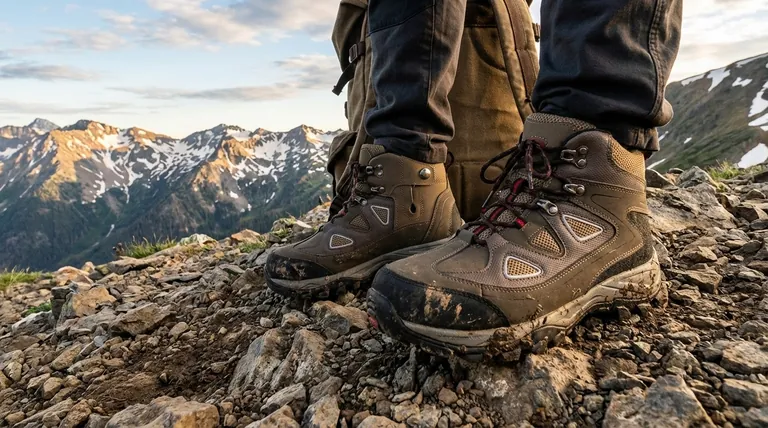
At their core, quality mountain hunting boots are a specialized system defined by five key features: a stiff, supportive structure, durable full-grain leather uppers, a protective rubber rand, aggressive outsoles for traction, and a reliable waterproof membrane. These elements work together to provide stability and protection in the demanding, off-trail environments where serious mountain hunting occurs.
The most critical mistake is viewing a mountain hunting boot as just a heavy-duty hiking boot. Instead, you must think of it as a piece of essential support equipment, engineered to protect your feet and ankles from extreme terrain while carrying heavy loads.
Deconstructing the Mountain Boot: A System for Survival
A true mountain boot is built from the ground up to handle vertical terrain, unpredictable weather, and the weight of a pack filled with gear and, hopefully, harvested game. Each component has a specific, non-negotiable job.
The Foundation: Outsole and Shank
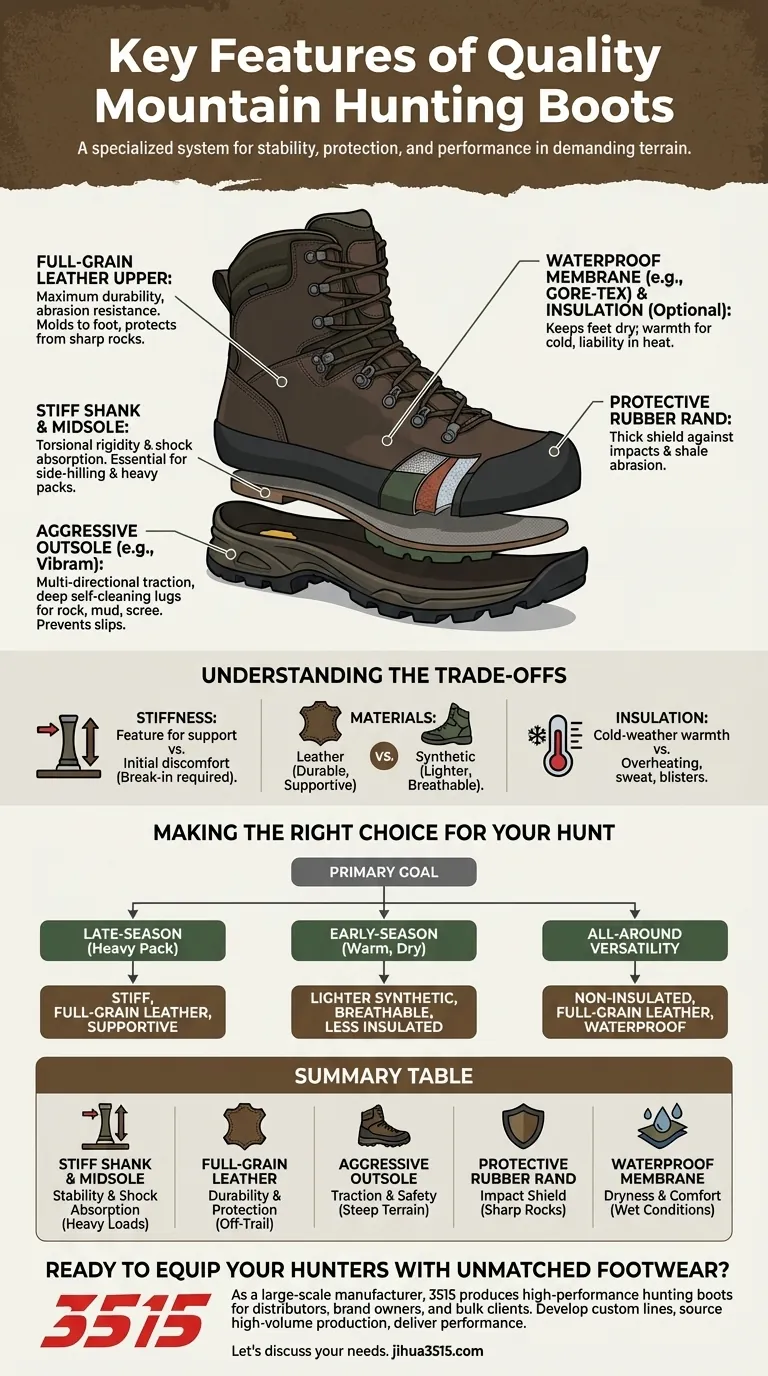
The outsole is your only point of contact with the ground, making its design crucial for safety. Look for deep, aggressive, and self-cleaning lug patterns that provide multi-directional traction on rock, mud, and scree. Brands like Vibram are an industry standard for their durable, non-slip rubber compounds.
Internally, a thick shank provides the boot's torsional rigidity. This stiffness is what allows you to edge into a steep hillside (side-hilling) or stand securely on a narrow rock ledge without the boot flexing and compromising your balance.
The Chassis: Midsole and Ankle Support
The midsole is the boot's suspension system, responsible for shock absorption. It mitigates the impact of descending steep terrain with a heavy pack, protecting your joints over a multi-day hunt.
Equally important is robust ankle support. The best boots often feature uppers of 10 inches or more and sophisticated lacing systems, like a heel-lock, to keep your ankle securely in place. This prevents sprains and provides stability when navigating uneven ground.
The Armor: Uppers and Rand
The boot's upper is its primary shield. Full-grain leather is the benchmark material due to its exceptional durability, abrasion resistance, and ability to mold to your foot over time.
A robust rubber rand is a thick band of rubber that wraps around the lower portion of the boot. This feature is non-negotiable for mountain use, as it protects the leather from being shredded by sharp rocks and shale.
The Climate Control: Waterproofing and Insulation
A high-quality waterproof membrane (like GORE-TEX) is essential for keeping your feet dry during creek crossings or unexpected storms. Dry feet are critical for preventing blisters and regulating temperature.
Insulation is a feature specific to the conditions you expect to face. It provides critical warmth for cold-weather or late-season hunts but can be a liability in warmer, early-season conditions.
Understanding the Trade-offs
Choosing the right boot involves balancing competing factors. What provides ultimate support in one scenario can be a drawback in another.
Stiffness is a Feature, Not a Flaw
The most common complaint about true mountain boots is their initial stiffness. This is by design. A flexible boot will collapse under the weight of a heavy pack on a steep incline, causing foot fatigue and instability. The rigid platform is essential for support and requires a dedicated break-in period.
Material Matters: Leather vs. Synthetic
While full-grain leather is the gold standard for durability and support in mountain applications, synthetic boots have a place. They are typically lighter, require less break-in time, and are more breathable, making them suitable for lighter-duty hunts in hot, dry climates like the Arizona deserts. However, they generally offer less long-term durability and support for heavy-load scenarios.
Insulation: A Double-Edged Sword
Insulated boots are critical for staying safe in cold environments. However, using a heavily insulated boot on a high-exertion, early-season hunt can lead to excessive sweating. Wet feet, whether from snow or sweat, can quickly lead to blisters and discomfort.
Making the Right Choice for Your Hunt
Your specific hunting environment and style dictate the ideal boot. Use your primary goal to guide your selection.
- If your primary focus is late-season hunts with a heavy pack: Prioritize a stiff, full-grain leather boot with a supportive shank and robust ankle support.
- If your primary focus is early-season hunts in warm, dry climates: Consider a lighter synthetic boot that prioritizes breathability over insulation and extreme stiffness.
- If your primary focus is all-around versatility across varied terrain: A non-insulated, full-grain leather boot with a quality waterproof membrane offers the most adaptable foundation.
Ultimately, the right mountain hunting boot is the one that empowers you to move through harsh terrain with confidence and safety.
Summary Table:
| Key Feature | Core Function | Why It Matters for Hunting |
|---|---|---|
| Stiff Shank & Midsole | Provides torsional rigidity and shock absorption. | Essential for stability when side-hilling or carrying heavy packs. |
| Full-Grain Leather Upper | Offers maximum durability and abrasion resistance. | Protects feet from sharp rocks and brush in off-trail environments. |
| Aggressive Outsole (e.g., Vibram) | Delivers multi-directional traction on rock, mud, and scree. | Prevents slips and falls on steep, unpredictable terrain. |
| Protective Rubber Rand | Shields the lower boot from impacts and abrasion. | Crucial for preventing damage from sharp rocks and shale. |
| Waterproof Membrane (e.g., GORE-TEX) | Keeps feet dry in wet conditions. | Vital for comfort and preventing blisters during creek crossings or storms. |
Ready to Equip Your Hunters with Unmatched Footwear?
As a large-scale manufacturer, 3515 produces a comprehensive range of high-performance hunting boots for distributors, brand owners, and bulk clients. Our production capabilities encompass all types of rugged footwear, from stiff, supportive mountain boots for heavy packs to versatile all-around models.
We can help you:
- Develop a custom line of hunting boots tailored to your brand and target market.
- Source reliable, high-volume production with consistent quality control.
- Deliver boots built to perform in the most demanding conditions, empowering your customers.
Let's discuss your specific needs. Contact our team today to explore manufacturing opportunities.
Visual Guide
Related Products
- Wholesale Lightweight Tactical Boots Custom Manufacturer for Desert & Combat Use
- Wholesale High-Traction Camo Boots - Custom Manufacturer for Brands
- Durable Spiked Camouflage Boots Wholesale & Factory Production
- Durable Rubber Sole Outdoor Shoes Wholesale & Custom Manufacturing
- High-Traction Suede Tactical Boots Wholesale & Custom Manufacturing
People Also Ask
- What are the common types of combat boots? Find the Right Boot for Your Mission
- What specialized protections do tactical boots offer? Maximize Endurance with High-Performance Footwear
- What are the different types of tactical boots available? Find the Right Boot for Your Mission
- How does additive manufacturing equipment reduce environmental risks? Sustainable Tactics for Modern Footwear Production
- What are the main construction similarities between tactical boots and tactical sneakers? Built for Performance & Durability