
At their core, paddock boots are ankle-height equestrian boots defined by three key characteristics: a short profile for flexibility, a sturdy heel for safety in the stirrup, and their intended use as part of a two-piece system with half chaps for riding. This design makes them the versatile workhorse of the equestrian world, suitable for everything from daily barn chores to training sessions.
The most critical feature of a paddock boot is not just its shape, but its role as a component. It is designed to function as part of a modular system with half chaps, offering a practical, affordable, and flexible alternative to the more specialized tall boot.
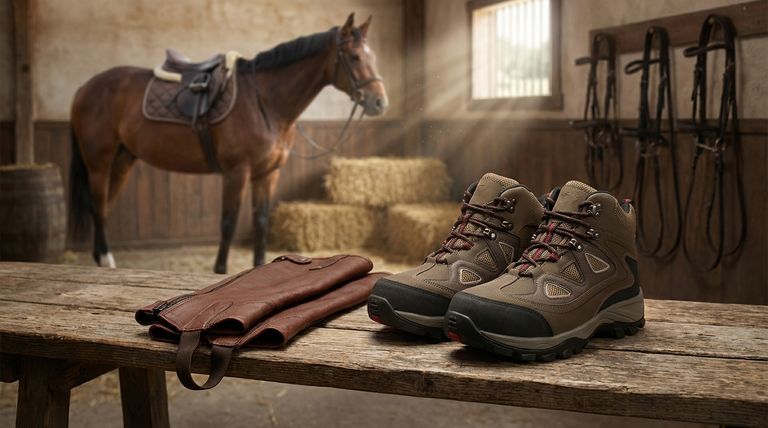
The Anatomy of a Paddock Boot
Paddock boots, also known as jodhpur boots, are engineered for practicality. Each element of their design serves a specific function for the rider's daily needs.
Ankle-Height Profile
The most recognizable feature is the boot's short stature, ending just above the ankle. This provides essential support for the ankle joint without the rigidity of a tall boot.
This lower profile gives the rider greater flexibility for walking, bending, and performing groundwork, making them ideal for tasks around the stable.
The Safety Heel
Every paddock boot has a low but distinct and sturdy heel. This is a critical safety feature, not a stylistic choice.
The heel is designed to prevent the rider's foot from accidentally slipping all the way through the stirrup, which could be extremely dangerous in the event of a fall.
Common Closure Systems
Paddock boots typically come in two main styles: zip-up or lace-up.
Zip-front boots offer speed and convenience, while lace-up versions provide a more customized and secure fit around the ankle. Many lace-up models also include a rear zipper for the best of both worlds.
Built for Durability
Given their use for both riding and stable work, these boots are constructed from durable materials like leather or hardy synthetics. They are designed to withstand daily wear, be easy to clean, and often include features like supportive arches or reinforced toe caps.
The Paddock Boot's Role in the Equestrian System
Understanding the paddock boot requires seeing it not just as a standalone item, but as part of a rider's complete equipment system.
The Symbiotic Relationship with Half Chaps
On their own, paddock boots offer no protection for the rider's lower leg from the friction and pinching of the saddle and stirrup leathers.
Because of this, they are almost always paired with half chaps for riding. These are separate leg coverings that zip up over the calf, providing the necessary grip and protection.
The "Tall Boot" Simulation
The combination of a paddock boot and a matching half chap effectively mimics the look and function of a single tall boot.
This two-part system is often more comfortable, as it allows for greater articulation at the ankle. It also provides a better fit for riders who have difficulty finding well-fitting tall boots.
Understanding the Trade-offs
While incredibly versatile, paddock boots are not the optimal choice for every situation. Their primary strengths are also the source of their limitations.
Inherent Lack of Leg Protection
As noted, a paddock boot alone is insufficient for serious riding. The rider must make the additional purchase of half chaps to create a safe and comfortable system, adding to the overall cost and equipment needed.
Perception in Competition
While the paddock boot and half chap combination is standard for daily training and common for children in shows, it can be seen as less formal or professional in higher-level competition.
Disciplines like dressage and hunter/jumper shows have a strong tradition favoring the sleek, uninterrupted line of a tall boot for a polished presentation.
Making the Right Choice for Your Goal
Selecting the right boot depends entirely on your primary activities as a rider.
- If your primary focus is daily training and barn work: Paddock boots offer superior versatility, comfort, and durability for activities both in and out of the saddle.
- If your primary focus is affordability and flexibility as a new rider: The paddock boot and half chap combination is the most practical and cost-effective entry point into proper equestrian footwear.
- If your primary focus is competing in formal disciplines: While excellent for schooling, a dedicated pair of tall boots will likely be necessary to meet presentation standards at higher levels.
Understanding these core features allows you to select the right tool for the job, ensuring safety, comfort, and performance for your specific equestrian needs.
Summary Table:
| Key Feature | Description | Primary Benefit |
|---|---|---|
| Ankle-Height Profile | Ends just above the ankle. | Provides support and flexibility for walking and stable work. |
| Safety Heel | Low, distinct, and sturdy heel. | Prevents the foot from slipping through the stirrup for rider safety. |
| Closure Systems | Typically zip-up or lace-up. | Offers convenience or a customized, secure fit. |
| Modular System | Designed to be paired with half chaps. | Creates a versatile and affordable alternative to tall boots for riding. |
Ready to Equip Your Riders with Durable, High-Performance Footwear?
As a large-scale manufacturer, 3515 produces a comprehensive range of equestrian footwear, including paddock boots, for distributors, brand owners, and bulk clients. Our production capabilities ensure durability, safety, and comfort for every rider's needs.
Contact us today to discuss your paddock boot requirements and discover how we can support your business with reliable, high-quality manufacturing.
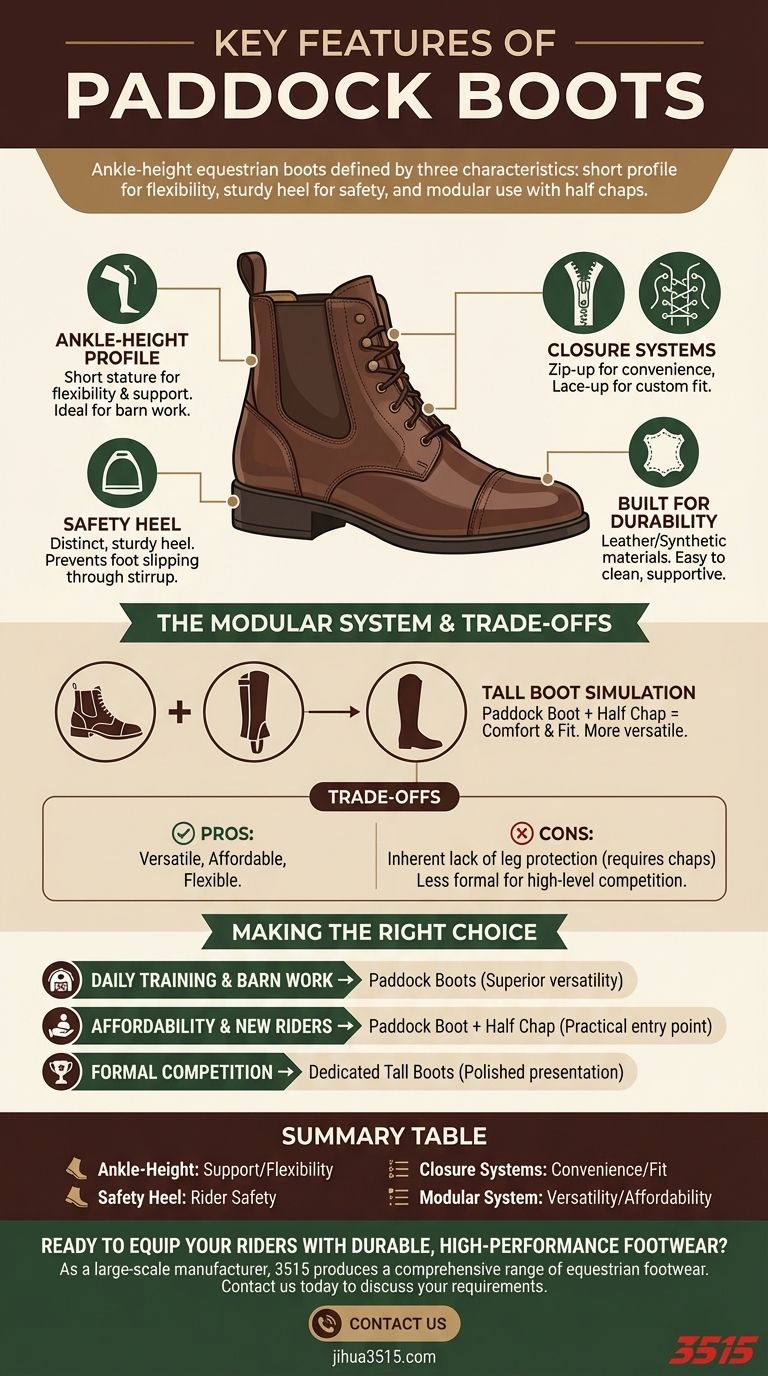
Visual Guide
Related Products
- Wholesale Lightweight Tactical Boots Custom Manufacturer for Desert & Combat Use
- Durable Military Combat Boots with Water Drainage for Wholesale & OEM
- Wholesale Durable Mid-Cut Tactical Boots for Custom & Private Label Brands
- Durable Leather Tactical Boots Wholesale & Custom Manufacturing for Brands
- High-Traction Suede Tactical Boots Wholesale & Custom Manufacturing
People Also Ask
- What are the common types of combat boots? Find the Right Boot for Your Mission
- What specialized protections do tactical boots offer? Maximize Endurance with High-Performance Footwear
- What are the main construction similarities between tactical boots and tactical sneakers? Built for Performance & Durability
- What are the different types of tactical boots available? Find the Right Boot for Your Mission
- How is the compatibility of polymer materials demonstrated in smart footwear? Enhancing Tactical & Training Performance


















