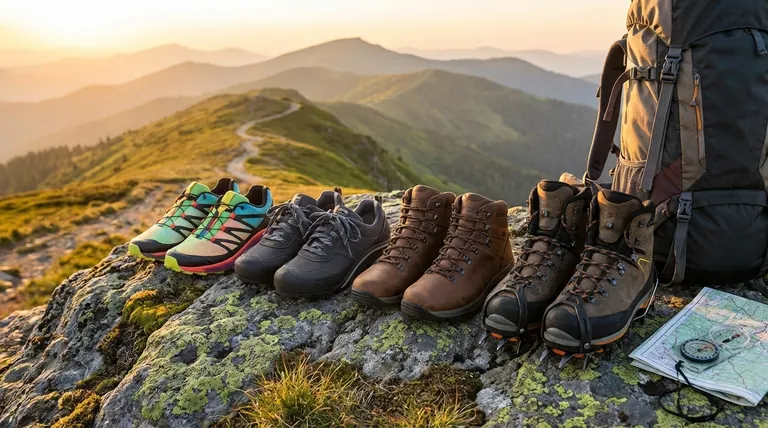
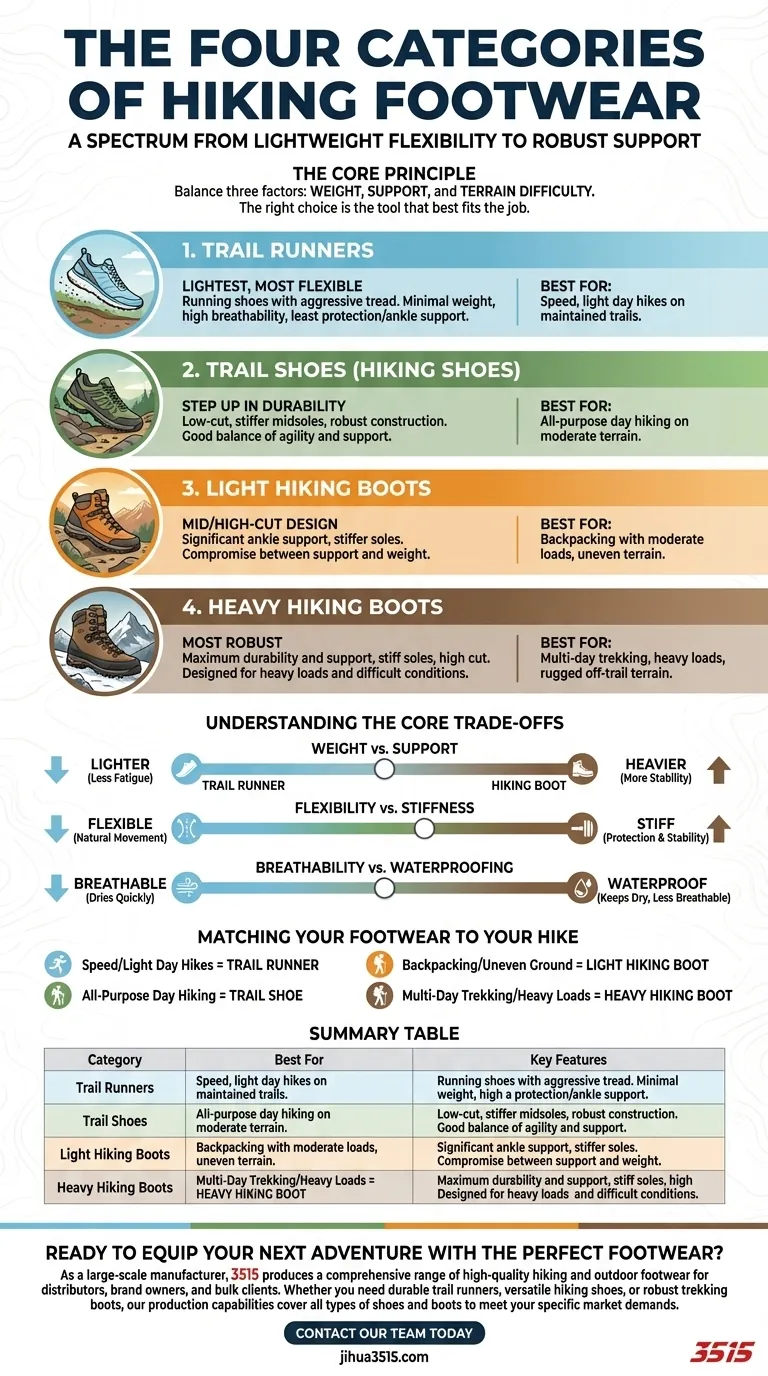
The four primary categories of hiking footwear are trail runners, trail shoes, light hiking boots, and heavy hiking boots. These classifications represent a spectrum from lightweight flexibility for simple trails to robust support for difficult terrain, allowing you to match your footwear directly to your activity.
The core principle in selecting hiking footwear is to balance three factors: the weight of the shoe, the level of support it provides, and the difficulty of the terrain you plan to tackle. The right choice is simply the tool that best fits the job.
Deconstructing the Four Categories
Understanding the specific purpose of each category is the key to preventing discomfort and ensuring stability on your hike. Each type is engineered for a distinct set of conditions.
Category 1: Trail Runners
Trail runners are the lightest and most flexible option. They are essentially running shoes enhanced with more aggressive tread for better grip on dirt and rock.
Their primary advantage is minimal weight, which reduces fatigue over long distances. They are highly breathable but typically offer the least amount of foot protection and ankle support.
Category 2: Trail Shoes (or Hiking Shoes)
Often called "hiking shoes," these are a step up in durability from trail runners. They feature a low-cut design like a regular shoe but have stiffer midsoles and more robust construction.
This category provides a good balance of agility and support, making it ideal for day hikes on moderate terrain where heavy ankle support isn't a critical requirement.
Category 3: Light Hiking Boots
This is where you begin to see mid or high-cut designs that cover the ankle. Light hiking boots offer significantly more ankle support and have stiffer soles than trail shoes.
They are the go-to choice for hikers carrying a moderate backpack or for those navigating varied, uneven terrain where an ankle roll is a greater risk. They provide a solid compromise between support and weight.
Category 4: Heavy Hiking Boots
Also known as trekking or mountaineering boots, this is the most robust category. These boots are built for maximum durability and support, featuring stiff soles and a high cut that firmly protects the ankle.
They are designed to handle heavy loads, strenuous multi-day backpacking trips, and difficult, off-trail terrain. Their rigidity provides the ultimate platform for stability in the most demanding conditions.
Understanding the Core Trade-offs
No single shoe is perfect for every situation. Your choice will always involve a series of trade-offs between competing characteristics.
Weight vs. Support
Lighter footwear, like a trail runner, reduces the energy you expend with every step, which can significantly lessen fatigue.
However, that low weight comes at the cost of support. Heavier hiking boots are essential for stabilizing your foot and ankle, especially when carrying a heavy pack over rough ground.
Flexibility vs. Stiffness
A flexible sole allows your foot to move naturally and is more comfortable on well-maintained, smooth trails.
A stiff sole, common in heavier boots, protects your feet from sharp rocks and provides a stable platform on uneven surfaces. This stiffness prevents foot fatigue on long, challenging hikes but can feel clunky on simple paths.
Breathability vs. Waterproofing
Highly breathable, non-waterproof shoes are excellent for hot, dry conditions. If they do get wet, they tend to dry out very quickly.
Waterproof membranes are crucial for keeping your feet dry in wet or snowy environments. The trade-off is reduced breathability, which can lead to sweaty feet in warm weather. Once water gets inside a waterproof boot, it also takes much longer to dry.
Matching Your Footwear to Your Hike
Use your intended activity as the primary guide for your selection.
- If your primary focus is speed and light day hikes on maintained trails: A trail runner is your best choice for its flexibility and low weight.
- If your primary focus is all-purpose day hiking on moderate terrain: A trail shoe offers the ideal balance of support and agility.
- If your primary focus is backpacking with a moderate load or hiking on uneven ground: A light hiking boot provides crucial ankle support and durability.
- If your primary focus is multi-day trekking with a heavy pack in rugged conditions: A heavy hiking boot is non-negotiable for maximum protection and stability.
Ultimately, the best hiking footwear is the one that lets you focus on the trail ahead, not on your feet.
Summary Table:
| Category | Best For | Key Features |
|---|---|---|
| Trail Runners | Speed, light day hikes | Lightweight, flexible, minimal support |
| Trail Shoes | All-purpose day hiking | Balanced agility and support, low-cut |
| Light Hiking Boots | Backpacking, uneven terrain | Ankle support, stiffer sole, mid/high-cut |
| Heavy Hiking Boots | Multi-day trekking, heavy loads | Maximum support, durable, stiff sole |
Ready to equip your next adventure with the perfect footwear?
As a large-scale manufacturer, 3515 produces a comprehensive range of high-quality hiking and outdoor footwear for distributors, brand owners, and bulk clients. Whether you need durable trail runners, versatile hiking shoes, or robust trekking boots, our production capabilities cover all types of shoes and boots to meet your specific market demands.
Contact our team today to discuss your footwear needs and discover how we can support your business with reliable, high-performance products.
Visual Guide
Related Products
- Durable Rubber Sole Outdoor Shoes Wholesale & Custom Manufacturing
- Wholesale High-Traction Camo Boots - Custom Manufacturer for Brands
- Wholesale Durable Camouflage Canvas Shoes with High-Traction Cleated Rubber Sole
- Wholesale Durable Camo Canvas Shoes with High-Traction Rubber Soles
- Wholesale Lightweight Tactical Boots Custom Manufacturer for Desert & Combat Use
People Also Ask
- What is the function of the sole in outdoor shoes? Find the Perfect Grip and Support
- What role do outdoor shoes and sneakers play in navigating external terrains? Engineered Stability for Every Surface
- How is AI utilized in the design of outdoor and safety footwear? Harnessing Big Data for Market-Driven Shoe Innovation
- Why is durability important when selecting outdoor shoes? A Guide to Safety & Long-Term Value
- What are the key components of outdoor shoes that affect comfort and sturdiness? A Guide to Durable, High-Performance Footwear