
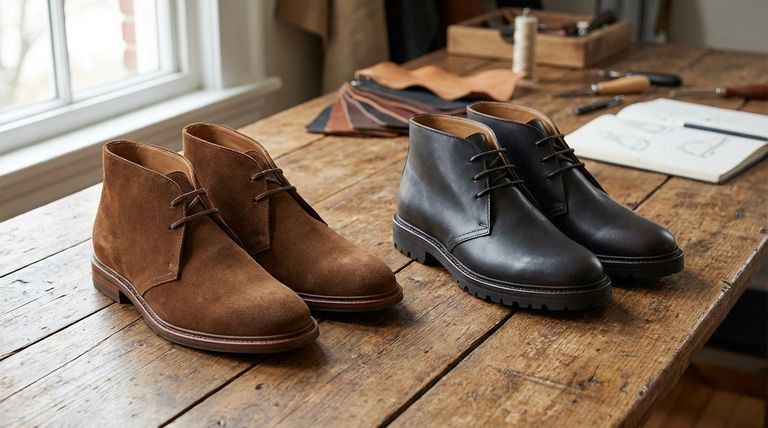
At its core, a Chukka boot is an ankle-height boot defined by its open lacing system and a minimal number of eyelets—typically just two or three pairs. This minimalist design, traditionally featuring suede or leather uppers and a thin sole, is the source of its enduring versatility and popularity.
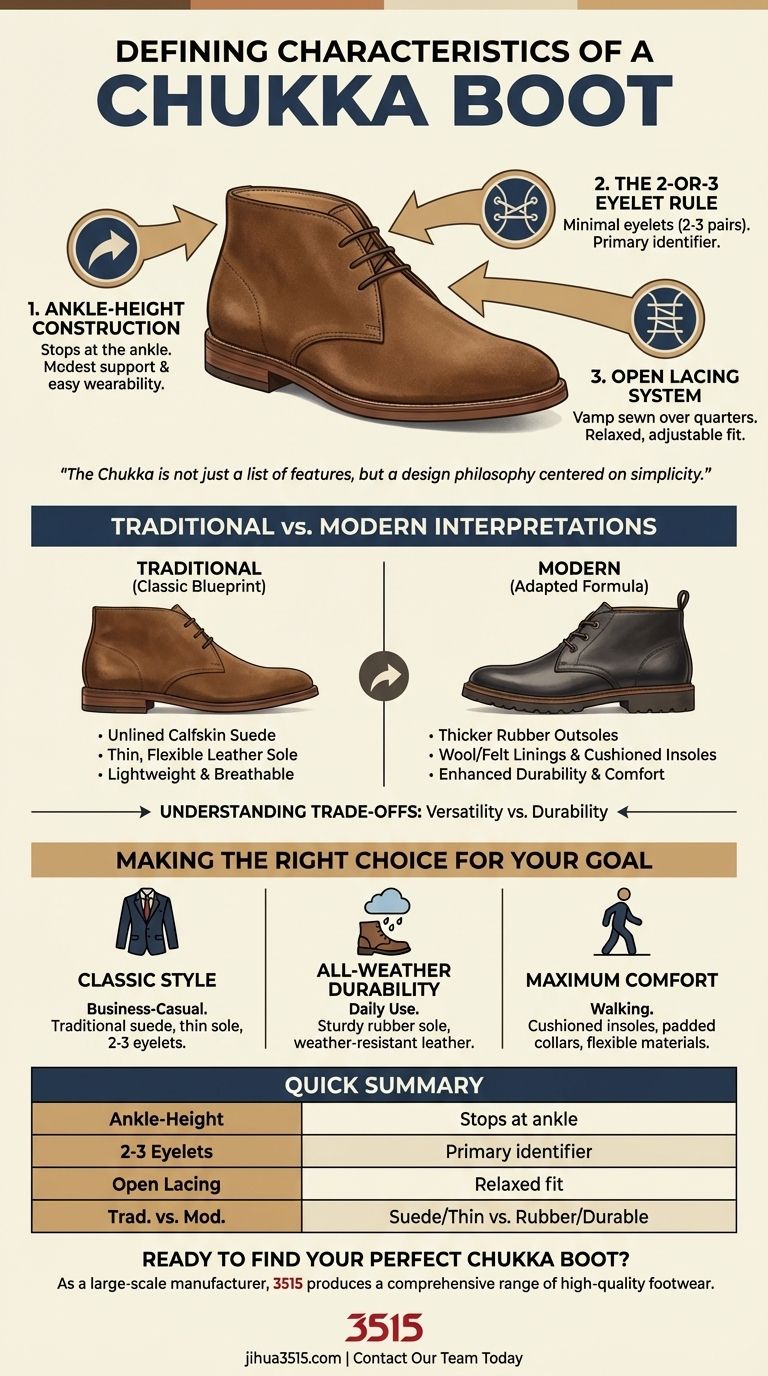
The Chukka is not just a list of features, but a design philosophy centered on simplicity. Its defining characteristics—ankle height, minimal eyelets, and open lacing—create a clean and adaptable silhouette that bridges the gap between formal and casual wear.
The Anatomy of a Classic Chukka
To truly identify a Chukka boot, you must recognize its foundational components. These three elements are the non-negotiable markers of the traditional style.
Ankle-Height Construction
A Chukka boot’s shaft stops at the ankle and goes no higher. This specific height is crucial to its identity, making it less imposing than a full boot but more substantial than a shoe.
This design provides modest ankle support while ensuring the boot is easy to slip on and off, contributing to its reputation as an effortlessly comfortable option.
The 2-or-3 Eyelet Rule
Perhaps the most distinctive feature is the minimal number of eyelets. A traditional Chukka will have only two or, at most, three pairs of eyelets for the laces.
This feature is a primary identifier. If a boot has four or more pairs of eyelets, it may be a similar style, but it deviates from the classic Chukka blueprint.
Open Lacing System
Chukkas utilize an open lacing system, where the vamp—the front part of the shoe—is sewn on top of the quarters (the side panels containing the lace eyelets).
This construction allows the boot to open more widely, offering a more relaxed and adjustable fit compared to the tighter, "closed" lacing system found on formal dress shoes.
Traditional vs. Modern Interpretations
While the core anatomy remains consistent, the materials and finer details can vary, creating a distinction between the original, minimalist style and contemporary adaptations.
The Classic Blueprint
The original Chukka, born from the polo fields of India, was built for lightweight comfort. It traditionally features unlined calfskin suede uppers made from just two pieces of leather.
This minimalist construction is paired with a thin, flexible leather sole, creating a boot that is light, breathable, and exceptionally comfortable in mild weather.
How Modern Brands Adapt the Formula
Many modern Chukkas modify the classic design to enhance durability or comfort for different conditions. It's common to see variations with thicker rubber outsoles for better traction and longevity.
Brands also introduce features like wool or felt linings for warmth, cushioned and antimicrobial insoles for enhanced comfort, and padded heel collars. These are practical upgrades but represent a departure from the unlined, traditional form.
Understanding the Trade-offs
The choice between a classic and a modern Chukka comes down to your specific needs and priorities. Understanding the inherent trade-offs is key to selecting the right boot.
Versatility vs. Durability
The classic Chukka with its thin leather sole and suede upper is incredibly versatile and stylish but offers limited protection against harsh weather.
Modern versions with thick rubber soles are far more durable and practical for wet conditions but can feel heavier and may lose some of the original's delicate, dress-casual appeal.
Identifying True Chukkas
As brands innovate, the lines can blur. A boot with six eyelets or a heavily padded, high-top design may be marketed as a "Chukka," but it fundamentally changes the character of the boot.
Recognizing the core principles—ankle height and 2-3 eyelets—allows you to assess whether you are buying a true Chukka or a different style of ankle boot inspired by it.
Making the Right Choice for Your Goal
To select the perfect Chukka, align its features with your primary objective.
- If your primary focus is classic style and business-casual wear: Seek out a traditional Chukka with 2-3 eyelets, a thin leather or crepe sole, and high-quality suede uppers.
- If your primary focus is all-weather durability and daily use: Opt for a modern interpretation with a sturdy rubber sole and weather-resistant leather uppers.
- If your primary focus is maximum comfort for walking: Look for modern adaptations that include features like cushioned insoles, padded collars, and flexible materials.
Understanding the simple blueprint of the Chukka boot empowers you to choose the perfect variation for your specific needs.
Summary Table:
| Defining Characteristic | Description |
|---|---|
| Ankle-Height Construction | Stops at the ankle, providing modest support and easy wearability. |
| 2-or-3 Eyelet Rule | The minimal number of eyelets is a primary identifier of the classic style. |
| Open Lacing System | Allows for a more relaxed and adjustable fit compared to formal shoes. |
| Traditional vs. Modern | Classic versions use thin soles and suede; modern versions offer durability with rubber soles. |
Ready to find your perfect Chukka boot?
As a large-scale manufacturer, 3515 produces a comprehensive range of high-quality footwear for distributors, brand owners, and bulk clients. Whether you need a classic suede Chukka for business-casual collections or a durable, modern interpretation for everyday wear, our production capabilities cover all types of shoes and boots to meet your exact specifications.
Contact our team today to discuss your production needs and let us help you deliver the perfect boots to your market.
Visual Guide
Related Products
- Durable Leather Tactical Boots Wholesale & Custom Manufacturing for Brands
- Premium Wholesale Tactical Style Safety Shoes Boots with Quick Lacing
- Wholesale High-Traction Camo Boots - Custom Manufacturer for Brands
- Durable Leather High-Ankle Tactical Boots for Wholesale & Custom Manufacturing
- Durable Leather Work Boots Wholesale Manufacturer & Custom Factory
People Also Ask
- What specialized protections do tactical boots offer? Maximize Endurance with High-Performance Footwear
- What features should law enforcement officers look for in tactical boots? Essential Guide for Safety & Performance
- Importance of Professional Tactical Boots in Loess Gully Regions: Ensure Safety and Precision for Field Monitoring
- What is rucking, and why are tactical boots suitable for it? Discover the Ultimate Footwear for Heavy Loads
- What makes the traction of tactical boots superior? Unlock the Science of Unbeatable Grip



















