
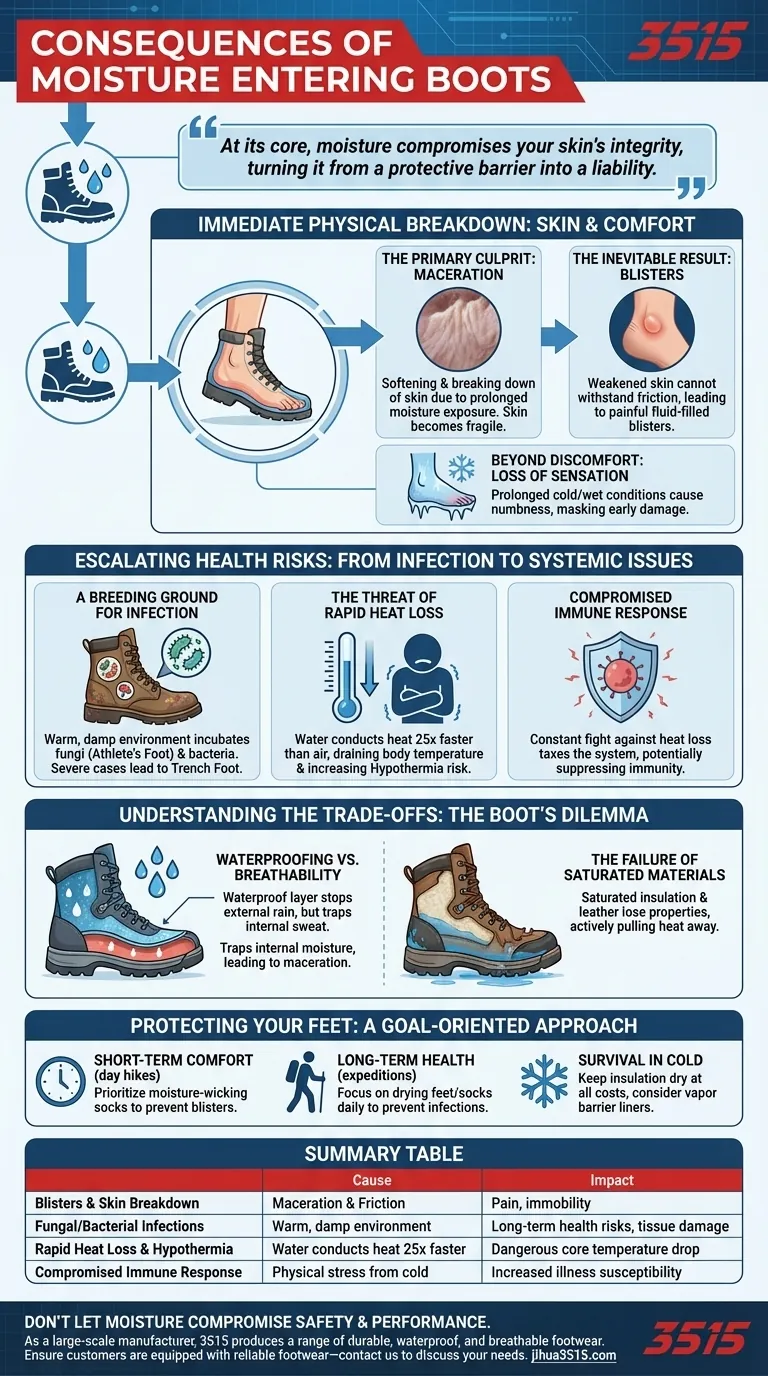
At its core, allowing moisture to enter your boots initiates a cascade of negative consequences for your feet and overall health. The immediate effects are physical discomfort from blisters, but the prolonged impact includes dangerous infections and a critical loss of body heat.
The fundamental problem with moisture in your boots is not the water itself, but how it compromises your skin's integrity, turning it from a protective barrier into a liability. This breakdown is the gateway to nearly all other related health and safety issues.

The Immediate Physical Breakdown: Skin and Comfort
When your feet are trapped with moisture, the environment inside your boot changes rapidly. This a direct assault on your skin, the first line of defense.
The Primary Culprit: Maceration
Maceration is the softening and breaking down of skin due to prolonged exposure to moisture. Think of how your fingers wrinkle after a long bath; now imagine that process continuing for hours under pressure and friction.
This waterlogged state drastically weakens the skin's structure, making it fragile and prone to tearing.
The Inevitable Result: Blisters
Soft, macerated skin is exceptionally vulnerable to friction. Every step you take creates a shearing force between your foot, sock, and boot.
Weakened skin cannot withstand this force, causing the layers to separate and fill with fluid, forming painful blisters that can stop you in your tracks.
Beyond Discomfort: Loss of Sensation
Prolonged cold and wet conditions can lead to numbness in the feet. This is not only uncomfortable but also dangerous, as it can prevent you from feeling the early formation of blisters or more severe tissue damage from the cold.
The Escalating Health Risks: From Infection to Systemic Issues
What begins as a skin-level problem can quickly escalate into a systemic health risk, particularly in demanding or cold environments.
A Breeding Ground for Infection
The warm, damp, low-oxygen environment inside a wet boot is a perfect incubator for fungi and bacteria. This can lead to persistent conditions like Athlete's Foot.
In severe cases, it can result in Trench Foot, a serious condition where tissue begins to die from prolonged immersion in cold, unsanitary water.
The Threat of Rapid Heat Loss
Water is an incredibly efficient thermal conductor, pulling heat away from your body up to 25 times faster than air. Wet socks and boots act as a direct channel for this heat loss.
This process of conduction can drain your body's core temperature, significantly increasing the risk of hypothermia, even in moderately cool conditions.
Compromised Immune Response
While getting your feet wet does not directly cause a viral illness like the flu, the resulting cold stress can be a factor. Forcing your body to constantly fight off heat loss can tax your system.
This sustained physical stress may potentially suppress your immune system, making you more susceptible to viruses you are already exposed to.
Understanding the Trade-offs: The Boot's Dilemma
Keeping feet perfectly dry involves a constant battle between keeping external water out and letting internal sweat escape.
Waterproofing vs. Breathability
A completely waterproof boot will keep rain and puddle water out, but it can also trap the sweat your feet naturally produce. This internal moisture can lead to the very same maceration and blistering you're trying to avoid.
The most effective footwear balances these two needs with breathable, waterproof membranes.
The Failure of Saturated Materials
Once the materials of your boot, particularly the insulation and leather, become saturated, they lose their essential properties. Insulation no longer traps air, and leather loses its structure and support.
At this point, your boot is doing more harm than good, actively working to pull heat from your feet.
Protecting Your Feet: A Goal-Oriented Approach
Managing moisture is the single most important skill for foot health in any demanding situation. Your strategy should adapt to your environment and objective.
- If your primary focus is short-term comfort (day hikes, daily work): Prioritize preventing blisters by wearing moisture-wicking synthetic or wool socks that pull sweat away from your skin.
- If your primary focus is long-term health (multi-day treks, expeditions): Focus on preventing infections like Trench Foot by having a system to clean and dry your feet and socks completely every day.
- If your primary focus is survival in cold environments: The critical threat is hypothermia due to heat loss, so keeping your insulation dry is paramount, even if it means using less-breathable vapor barrier liners.
Ultimately, understanding how moisture impacts your feet is the first step toward ensuring every journey is safe and effective.
Summary Table:
| Consequence | Primary Cause | Key Impact |
|---|---|---|
| Blisters & Skin Breakdown | Maceration & Friction on wet skin | Pain, discomfort, immobility |
| Fungal/Bacterial Infections | Warm, damp environment (e.g., Trench Foot) | Long-term health risks, tissue damage |
| Rapid Heat Loss & Hypothermia | Water conducts heat 25x faster than air | Dangerous drop in core body temperature |
| Compromised Immune Response | Physical stress from fighting cold | Increased susceptibility to illness |
Don't let moisture compromise safety and performance. As a large-scale manufacturer, 3515 produces a comprehensive range of durable, waterproof, and breathable footwear for distributors, brand owners, and bulk clients. Our production capabilities encompass all types of safety, work, and tactical boots designed to protect against the very consequences outlined above. Ensure your customers are equipped with reliable footwear—contact us today to discuss your needs and explore our product lines.
Visual Guide
Related Products
- Wholesale Durable Safety Boots | Custom Steel Toe & Puncture-Resistant Manufacturing
- Premium Wholesale Tactical Style Safety Shoes Boots with Quick Lacing
- Durable Leather Work Boots for Wholesale & Custom Manufacturing
- Durable Goodyear Welt Leather Work Boots for Wholesale & Private Label
- Premium Wholesale Waterproof Safety Boots High Performance Protection for Industrial Markets
People Also Ask
- Why is proper storage important for safety boots? Preserve Protection and Extend Lifespan
- What are the risks of using ordinary rubber boots in forest clearing? Why professional safety boots are essential
- What materials are commonly used for outsoles in safety boots? A Guide to Durability, Grip, and Comfort
- How should safety boots be cleaned to avoid damage? A Gentle Guide to Preserve Your Boots
- What are the consequences of not wearing safety boots? Protect Your Finances and Career



















