
Okay, here's how I'm going to approach this. I need to provide a truly helpful answer, not just regurgitate facts. The user wants more than just a list of characteristics; they're trying to figure out if these soles are the right fit for their specific needs.
First, I need to get to the root of the question. They want to know the what - the characteristics of Red X soles. But more importantly, I need to understand the why - why these characteristics matter and how they translate to real-world performance. Are these soles good for general use, or are they a specialized tool? That's the core question.
I'll start by analyzing the key points from the provided information. I see these as the most important things to consider:
- Heat Resistance: This is a major selling point. The material outperforms standard rubber and polyurethane in high-temperature environments.
- Aggressive Tread: This implies superior grip, and combined with the rugged terrain reference, indicates off-road performance is a priority.
- Durability Trade-off: The softer composition that enables grip is also what leads to faster wear on hard surfaces like concrete or asphalt.
To answer the user's need, I plan to build a structure that immediately provides clarity. I'll start with a concise statement about the primary characteristics. Then, I'll put the trade-off front and center, stating that these soles are designed for specific harsh conditions and have decreased durability on common surfaces.
Then, I'll go into more depth. I'll explain the core design philosophy - Red X soles are specialized tools, not general-purpose soles. I'll break down why the heat resistance is valuable, and what it means in practical terms. I'll connect the aggressive tread with the softer composition, explaining how this combination improves grip on uneven terrain.
The crux of the article will focus on the trade-offs, particularly the accelerated wear on hard surfaces. I will make this point very clear. Lastly, I'll provide actionable advice, bullet pointing specific scenarios where Red X soles would be a good or bad choice. I need to make the point clear that these soles aren't meant for everyday use.
The tone will be objective and authoritative. I will use short, direct sentences, headings, and bolding to make the information easy to scan and understand. The goal is to empower the user to make an informed decision based on their specific needs. It's about helping them choose the right tool for the job. At their core, Vibram Red X soles are a specialized footwear component designed for high-performance in specific, demanding conditions. They are defined by a unique, heat-resistant compound and an aggressive tread pattern, setting them apart from general-purpose soles.
The central takeaway is that Vibram Red X soles are engineered for exceptional performance in hazardous environments, specifically those involving high heat and rugged terrain. This specialization comes at the direct trade-off of reduced durability on common, hard surfaces like pavement.
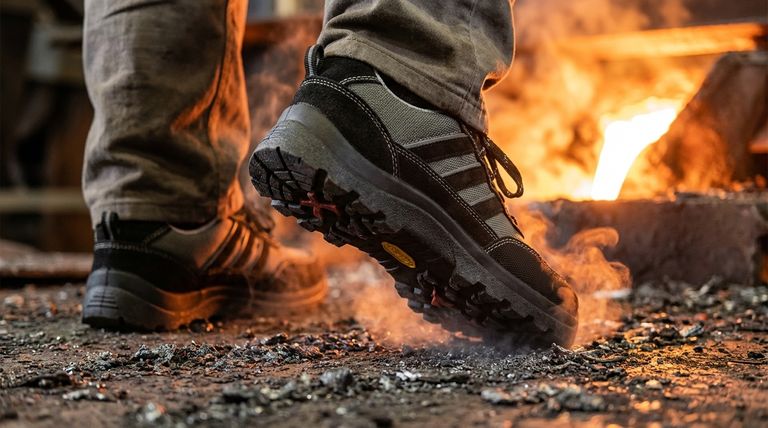
The Core Design Philosophy: Specialization
The characteristics of the Vibram Red X sole are not accidental; they are the result of a design focused on excelling in environments where standard materials would fail.
Engineered for Extreme Heat
The standout feature is its heat-resistant compound. This material is formulated to maintain its integrity and performance in high-temperature settings, significantly outperforming typical rubber or polyurethane soles.
This makes them ideal for industrial applications where contact with hot surfaces is a risk, such as in foundries, welding shops, or asphalt paving.
Prioritizing Grip on Unstable Ground
Vibram Red X soles feature aggressive tread patterns designed to bite into loose or uneven surfaces. This ensures maximum traction on rugged, off-road terrain.
The grip is further enhanced by a softer material composition. This allows the sole to conform slightly to the ground, increasing the surface area of contact and providing a more secure foothold.
Understanding the Trade-off: Performance vs. Longevity
Choosing a specialized component like the Red X sole means accepting a critical compromise. Its strengths in one area create a deliberate weakness in another.
Accelerated Wear on Hard Surfaces
The very softness that provides excellent grip on natural terrain is a liability on hard, flat surfaces. Continuous use on concrete or asphalt will cause the sole to abrade and wear down much faster than a standard, harder sole.
This accelerated wear is the primary trade-off for its superior heat resistance and traction capabilities.
Not an Everyday Sole
Because of this rapid wear on common surfaces, the Vibram Red X is not intended to be a general-purpose or everyday sole. Using it primarily for walking on pavement would negate its benefits and lead to premature replacement.
Making the Right Choice for Your Use Case
To determine if a Red X sole is appropriate, you must match its specialized features to your primary activity.
- If your primary focus is safety and traction in high-heat or rugged industrial environments: This sole is an excellent choice, providing the specific protection and grip you need.
- If your primary focus is hiking on varied natural trails: The aggressive tread is beneficial, but be mindful that any segments on paved paths will increase wear.
- If your primary focus is everyday wear, construction on concrete, or walking on pavement: You should choose a different, harder-wearing sole compound to ensure longevity.
Ultimately, selecting the Vibram Red X sole is about choosing the right tool for a very specific job.
Summary Table:
| Characteristic | Description | Key Takeaway |
|---|---|---|
| Heat Resistance | Specialized compound withstands high temperatures. | Ideal for industrial settings like foundries and welding. |
| Aggressive Tread | Deep lugs provide superior grip on loose, uneven terrain. | Excellent for off-road traction and rugged environments. |
| Material Softness | Softer composition enhances grip but wears faster on hard surfaces. | Trade-off: Superior performance in specific conditions, reduced durability on pavement. |
| Primary Use Case | Specialized for high-heat, hazardous, and rugged terrain. | Not intended for general, everyday use on concrete or asphalt. |
Need High-Performance Safety Footwear for Your Operations?
As a large-scale manufacturer, 3515 produces a comprehensive range of industrial and outdoor footwear for distributors, brand owners, and bulk clients. Our production capabilities encompass all types of safety shoes and boots, including models engineered with specialized soles like Vibram Red X for superior heat resistance and traction.
We can help you:
- Source or customize safety footwear tailored to your specific industrial or outdoor needs.
- Ensure worker safety with durable, high-performance boots built for demanding environments.
- Benefit from large-scale manufacturing efficiencies and reliable supply for your business.
Let's discuss your requirements: Contact 3515 today for a quote!
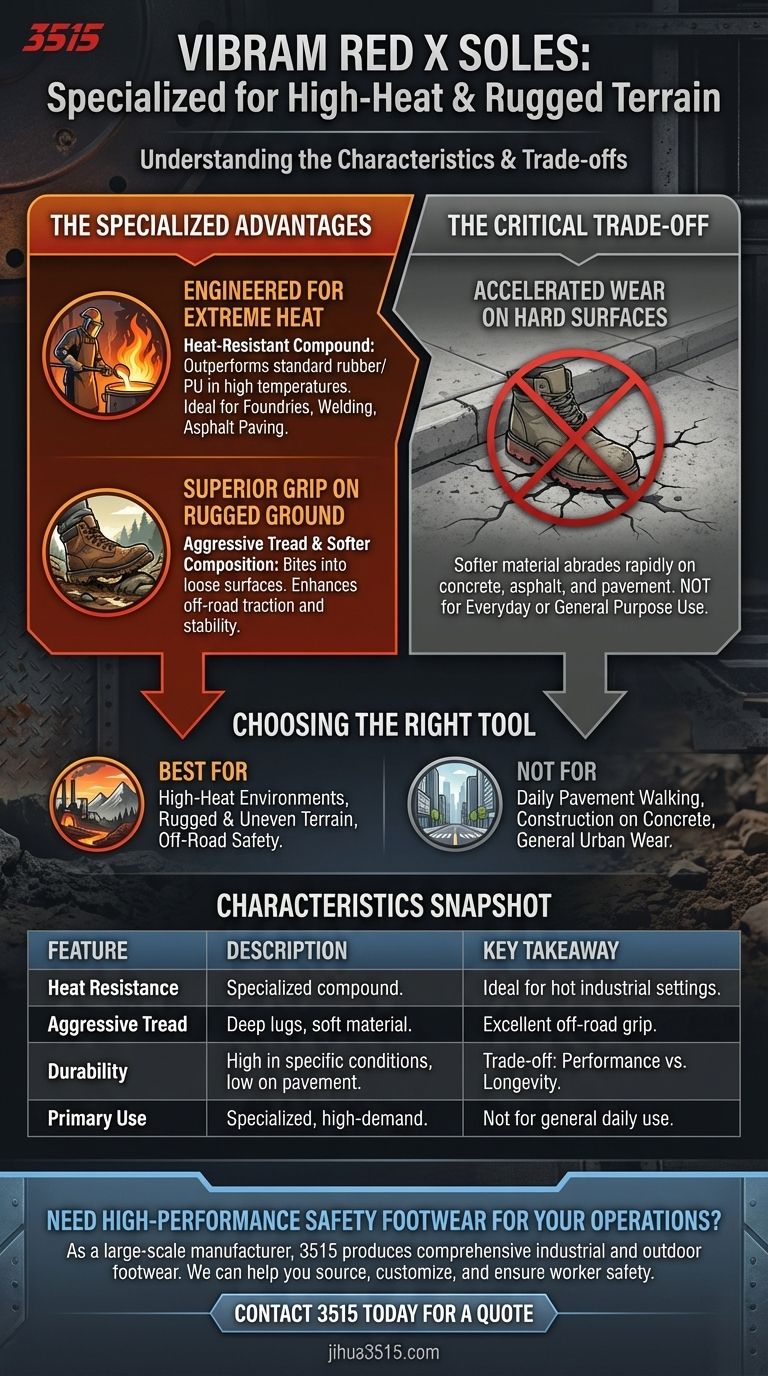
Visual Guide
Related Products
- Premium Safety Shoes with Rotating Buckle Safety Sneakers
- Wholesale Breathable Training Shoes Custom Athletic Footwear Manufacturer
- Wholesale Durable & Breathable Training Shoes for Custom Brands
- Durable Rubber Sole Outdoor Shoes Wholesale & Custom Manufacturing
- Custom OEM Training Shoes Wholesale Manufacturer Durable & Breathable
People Also Ask
- What happens during the cutting stage of safety shoes manufacturing? Precision, Process & Quality
- How Specialized Footwear Impacts Side-Cutting Performance and Injury Risk Assessment
- How do I choose the best safety shoes? Match Certified Features to Your Hazards
- Why should ergonomics and comfort be prioritized when selecting safety shoes? Boost Compliance & Worker Health
- How do specialized safety shoes protect against battery maintenance injuries? Prevent Impact and Chemical Burns














