
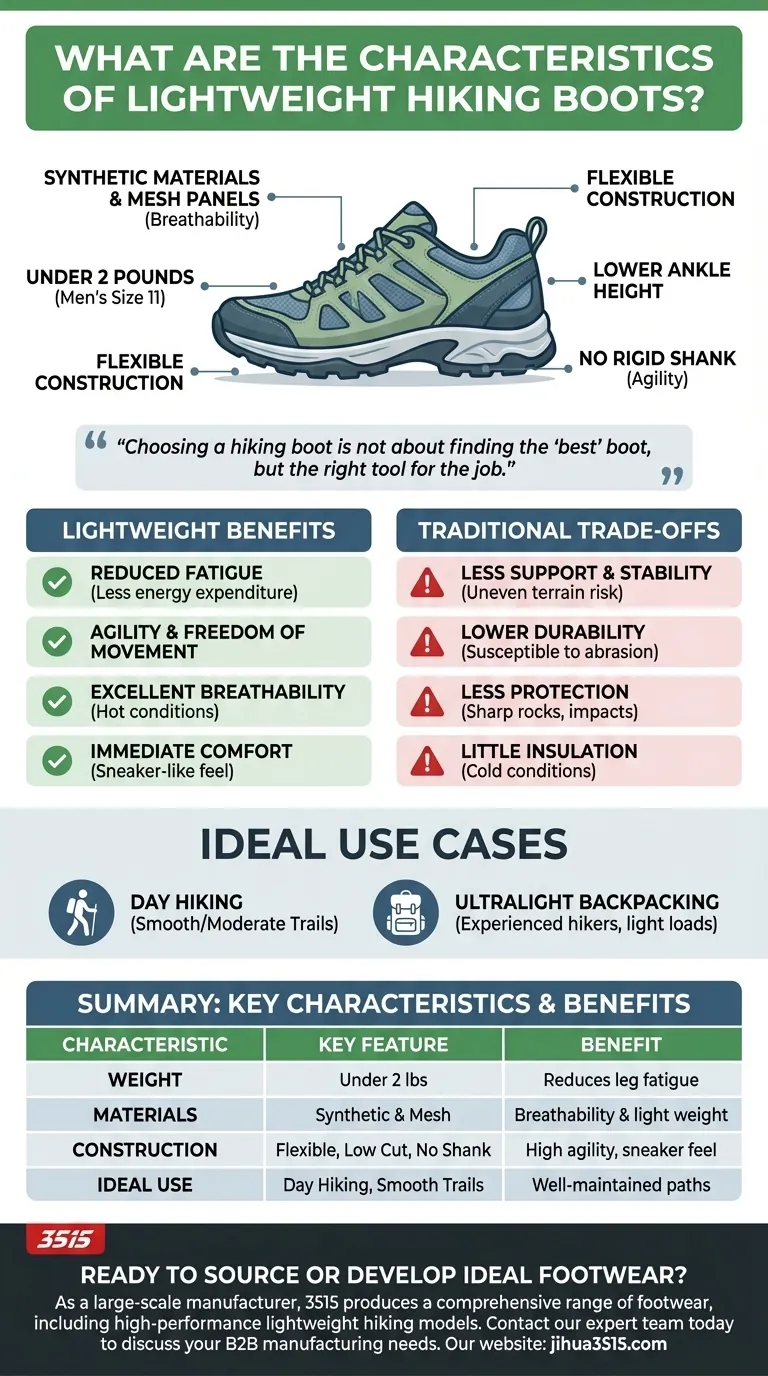
At their core, lightweight hiking boots are characterized by their use of synthetic materials, a total weight under two pounds, and a more flexible construction than their traditional counterparts. They prioritize reduced fatigue and agility by featuring thinner uppers with mesh panels, lower ankle heights, and the absence of a rigid internal shank for support.
Choosing a hiking boot is not about finding the "best" boot, but the right tool for the job. Lightweight boots trade the robust support and long-term durability of traditional boots for immediate comfort and reduced energy expenditure on less demanding terrain.
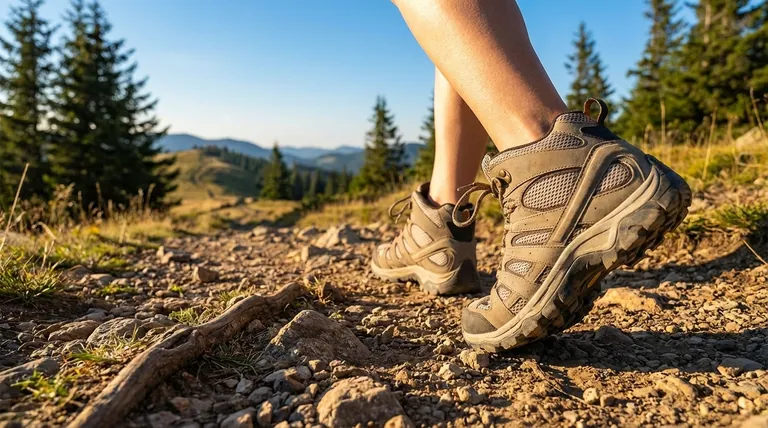
Deconstructing the Lightweight Boot
To understand if a lightweight boot is right for you, we must first examine its specific components and how they contribute to its overall performance.
Material and Weight
Lightweight boots almost exclusively use synthetic fabrics like nylon and polyester, often incorporating large mesh panels. This construction is the primary reason they can achieve a weight of two pounds or less per pair (for a men's size 11).
This reduction in weight directly translates to less energy spent with every step, reducing fatigue over the course of a long day on the trail.
Construction and Flexibility
Unlike traditional boots, lightweight models feature thinner uppers and a lower ankle cut. This design provides more freedom of movement, making the boot feel more like a high-top sneaker.
They also typically lack a rigid shank, which is a hard piece of material (like steel or plastic) embedded in the midsole of traditional boots to provide stiffness and arch support. This omission makes the boot far more flexible underfoot.
Intended Terrain and Use
These characteristics make lightweight boots ideal for day hiking on smooth to moderate trails. Their flexibility and low weight are perfect for well-maintained paths where ankle-twisting hazards are minimal.
They can also be a viable choice for experienced ultralight backpackers who carry less weight and have developed strong feet and ankles that require less external support.
Understanding the Trade-offs: Lightweight vs. Traditional
The benefits of a lightweight boot come with significant trade-offs. Understanding these compromises is critical to avoiding discomfort or injury.
Support and Stability
The primary trade-off is in support. The lower ankle cut and flexible sole provide far less stability on uneven, rocky, or off-camber terrain compared to a traditional boot.
A heavier boot with a high ankle and a rigid shank acts as a platform, protecting your foot and preventing dangerous ankle rolls when carrying a heavy pack or navigating difficult ground.
Durability and Protection
Durability is the second major compromise. Synthetic fabrics and mesh, while breathable, are far more susceptible to abrasion and tearing from rocks and roots than the full-grain leather found on traditional boots.
Similarly, the thinner uppers and softer soles offer less protection from sharp rocks underfoot or accidental impacts to the toe.
Weather Resistance and Breathability
While many lightweight boots offer a waterproof membrane, their mesh panels can become saturated more quickly than leather. However, their primary advantage is breathability.
The synthetic construction allows heat and moisture to escape efficiently, which is a major benefit in hot and dry conditions. Conversely, they offer little insulation in the cold.
Making the Right Choice for Your Hike
Your decision should be guided by your intended use, not by the weight on a scale alone.
- If your primary focus is day hiking on established trails: A lightweight boot is an excellent choice, providing all-day comfort and minimizing fatigue.
- If your primary focus is backpacking with a heavy load: A traditional, more supportive boot is essential for preventing foot fatigue and ankle injuries under weight.
- If your primary focus is navigating rugged, off-trail terrain: A heavier, more durable boot with superior protection and a stiff sole is the safer and more effective option.
Ultimately, matching your footwear to the demands of the terrain and your load is the most important step in ensuring a safe and enjoyable hike.
Summary Table:
| Characteristic | Key Feature | Benefit |
|---|---|---|
| Weight | Under 2 pounds (men's size 11) | Reduces leg fatigue and energy expenditure |
| Materials | Synthetic fabrics (nylon, polyester) & mesh panels | Provides excellent breathability and light weight |
| Construction | Low ankle cut, flexible sole, no rigid shank | Offers high agility and a natural, sneaker-like feel |
| Ideal Use | Day hiking, smooth to moderate trails, ultralight backpacking | Perfect for well-maintained paths and experienced hikers with light loads |
Ready to find the perfect hiking boot for your brand or retail needs?
As a large-scale manufacturer, 3515 produces a comprehensive range of footwear for distributors, brand owners, and bulk clients. Our production capabilities encompass all types of shoes and boots, including high-performance lightweight hiking models designed for comfort and agility.
We can help you source or develop the ideal footwear to meet your customers' demands. Contact our expert team today to discuss your manufacturing requirements and discover how we can bring value to your business.
Visual Guide
Related Products
- Wholesale Lightweight Tactical Boots Custom Manufacturer for Desert & Combat Use
- Wholesale Lightweight Tactical Boots with Dial Closure OEM & Bulk Orders
- Wholesale High-Traction Camo Boots - Custom Manufacturer for Brands
- Lightweight Breathable Training Shoes for Wholesale & Custom OEM Manufacturing
- Lightweight Breathable Sneakers with Wet-Traction Grip for Wholesale & Private Label
People Also Ask
- What are the common types of combat boots? Find the Right Boot for Your Mission
- What specialized protections do tactical boots offer? Maximize Endurance with High-Performance Footwear
- What are the main construction similarities between tactical boots and tactical sneakers? Built for Performance & Durability
- What are the different types of tactical boots available? Find the Right Boot for Your Mission
- How does additive manufacturing equipment reduce environmental risks? Sustainable Tactics for Modern Footwear Production



















