
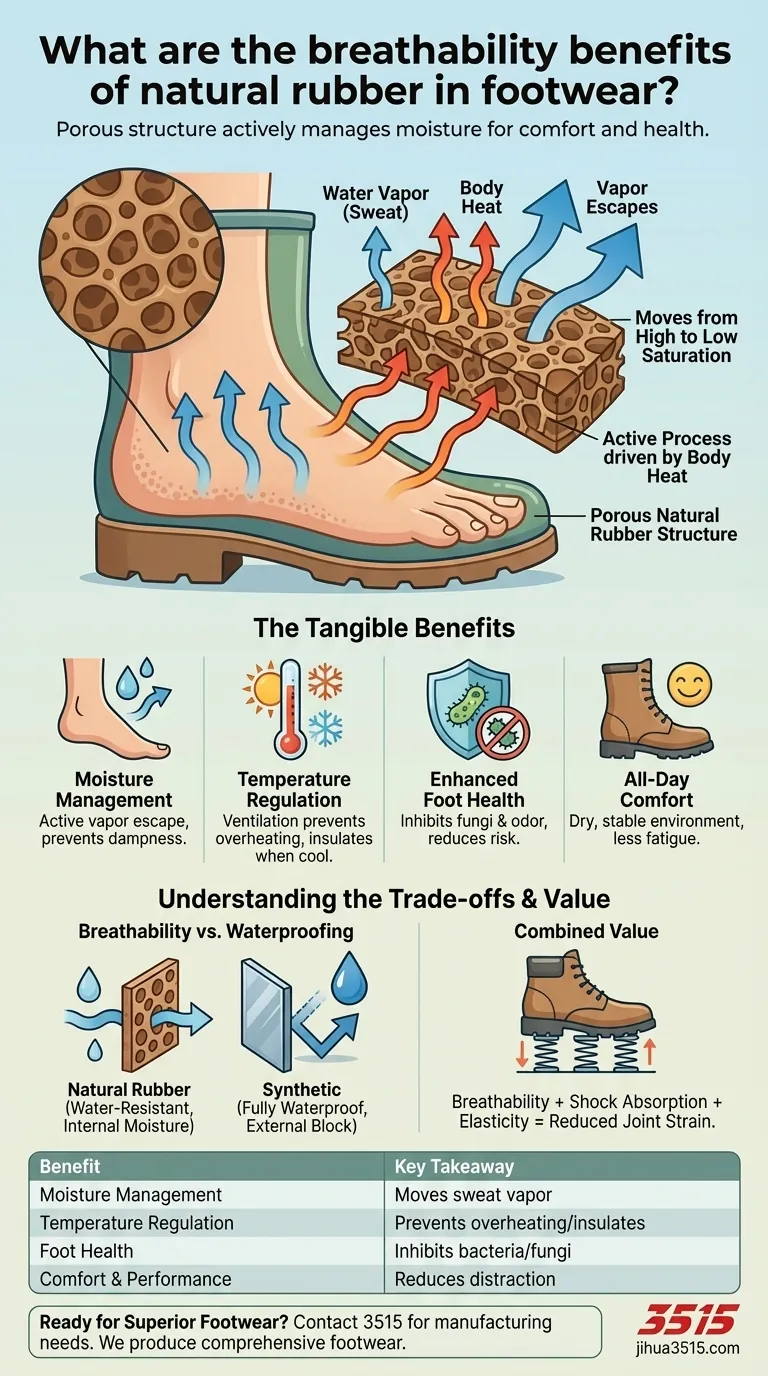
At its core, the breathability of natural rubber in footwear stems directly from its inherently porous structure. This microscopic composition allows air to circulate and water vapor (sweat) to escape, actively preventing moisture build-up and maintaining a dry, healthy environment for your feet.
The primary benefit of natural rubber's breathability is not just comfort, but a functional system for managing the foot's microclimate. It works to regulate temperature and inhibit the growth of odor-causing bacteria and fungi by keeping the foot dry from the inside out.
How Natural Rubber Manages Moisture
The effectiveness of natural rubber footwear comes from its ability to move moisture away from the skin. This isn't a passive quality; it's an active process driven by basic physics.
The Role of Porous Structure
Natural rubber is not a solid, impermeable barrier. It contains a network of microscopic pores that are key to its function.
These pores create pathways for air and water vapor to travel through the material, facilitating constant, gentle ventilation.
The Mechanism of Moisture Transfer
Breathability works by moving moisture from an area of high saturation (next to your skin) to an area of lower saturation (outside the footwear).
Your body heat warms the moisture from sweat, turning it into water vapor. This vapor naturally moves through the rubber's pores toward the cooler, drier air outside.
Preventing Moisture Build-Up
By continuously venting this water vapor, natural rubber prevents the accumulation of sweat inside the shoe.
This keeps your socks and skin drier, which is the foundation of foot comfort and health during long periods of wear.
The Tangible Benefits of a Breathable Foot Environment
A boot that manages moisture effectively delivers several critical advantages, especially during work or extended outdoor activities.
Superior Temperature Regulation
Proper ventilation is essential for preventing overheating in warm conditions. It allows excess heat to escape along with moisture.
This same process helps insulate in cooler weather by keeping the skin dry, as a damp foot loses heat much more rapidly.
Enhanced Foot Health
A consistently damp environment is the ideal breeding ground for fungus and odor-causing bacteria.
By maintaining a dry environment, natural rubber's breathability directly reduces the risk of issues like athlete's foot and persistent odors.
All-Day Comfort and Performance
The combination of dryness and stable temperature eliminates the primary sources of discomfort and distraction.
This makes footwear with natural rubber components exceptionally well-suited for demanding tasks where focus and physical well-being are paramount.
Understanding the Trade-offs
While highly effective, it's important to understand where natural rubber's breathability fits in the spectrum of material properties. No single material is perfect for every scenario.
Breathability vs. Waterproofing
Natural rubber provides excellent management of internal moisture (sweat). However, its porosity means it is water-resistant, not completely waterproof like a sealed synthetic boot.
Materials like Gore-Tex use a specialized membrane with pores small enough to let vapor out but block liquid water from entering. Natural rubber's breathability is a property of the material itself, not a separate membrane.
The Value of Combined Properties
The true advantage of natural rubber is its unique combination of features. It offers exceptional shock absorption and elasticity alongside its breathability.
This means it not only keeps your feet dry but also reduces strain and impact on your joints, a dual benefit that many synthetic materials struggle to replicate.
Making the Right Choice for Your Goal
Select your footwear based on the specific demands of your environment and activity.
- If your primary focus is all-day comfort during active use: The ability of natural rubber to manage sweat and regulate temperature is a significant advantage.
- If your primary focus is wading through water: A fully sealed synthetic boot or one with a dedicated waterproof membrane may be more appropriate, though it will sacrifice breathability.
- If your primary focus is reducing joint strain and fatigue: The combination of natural rubber's shock absorption and its breathable comfort is unparalleled.
Ultimately, choosing footwear with natural rubber is an investment in a balanced system that prioritizes both comfort and foot health.
Summary Table:
| Benefit | Key Takeaway |
|---|---|
| Moisture Management | Porous structure actively moves sweat vapor away from the skin, preventing dampness. |
| Temperature Regulation | Ventilation prevents overheating in warm conditions and helps insulate when it's cool. |
| Foot Health | A dry environment inhibits the growth of odor-causing bacteria and fungi like athlete's foot. |
| Comfort & Performance | Reduces discomfort and distraction, ideal for long periods of wear or demanding tasks. |
| Trade-off | Offers water-resistance, not full waterproofing like sealed synthetic boots. |
Ready to experience the superior comfort and performance of breathable natural rubber footwear?
As a large-scale manufacturer, 3515 produces a comprehensive range of footwear for distributors, brand owners, and bulk clients. Our production capabilities encompass all types of shoes and boots, including those featuring the exceptional benefits of natural rubber.
We can help you provide your customers with footwear that combines comfort, durability, and foot health.
Contact our team today to discuss your manufacturing needs and discover how we can bring value to your product line.
Visual Guide
Related Products
- Durable Rubber Sole Outdoor Shoes Wholesale & Custom Manufacturing
- Wholesale Durable Camo Canvas Shoes with High-Traction Rubber Soles
- Durable Leather Work Boots for Wholesale & Custom Manufacturing
- Durable Leather Work Boots for Wholesale & Custom OEM Manufacturing
- Wholesale Leather Work Boots with Customizable Wedge Sole for Brands
People Also Ask
- What is the function of the sole in outdoor shoes? Find the Perfect Grip and Support
- What role do outdoor shoes and sneakers play in navigating external terrains? Engineered Stability for Every Surface
- How is AI utilized in the design of outdoor and safety footwear? Harnessing Big Data for Market-Driven Shoe Innovation
- Why is durability important when selecting outdoor shoes? A Guide to Safety & Long-Term Value
- What are the key components of outdoor shoes that affect comfort and sturdiness? A Guide to Durable, High-Performance Footwear
















