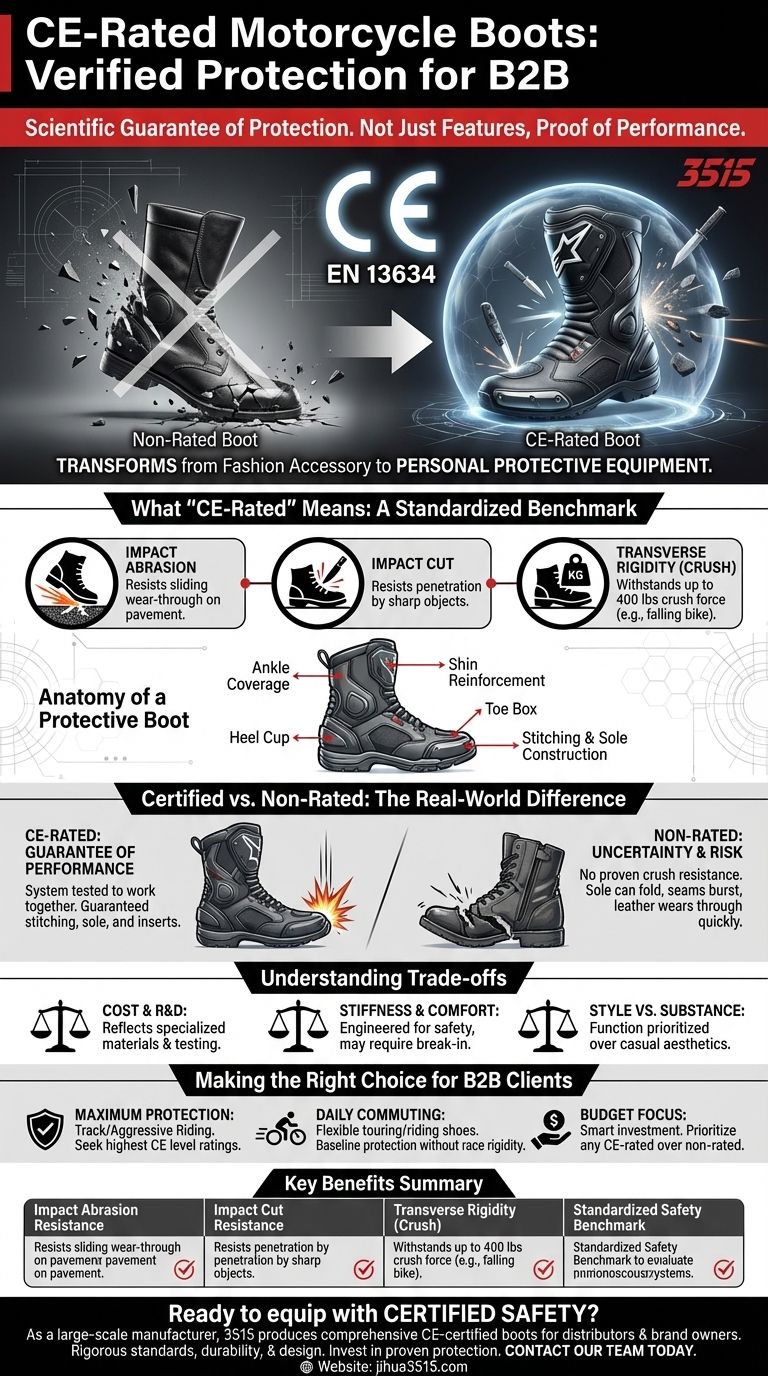
The primary benefit of CE-rated motorcycle boots is the verified, scientific guarantee of protection. This certification ensures the boot has passed rigorous, standardized tests for resistance to impacts, crushing forces, and abrasion, which non-rated boots, regardless of their appearance, do not provide.
The "CE" mark is not a feature; it's proof of performance. It transforms your boot from a fashion accessory into a piece of personal protective equipment that has been scientifically validated to protect you from common and severe motorcycle-related foot and ankle injuries.
What "CE-Rated" Actually Means
To make an informed decision, it's crucial to understand what the certification process entails. It's a systematic evaluation of a boot's ability to function as genuine safety equipment.
A Standardized Benchmark for Safety
The CE rating signifies that the footwear meets the specific technical standards set by the European Union (EN 13634 standard). This has become the de facto global benchmark for verifying the protective capabilities of motorcycle boots.
The Core Tests for Protection
Certified boots are subjected to a battery of laboratory tests designed to simulate real-world crash scenarios. The key tests evaluate the boot's performance in three critical areas.
- Impact Abrasion: This tests how long the boot material can withstand being scraped against a rough surface before wearing through, simulating a slide on pavement.
- Impact Cut: This measures the boot's resistance to being cut by a sharp object, a critical factor in many accidents.
- Transverse Rigidity: This is the crush resistance test. The boot is compressed laterally to ensure it can withstand the extreme pressure of a motorcycle falling on the rider's foot, with certified boots tested to handle forces up to 400 lbs.
The Anatomy of a Protective Boot
CE certification also requires specific design features. This includes minimum height requirements for ankle coverage and reinforcements in high-risk zones like the ankle, shin, heel, and toe box.
Certified vs. Non-Rated Boots: The Real-World Difference
Many sturdy-looking work boots or fashion boots seem protective, but they lack the specific engineering required for on-road safety. The difference lies in the guarantee.
The Guarantee of Performance
With a CE-rated boot, you have a guarantee that it will not simply fall apart on impact. The stitching, sole construction, and protective inserts have all been tested to work as a system during the violent forces of a crash.
The Uncertainty of Non-Rated Footwear
A standard work boot, while durable for walking, offers no proven transverse rigidity. Its sole could easily fold, allowing your foot to be crushed. Its seams may burst on impact, and the leather may wear through in less than a second during a slide.
Understanding the Trade-offs
Choosing certified gear involves acknowledging a few practical considerations. True protection often requires specific design choices.
Cost and R&D
Certified boots can be more expensive. The price reflects the research, specialized materials, and rigorous third-party testing required to meet the safety standards.
Stiffness and Comfort
A boot engineered to prevent your ankle from twisting or your foot from being crushed will inherently be stiffer than a casual shoe. While modern designs have greatly improved comfort, there is often a break-in period.
Style vs. Substance
While many brands now offer stylish CE-rated options, the most highly protective boots prioritize function over form. The choice is often between optimized safety and casual aesthetics.
Making the Right Choice for Your Riding
Your decision should be based on a clear understanding of your needs and the risks you face.
- If your primary focus is maximum protection for track or aggressive riding: Seek out boots with the highest CE level ratings, which offer superior abrasion resistance and rigidity.
- If your primary focus is daily commuting or casual touring: A more flexible, CE-certified touring or "riding shoe" provides a crucial baseline of verified protection without the rigidity of a race boot.
- If your primary focus is budget: Prioritizing any CE-rated boot over a non-rated boot at the same price is the smartest investment you can make in your safety.
Choosing CE-rated boots is a direct investment in your own protection, ensuring your gear is proven to perform when you need it most.
Summary Table:
| Key Benefit | What It Means for You |
|---|---|
| Impact Abrasion Resistance | Boot material is tested to withstand slides on pavement, preventing wear-through. |
| Impact Cut Resistance | Certified protection against sharp objects, a critical factor in many accidents. |
| Transverse Rigidity (Crush) | Proven to withstand crushing forces up to 400 lbs, protecting your foot from a falling bike. |
| Standardized Safety Benchmark | Guaranteed performance meeting the EN 13634 standard, the global benchmark for protection. |
Ready to equip yourself with certified safety?
As a large-scale manufacturer, 3515 produces a comprehensive range of CE-certified motorcycle boots for distributors, brand owners, and bulk clients. Our production capabilities ensure every pair meets rigorous safety standards without compromising on durability or design.
Invest in proven protection for your customers. Contact our team today to discuss your footwear needs and explore our full catalog.
Visual Guide
Related Products
- High Performance Fire-Retardant Waterproof Safety Boots
- Premium High-Cut Waterproof Safety Boots Manufacturing & Wholesale Solutions
- Heavy-Duty Waterproof Nubuck Safety Boots Safety Shoes for Bulk Supply
- Premium Wholesale Waterproof Safety Boots High Performance Protection for Industrial Markets
- Premium Waterproof High-Cut Industrial Safety Boots for Wholesale and Bulk Orders
People Also Ask
- Why are waterproof safety boots recommended for certain work environments? Essential Protection for Wet & Hazardous Jobs
- What roles do 3D vision systems and industrial robots play in the manufacturing of fire safety boots? Smart Automation
- How can you ensure your feet stay dry during winter walks? A Two-Part Defense System for Total Comfort
- How does boot construction affect waterproofing? The Science Behind Truly Dry Feet
- What is the difference between waterproof and water-resistant boots? Choose the Right Footwear for Any Condition