
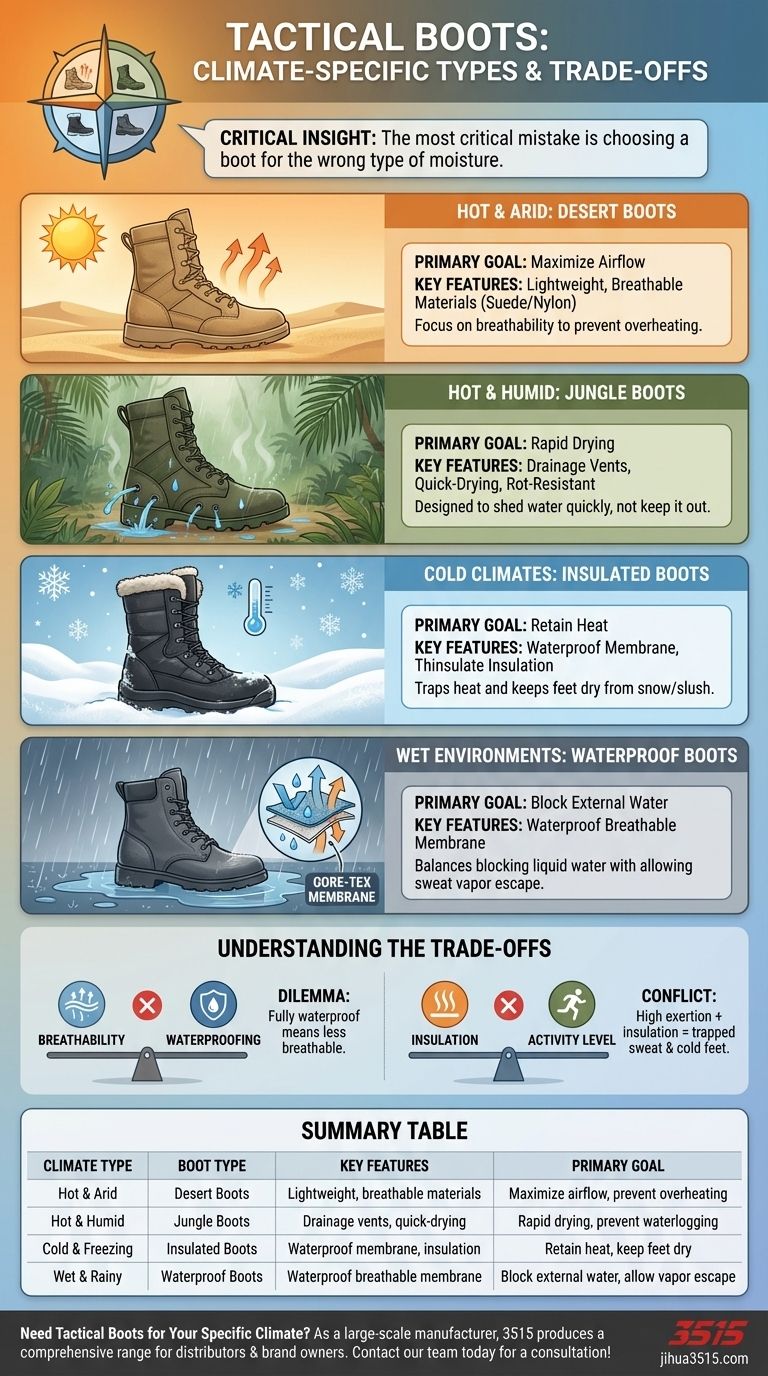
To put it simply, the common types of tactical boots are categorized by the environment they are designed for: desert boots for hot and arid conditions, jungle boots for hot and humid climates, insulated boots for cold weather, and waterproof boots for consistently wet environments. Each type uses specific materials and construction to protect your feet from the elements while ensuring operational effectiveness.
The most critical mistake is choosing a boot for the wrong type of moisture. A boot designed for jungle humidity is fundamentally different from one made for rain or snow, and confusing the two can lead to discomfort and failure.
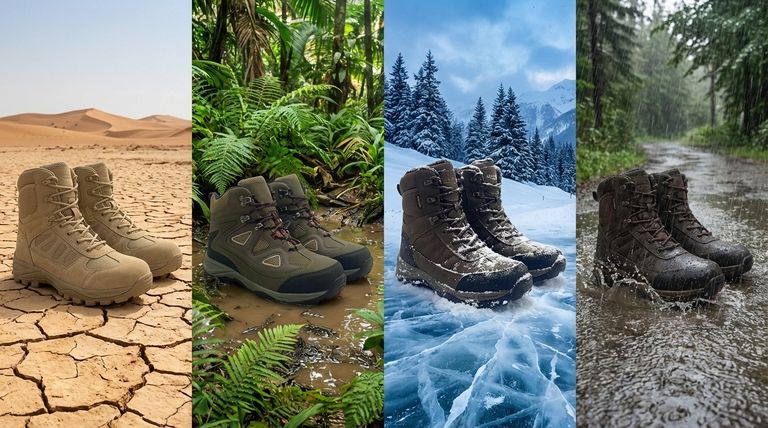
Why Climate-Specific Design Matters
The effectiveness of any tactical footwear hinges on its ability to manage temperature and moisture. A boot that excels in one climate can be a significant liability in another. The core challenge is balancing protection from the external environment with the need to let internal moisture—sweat—escape.
Hot, Arid Climates: Desert Boots
Desert boots prioritize breathability above all else. They are designed for environments where external moisture is low, but internal sweat production is high.
These boots often use lightweight materials like suede or nylon fabric panels. This construction allows heat and water vapor from your feet to escape easily, preventing overheating and blisters.
Their tread is typically designed for traction on sand and rock, and they are often lighter in color to reflect sunlight.
Hot, Humid Climates: Jungle Boots
Jungle boots are built to handle constant wetness, both from the environment and from sweat. Their primary feature is not waterproofing, but rapid drying and drainage.
They famously include drainage vents or ports near the instep. These allow water that enters the boot to be physically pushed out as you walk.
The materials are treated to resist rot and mildew in persistently damp conditions. Keeping feet dry is impossible, so the goal is to prevent the boot from becoming waterlogged and to dry as quickly as possible.
Cold Climates: Insulated Boots
For cold environments, the priority shifts to heat retention. Insulated boots use materials like Thinsulate to trap air, which acts as a barrier against external cold.
The amount of insulation is typically measured in grams (e.g., 200g, 400g). Higher numbers mean more insulation for more extreme cold.
These boots almost always feature a waterproof membrane to keep feet dry from snow and slush, as wet feet lose heat exponentially faster than dry feet. The tread is also specialized to grip on ice and packed snow.
Wet Environments: Waterproof Boots
Waterproof boots are designed for temperate or cool climates where the main challenge is external water like rain, puddles, or streams.
They rely on a waterproof, breathable membrane (like a Gore-Tex bootie) sandwiched between the boot's outer layer and inner lining.
This membrane has pores small enough to block liquid water molecules from entering but large enough to allow smaller water vapor molecules (sweat) to escape, keeping your feet dry from both the inside and out.
Understanding the Trade-offs
Choosing a tactical boot is an exercise in managing compromises. No single boot is perfect for every condition, and the technology designed to solve one problem can create another.
The Breathability vs. Waterproofing Dilemma
This is the most common trade-off. A fully waterproof membrane, while excellent at keeping rain and snow out, will always be less breathable than a non-waterproof design.
In a hot, arid desert, a waterproof boot is a liability. It will trap sweat, leading to moisture buildup, blisters, and overheating. Here, maximum breathability is the only correct choice.
The Insulation vs. Activity Level Conflict
Insulation traps heat, which is essential when you are stationary in the cold. However, during high-exertion activity, that same insulation can cause your feet to sweat profusely.
This trapped sweat can then cool down when you stop moving, making your feet feel even colder and increasing the risk of frostbite. Choosing the right insulation level for your expected activity is crucial.
Making the Right Choice for Your Goal
Your selection must be based on a realistic assessment of your most common operational environment.
- If your primary focus is hot, dry conditions: Prioritize a lightweight, highly breathable boot made of suede and nylon, and actively avoid waterproof membranes.
- If your primary focus is hot, humid, and wet conditions: Choose a jungle boot with drainage vents and quick-drying materials, understanding it will not keep water out but is designed to shed it quickly.
- If your primary focus is cold to freezing weather: Select a boot with a waterproof membrane and an appropriate level of insulation for your activity level.
- If your primary focus is temperate, rainy conditions: A standard waterproof boot with a breathable membrane offers the most versatile protection.
Ultimately, the right boot is the one that correctly manages the specific type of temperature and moisture you will face.
Summary Table:
| Climate Type | Boot Type | Key Features | Primary Goal |
|---|---|---|---|
| Hot & Arid | Desert Boots | Lightweight, breathable materials (suede/nylon) | Maximize airflow, prevent overheating |
| Hot & Humid | Jungle Boots | Drainage vents, quick-drying, rot-resistant | Rapid drying, prevent waterlogging |
| Cold & Freezing | Insulated Boots | Waterproof membrane, Thinsulate insulation | Retain heat, keep feet dry |
| Wet & Rainy | Waterproof Boots | Waterproof breathable membrane (e.g., Gore-Tex) | Block external water, allow vapor escape |
Need Tactical Boots for Your Specific Climate?
As a large-scale manufacturer, 3515 produces a comprehensive range of tactical footwear for distributors, brand owners, and bulk clients. Our production capabilities encompass all types of climate-specific boots—from breathable desert designs to fully insulated cold-weather models.
We ensure every pair is engineered with the right materials and construction to protect your feet and enhance operational effectiveness in any environment.
Let's discuss your specific needs and get you the perfect tactical footwear solution. Contact our team today for a consultation!
Visual Guide
Related Products
- Durable Leather Tactical Boots Wholesale & Custom Manufacturing for Brands
- High-Traction Suede Tactical Boots Wholesale & Custom Manufacturing
- Durable Leather High-Ankle Tactical Boots for Wholesale & Custom Manufacturing
- Wholesale Waterproof Tactical Boots Custom Suede & High-Traction Soles
- Durable Mid-Cut Tactical Boots for Wholesale & Private Label
People Also Ask
- What specialized protections do tactical boots offer? Maximize Endurance with High-Performance Footwear
- What features should law enforcement officers look for in tactical boots? Essential Guide for Safety & Performance
- Importance of Professional Tactical Boots in Loess Gully Regions: Ensure Safety and Precision for Field Monitoring
- What is rucking, and why are tactical boots suitable for it? Discover the Ultimate Footwear for Heavy Loads
- What makes the traction of tactical boots superior? Unlock the Science of Unbeatable Grip















