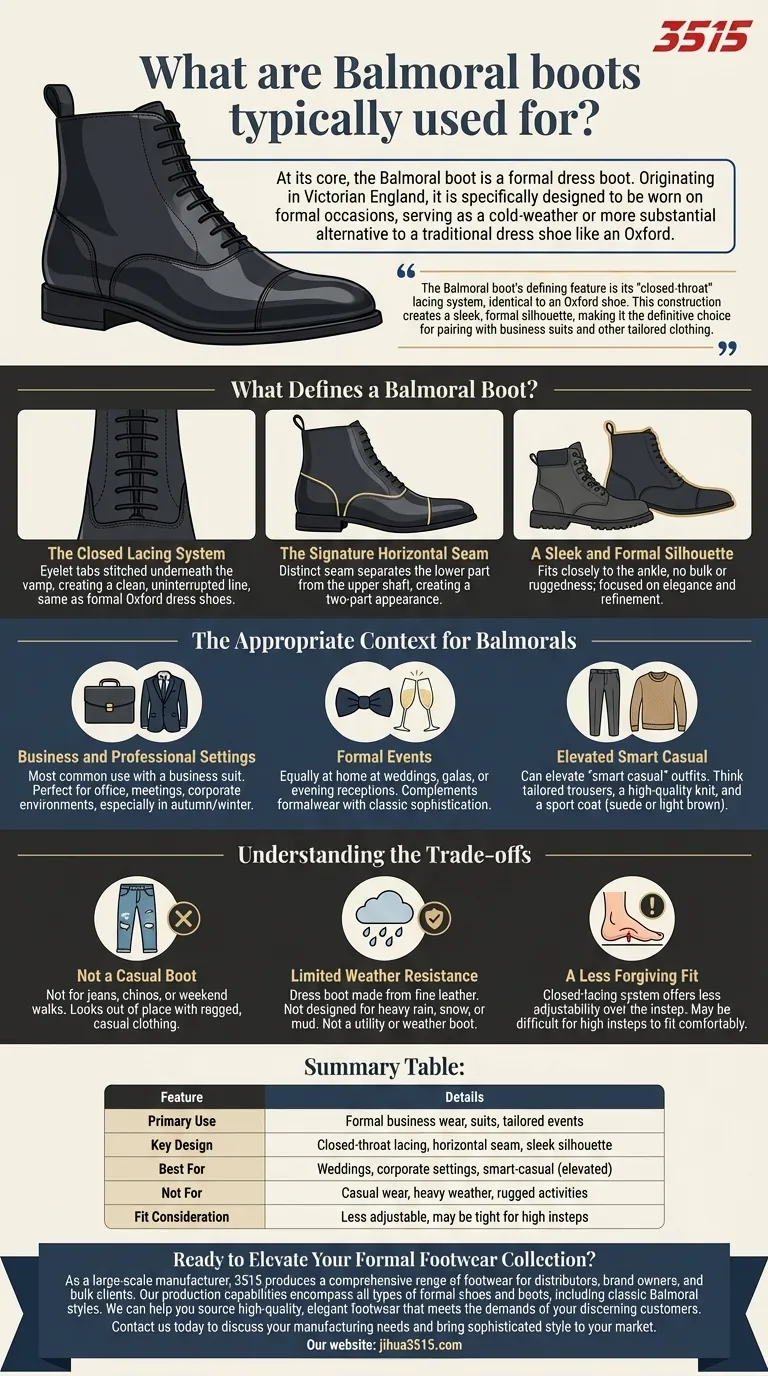
At its core, the Balmoral boot is a formal dress boot. Originating in Victorian England, it is specifically designed to be worn on formal occasions, serving as a cold-weather or more substantial alternative to a traditional dress shoe like an Oxford.
The Balmoral boot's defining feature is its "closed-throat" lacing system, identical to an Oxford shoe. This construction creates a sleek, formal silhouette, making it the definitive choice for pairing with business suits and other tailored clothing.
What Defines a Balmoral Boot?
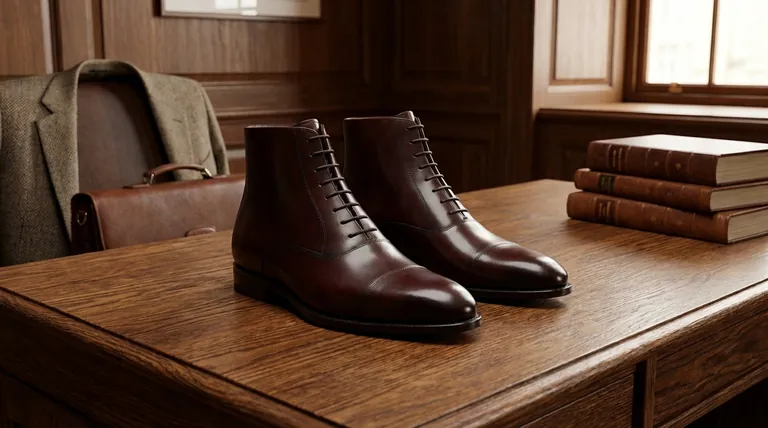
To understand its use, you must first recognize its specific design features. The Balmoral is not a generic term for any lace-up dress boot; it has a precise anatomy that dictates its high level of formality.
The Closed Lacing System
The most critical feature is its closed-throat lacing. The eyelet tabs are stitched underneath the vamp (the front part of the boot), creating a clean, uninterrupted line. This is the same construction found on formal Oxford dress shoes.
The Signature Horizontal Seam
A true Balmoral boot features a distinct horizontal seam that runs from the front to the back of the boot. This seam visually separates the lower part of the boot (the vamp and quarters) from the upper shaft, creating a two-part appearance.
A Sleek and Formal Silhouette
The combination of its closed lacing and sleek construction results in a boot that fits closely to the ankle. There is no bulk or ruggedness; the entire design is focused on elegance and refinement.
The Appropriate Context for Balmorals
The unique, formal construction of the Balmoral boot dictates where it should be worn. It is not an all-purpose boot but a specialized piece of footwear.
Business and Professional Settings
The most common and appropriate use for a Balmoral boot is with a business suit. It functions exactly like an Oxford shoe, making it a perfect choice for the office, important meetings, and corporate environments, especially in autumn and winter.
Formal Events
Balmorals are equally at home at formal events like weddings, galas, or evening receptions. A well-polished pair in black or a deep oxblood complements formalwear and adds a touch of classic, sophisticated style.
Elevated Smart Casual
While its primary domain is formalwear, a Balmoral boot in a material like suede or a lighter brown leather can elevate a "smart casual" outfit. Think tailored trousers, a high-quality knit, and a sport coat.
Understanding the Trade-offs
The Balmoral's greatest strength—its formality—is also the source of its limitations. Understanding these trade-offs is key to wearing it correctly.
Not a Casual Boot
This is not the boot to wear with jeans, chinos, or for a weekend walk. Its sleek design looks out of place with rugged, casual clothing. A different style, like a service boot or work boot, is far better suited for those situations.
Limited Weather Resistance
While it offers more coverage than a shoe, the Balmoral is still a dress boot made from fine leather. It is not designed for heavy rain, snow, or mud. It is not a utility or weather boot.
A Less Forgiving Fit
The closed-lacing system, while elegant, offers less adjustability over the instep compared to boots with an open-lacing system (like Derby boots). Individuals with a very high instep may find them more difficult to fit comfortably.
Making the Right Choice for Your Goal
Deciding if a Balmoral is right for you depends entirely on your wardrobe and needs.
- If your primary focus is formal business wear: The Balmoral is an exceptional and stylish alternative to an Oxford shoe, providing more presence and cold-weather coverage.
- If your primary focus is versatility for casual and smart-casual wear: A different style, such as a chukka or a Derby-style boot, will serve you much better across a wider range of outfits.
- If your primary focus is durability and all-weather use: The Balmoral is entirely unsuitable; you should look for purpose-built work boots or weather-resistant boots.
Ultimately, choosing a Balmoral is a deliberate decision to embrace a higher level of formal elegance.
Summary Table:
| Feature | Details |
|---|---|
| Primary Use | Formal business wear, suits, tailored events |
| Key Design | Closed-throat lacing, horizontal seam, sleek silhouette |
| Best For | Weddings, corporate settings, smart-casual (elevated) |
| Not For | Casual wear, heavy weather, rugged activities |
| Fit Consideration | Less adjustable, may be tight for high insteps |
Ready to Elevate Your Formal Footwear Collection?
As a large-scale manufacturer, 3515 produces a comprehensive range of footwear for distributors, brand owners, and bulk clients. Our production capabilities encompass all types of formal shoes and boots, including classic Balmoral styles. We can help you source high-quality, elegant footwear that meets the demands of your discerning customers.
Contact us today to discuss your manufacturing needs and bring sophisticated style to your market.
Visual Guide
Related Products
- High-Traction Suede Tactical Boots Wholesale & Custom Manufacturing
- Durable Leather High-Ankle Tactical Boots for Wholesale & Custom Manufacturing
- Durable Leather Tactical Boots Wholesale & Custom Manufacturing for Brands
- Durable High-Ankle Tactical Boots Wholesale Manufacturer for Custom & Bulk Orders
- Durable High-Ankle Tactical Boots for Wholesale & Custom Manufacturing
People Also Ask
- Why is sequential analysis utilized to evaluate tactical boots? Master Dynamic Boot Development and Ergonomic Performance
- How does the material of tactical boots affect their performance? Choose the Right Material for Your Mission
- How do tactical boots differ from regular boots? Performance, Durability & Design Explained
- How do military uniforms and tactical boots impact the prediction of thermal risk? Essential Safety Insights
- What are the benefits of integrating FES and sEMG into tactical boots? Safety, Reliability & Field-Ready Performance