Buying cowboy boots online is a gamble, especially for your first pair. While the selection and pricing can be tempting, the unique and complex fit of a cowboy boot is something that cannot be reliably assessed through a screen. For a purchase meant to last years, getting the fit right is paramount, and this is best achieved by trying them on in a physical store.
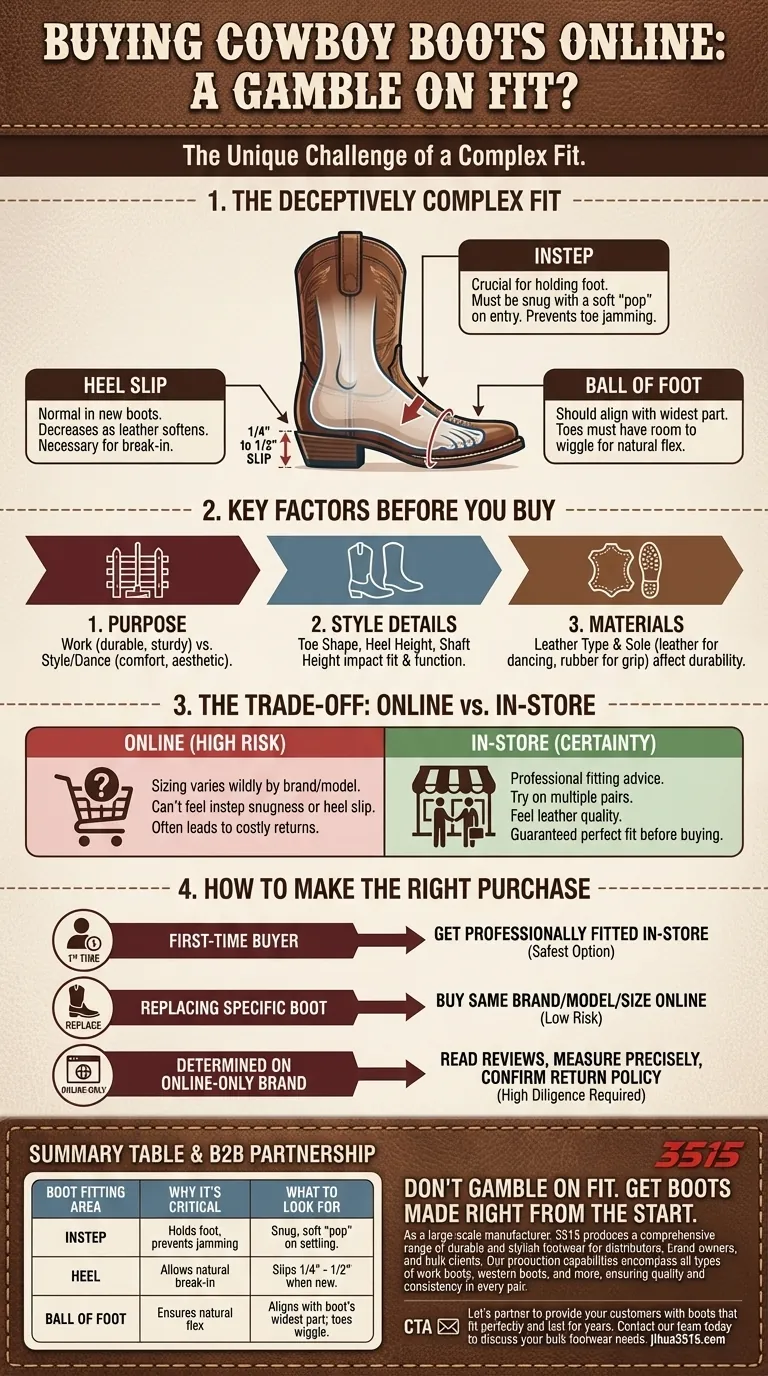
The core challenge is that a boot's fit isn't just about length and width; it's about the volume and shape of the instep, the feel of the heel slip, and the position of the ball of your foot. These critical dimensions are nearly impossible to confirm without physically putting the boot on.
Why Cowboy Boot Fit is Deceptively Complex
Unlike a sneaker or dress shoe, a cowboy boot must fit correctly in several specific areas to provide support and comfort. A poor fit isn't just a minor annoyance; it can make the boots painful and unwearable.
The Critical Role of the Instep
The most important part of a boot's fit is the instep, which is the arched top part of your foot. A proper-fitting boot should be snug and firm over the instep.
This snugness is what holds your foot in place, preventing it from sliding forward and jamming your toes into the front of the boot. When you pull a boot on, you should feel a distinct resistance here, followed by a soft "pop" as your foot settles into the bottom.
Understanding "Heel Slip"
When you first try on a new pair of boots, your heel should slip slightly—about a quarter to a half-inch. This is normal and expected.
As you wear the boots, the leather sole will soften and flex with your foot, causing this initial slip to decrease significantly. If there is no slip at all in a new boot, it is likely too short.
The Ball of Your Foot
The ball of your foot—the widest part—should sit squarely in the widest part of the boot. This ensures your foot can flex naturally as you walk without being constricted. Your toes should have room to wiggle and should not be cramped.
Key Factors to Consider Before You Buy
Before you can even think about size, you must define the boot's purpose. The right boot for working on a ranch is entirely different from one meant for a wedding.
Start with Your Purpose
Consider what you'll be doing most often. Are these for working cattle, where durability and a sturdy heel are key? Or are they for dancing and presenting, where comfort and style take precedence? Your primary activity dictates every other choice.
Toe, Heel, and Shaft Style
The toe style (e.g., round, square, pointed) affects both the look and the roominess for your toes. The heel height impacts your posture and is designed for different tasks, from walking to staying secure in a stirrup. The shaft height is largely a matter of personal preference and style.
Leather and Sole Materials
The type of leather—from standard cowhide to exotics like caiman or ostrich—impacts the boot's durability, flexibility, and appearance. Likewise, the sole is crucial; traditional leather soles are excellent for dancing, while rubber soles offer better traction and water resistance for work or daily wear.
The Trade-Off: Online Convenience vs. In-Store Certainty
Choosing where to buy involves balancing selection and price against the high risk of a poor fit.
The Clear Advantage of an In-Person Fitting
Visiting a store allows you to get professional fitting advice. An experienced salesperson can assess your foot, recommend brands that suit your foot shape, and ensure you get the correct size. You can feel the leather quality and try on multiple pairs in minutes, guaranteeing a perfect fit before you pay.
The High Risk of an Online Purchase
The primary risk of buying online is getting the fit wrong. Sizing varies significantly between brands, and even between different models from the same brand. What you can't feel online is the instep tightness or the proper amount of heel slip, leading to a frustrating and often costly cycle of returns.
How to Make the Right Purchase
Your experience level and priorities should guide your purchasing decision.
- If you are a first-time buyer: Your best and safest option is to get professionally fitted at a reputable Western wear store.
- If you are replacing a specific boot you already own: Buying the same brand, model, and size online is a relatively low-risk and convenient choice.
- If you are determined to buy from an online-only brand: Read every review you can find regarding fit, measure your foot precisely according to their guide, and confirm they have a free and simple return policy.
Ultimately, a well-chosen pair of cowboy boots is a long-term investment in your comfort and style that begins with a perfect fit.
Summary Table:
| Boot Fitting Area | Why It's Critical | What to Look For |
|---|---|---|
| Instep | Holds your foot in place, prevents toe jamming. | Should feel snug with a soft "pop" when your foot settles. |
| Heel | Allows for natural break-in. | Should slip about 1/4" to 1/2" when new. |
| Ball of Foot | Ensures natural flex and comfort. | Should align with the boot's widest part; toes should wiggle freely. |
Don't gamble on fit. Get boots made right from the start.
As a large-scale manufacturer, 3515 produces a comprehensive range of durable and stylish footwear for distributors, brand owners, and bulk clients. Our production capabilities encompass all types of work boots, western boots, and more, ensuring quality and consistency in every pair.
Let's partner to provide your customers with boots that fit perfectly and last for years.
Contact our team today to discuss your bulk footwear needs.
Visual Guide
Related Products
- Wholesale High-Traction Camo Boots - Custom Manufacturer for Brands
- Durable Spiked Camouflage Boots Wholesale & Factory Production
- High-Traction Suede Tactical Boots Wholesale & Custom Manufacturing
- Wholesale Lightweight Tactical Boots Custom Manufacturer for Desert & Combat Use
- Durable Leather Tactical Boots Wholesale & Custom Manufacturing for Brands
People Also Ask
- What are the key features of the new line of camo boots? Built for Extreme Cold & Rugged Terrain
- Are camo boots necessary for hunting success? Prioritize Performance Over Pattern
- What is the technical logic behind using closed-eye testing for tactical boots? Unlocking Peak Footwear Stability
- How does the Rank Score Test identify the primary causes of premature failure in tactical and work boots? Key Insights
- What shoes to wear for a security job? Durable, Protective Footwear for Long Shifts