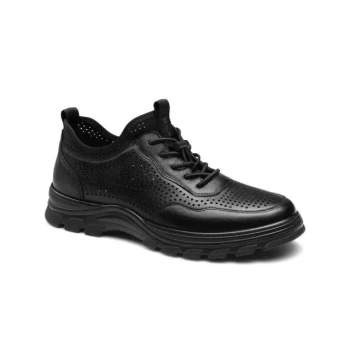
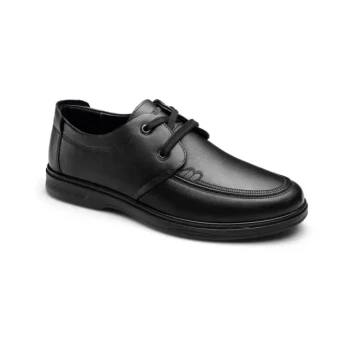
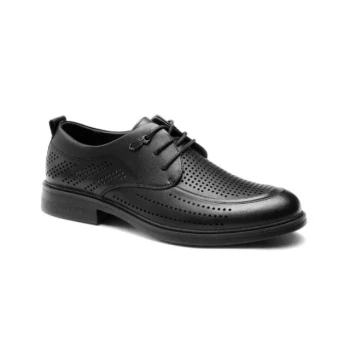
The ideal fit for a quality dress shoe is snug but not constricting. It should feel secure throughout the midfoot and heel while allowing your toes enough room to move slightly. The key is to find a balance between a firm hold that prevents your foot from sliding and a comfortable space that avoids painful pressure points.
Finding the right fit is less about the size number and more about understanding how a well-made shoe is designed to conform to your foot over time. The initial snugness of quality leather is a feature, not a flaw, as it allows the shoe to mold into a truly custom fit.
Deconstructing the Perfect Fit: Key Checkpoints
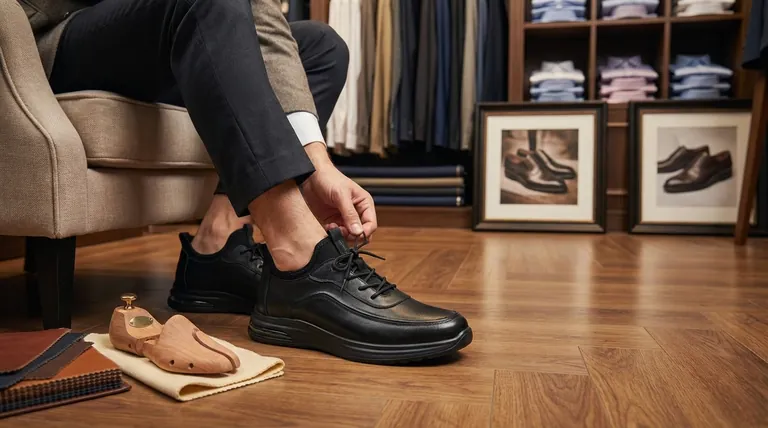
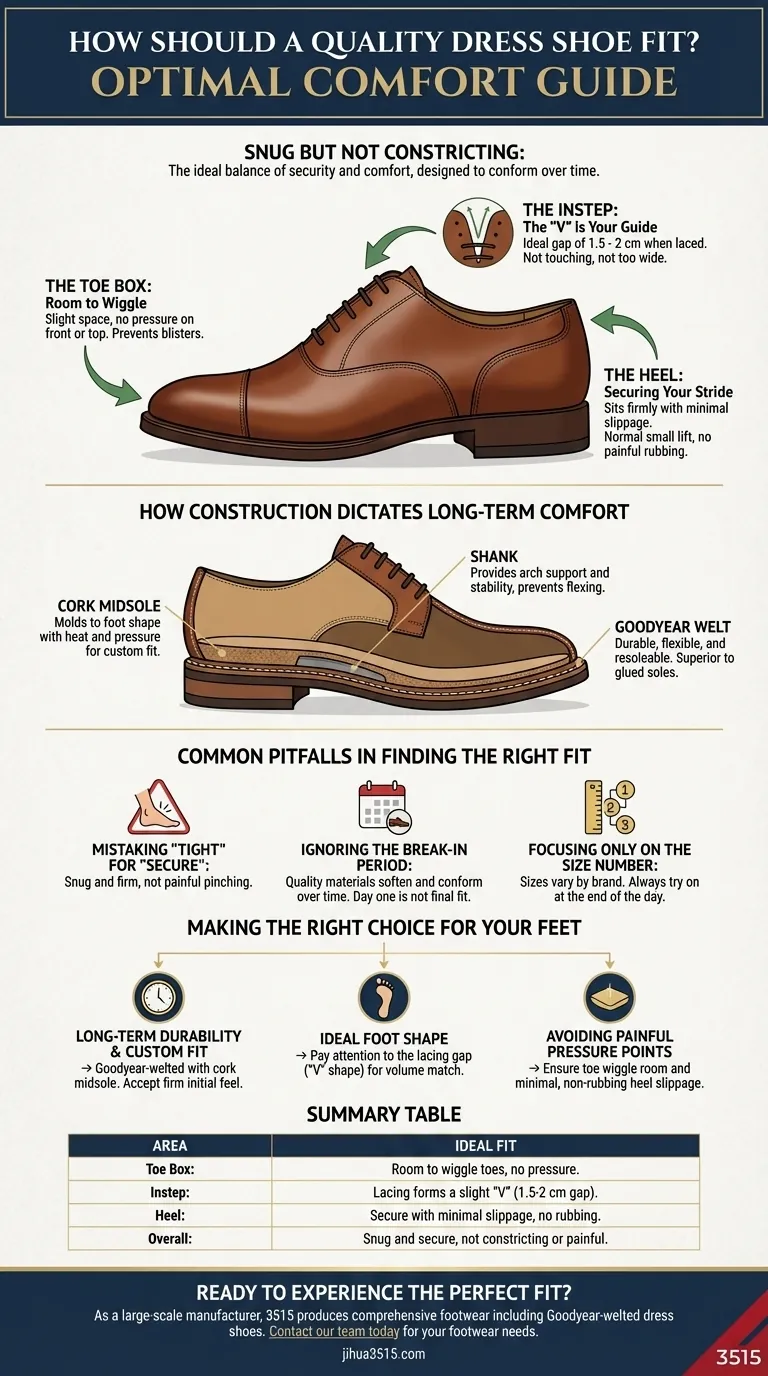
A proper fit isn't just about length. It's a three-dimensional match between the shoe's structure, known as the "last," and the unique shape of your foot. Pay close attention to these three critical areas.
The Toe Box: Room to Wiggle
Your toes should not be pressed against the end or top of the shoe.
There should be a slight amount of space, allowing you to move your toes freely without them feeling cramped. This prevents blisters and discomfort during a long day of wear.
The Instep: The "V" is Your Guide
When the shoe is laced, look at the gap between the two sides (the facings).
An ideal fit is indicated by a slightly open "V" shape at the top, with the facings about 1.5 to 2 cm apart. If the facings touch, the shoe is too large for your instep; if they are extremely far apart, it's too tight.
The Heel: Securing Your Stride
Your heel should sit firmly in the back of the shoe with minimal slippage as you walk.
A small amount of lift is normal in a new, stiff leather shoe, but it should not feel loose or rub uncomfortably. A well-constructed heel counter will cup your heel securely.
How Construction Dictates Long-Term Comfort
The superior fit and comfort of a quality dress shoe are direct results of its construction. Unlike cheaply made footwear, these shoes are designed to support your foot and adapt to it over time.
The Role of the Midsole
Between the insole you feel and the outsole that hits the ground, many quality shoes use a cork midsole.
This layer provides excellent cushioning and, with heat and pressure from wear, gradually molds to the exact shape of your foot, creating a personalized footbed.
Support From the Shank
A small, rigid piece of material called a shank is often embedded in the midsole under the arch.
This component prevents the shoe from flexing in the middle, providing crucial arch support and stability that is essential for all-day comfort.
Goodyear Welt vs. Glued Soles
High-quality shoes often use a Goodyear welt or Blake stitch construction.
These methods stitch the sole to the upper, resulting in a durable, flexible, and resoleable shoe. This robust construction provides a stable platform for your foot, unlike cheaper glued soles which offer little support and cannot be repaired.
Common Pitfalls in Finding the Right Fit
Achieving the perfect fit requires navigating a few common misunderstandings, especially when investing in a high-quality pair of shoes designed to last for years.
Mistaking "Tight" for "Secure"
A new leather shoe should feel snug and firm. This is different from a painful tightness that pinches or cuts off circulation.
The shoe should hold your foot securely, but you shouldn't feel any sharp or specific points of pain.
Ignoring the Break-in Period
Quality materials like full-grain leather and cork need time to soften and conform to your foot.
The fit on day one is not the final fit. Expect a brief break-in period where the shoe transforms from a generic shape into one that is uniquely yours.
Focusing Only on the Size Number
Shoe sizes are not standardized across brands or even across different models from the same brand.
Always try shoes on, preferably at the end of the day when your feet are slightly swollen, to get the most accurate assessment of the fit.
Making the Right Choice for Your Feet
Your ideal shoe depends on balancing initial feel with long-term performance. Use your primary goal to guide your decision.
- If your primary focus is long-term durability and a custom fit: Choose a Goodyear-welted shoe with a cork midsole and accept a firm initial feel that will require a break-in period.
- If your primary focus is discovering your ideal foot shape: Pay the most attention to the lacing gap, as the "V" shape is the clearest indicator of how well the shoe's volume matches your instep.
- If your primary focus is avoiding painful pressure points: Ensure there is slight wiggle room in the toe box and that any slippage in the heel is minimal and does not cause rubbing.
Ultimately, investing in a properly fitting, well-constructed shoe is an investment in your own comfort and confidence.
Summary Table:
| Area | Ideal Fit |
|---|---|
| Toe Box | Room to wiggle toes, no pressure on the front or top. |
| Instep | Lacing forms a slight "V" (1.5-2 cm gap). |
| Heel | Secure with minimal slippage; no painful rubbing. |
| Overall | Snug and secure, not constricting or painful. |
Ready to experience the perfect fit and superior comfort of a quality dress shoe?
As a large-scale manufacturer, 3515 produces a comprehensive range of footwear for distributors, brand owners, and bulk clients. Our production capabilities encompass all types of shoes and boots, including Goodyear-welted dress shoes designed for long-term comfort and durability.
Let us help you provide your customers with the ideal fit. Contact our team today to discuss your footwear needs and explore our extensive catalog.
Visual Guide
Related Products
- Wholesale Comfort Dress Shoes with Dial Closure for Custom Manufacturing
- Classic Leather Derby Dress Shoes Wholesale & Custom Manufacturing
- Wholesale Leather Derby Dress Shoes Custom Manufacturer for Brands
- Wholesale Patent Oxford Dress Shoes | Custom & Bulk Manufacturing
- Wholesale Perforated Comfort Dress Shoes | Custom Derby Shoe Manufacturer
People Also Ask
- How do comfort dress shoes differ from traditional dress shoes? Discover the Ergonomic Advantage
- Which dress shoe styles are suitable for wearing with jeans? A Guide to Smart-Casual Style
- What features make dress shoes suitable for standing all day? Achieve All-Day Comfort with Anatomical Design
- What are the benefits of resoling dress shoes? Extend Life & Boost Comfort
- What recent trends have influenced traditional dress shoe designs? The Shift to Modern Comfort