
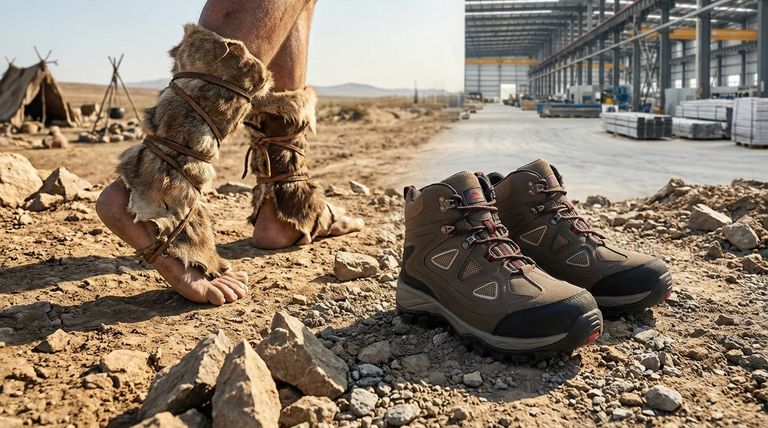
Humans have been using footwear for a remarkably long time. The earliest forms of foot protection likely emerged as far back as 40,000 years ago, during the Middle Paleolithic period. These primitive shoes were not complex constructions but simple, effective coverings made from readily available materials like animal hides and fur.
The invention of footwear was not a matter of comfort or fashion; it was a critical survival technology. This innovation enabled early humans to protect themselves from environmental hazards, traverse harsh new terrains, and expand across the globe.
The Evolutionary Driver: Why Footwear Became Essential
The need for foot protection arose from fundamental shifts in human anatomy and behavior. As early humans became more mobile and ventured out of familiar environments, their bare feet were no longer sufficient.
A New Level of Mobility
Early humans were long-distance travelers. Covering the feet reduced the risk of cuts, bruises, and infections from sharp rocks, thorns, and rough ground, which could otherwise be debilitating or fatal for a nomadic hunter-gatherer.
Expanding into Harsher Climates
The 40,000-year estimate coincides with periods of human migration into colder, more challenging climates. Insulated footwear, likely made from fur-lined hides, was essential for preventing frostbite and conserving body heat in icy or snowy conditions.
Protection from Environmental Hazards
Beyond just terrain, early footwear offered crucial protection from a range of threats. This included shielding feet from the extreme heat of sun-baked earth, the cold of frozen ground, and the bites of insects or small animals.
The First Footwear: Form Follows Function
Because organic materials like leather and fur decay over time, direct archaeological evidence of the very first shoes is incredibly rare. Our understanding is pieced together from indirect evidence and logical inference about the materials available.
Simple and Effective Materials
The most logical and accessible materials for early humans were the byproducts of hunting. Animal hides offered durability and toughness for the sole, while fur provided unmatched insulation, making them the perfect combination for primitive footwear.
A Basic "Foot Bag" Design
The earliest footwear was likely a simple wrap or bag-like covering. Imagine a single piece of leather wrapped around the foot and secured with a leather thong or cordage. This design was easy to produce and highly effective at providing all-around protection and warmth.
The Archaeological Challenge
The lack of preserved 40,000-year-old shoes forces scientists to look for other clues. Researchers have studied the anatomy of ancient human skeletons, noting changes in toe bone density that suggest a life spent wearing supportive shoes rather than walking barefoot.
Understanding the Limitations of the Evidence
While the 40,000-year figure is a widely discussed estimate, it's important to recognize the uncertainty involved. This is not a failure of science but a reflection of the challenges of studying the deep past.
The Problem of Preservation
Organic materials like hide, fur, and plant fibers rarely survive for tens of thousands of years. The oldest known preserved shoe, the Areni-1 shoe found in a cave in Armenia, is only about 5,500 years old. Anything older has long since disintegrated.
Reliance on Indirect Clues
Because physical shoes are absent, the evidence is circumstantial. It includes the development of more sophisticated bone and stone tools used for scraping hides, as well as the anatomical foot changes mentioned earlier. These clues are powerful but not definitive proof.
What This Tells Us About Human Ingenuity
The story of footwear is a story of human adaptation and innovation. By understanding its origins, we can better appreciate the forces that have shaped our history.
- If your primary focus is on human evolution: View footwear as a key technological adaptation, on par with clothing or controlled fire, that was essential for our species' survival and global expansion.
- If your primary focus is on archaeology: Recognize that the absence of direct evidence is not the absence of existence; our understanding is built by interpreting indirect clues from bones and tools.
- If your primary focus is on design: Appreciate that the core principles of footwear—protection, durability, and insulation—have remained constant for millennia, driven by fundamental human needs.
Ultimately, the simple act of wrapping our feet was a monumental step forward in the human journey.
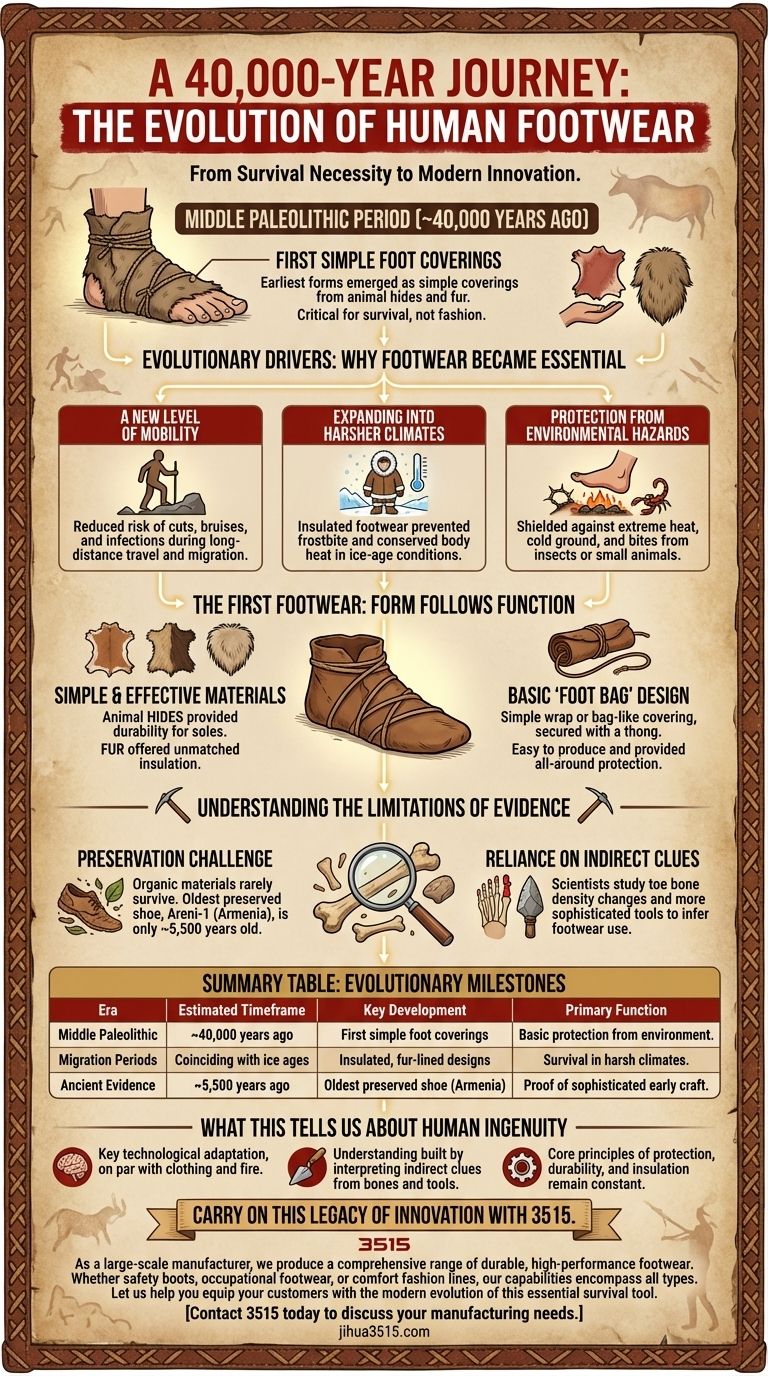
Summary Table:
| Era | Estimated Timeframe | Key Development | Primary Function |
|---|---|---|---|
| Middle Paleolithic | ~40,000 years ago | First simple foot coverings | Basic protection from environment |
| Migration Periods | Coinciding with ice ages | Insulated, fur-lined designs | Survival in harsh climates |
| Ancient Evidence | ~5,500 years ago | Oldest preserved shoe (Armenia) | Proof of sophisticated early craft |
Carry on this legacy of innovation with 3515. As a large-scale manufacturer, we produce a comprehensive range of durable, high-performance footwear for distributors, brand owners, and bulk clients. Whether you need safety boots, specialized occupational footwear, or fashion lines built for comfort, our production capabilities encompass all types of shoes and boots. Let us help you equip your customers with the modern evolution of this essential survival tool. Contact 3515 today to discuss your manufacturing needs.
Visual Guide
Related Products
- Lightweight Breathable Training Shoes for Wholesale & Custom OEM Manufacturing
- Wholesale Durable Camouflage Canvas Shoes with High-Traction Cleated Rubber Sole
- Wholesale Breathable Training Shoes Custom Athletic Footwear Manufacturer
- Durable Leather High-Ankle Tactical Boots for Wholesale & Custom Manufacturing
- Wholesale Durable Safety Boots Manufacturer Customizable Steel Toe Work Boots
People Also Ask
- Why are lightweight training shoes often preferred over professional hiking boots in urban walking? Maximize City Comfort
- What is the primary role of specialized training or orthopedic shoes? Enhance Safety in Elderly Balance Training
- Why are professional-grade training shoes essential for physical therapy? Ensure Patient Safety and Gait Stability
- Why are the slip-resistance and stability performance of training shoes critical in gait analysis? Ensure Data Accuracy
- Why is the use of flat-soled or professional training shoes essential for WBV? Maximize Vibration Energy Transfer

















