
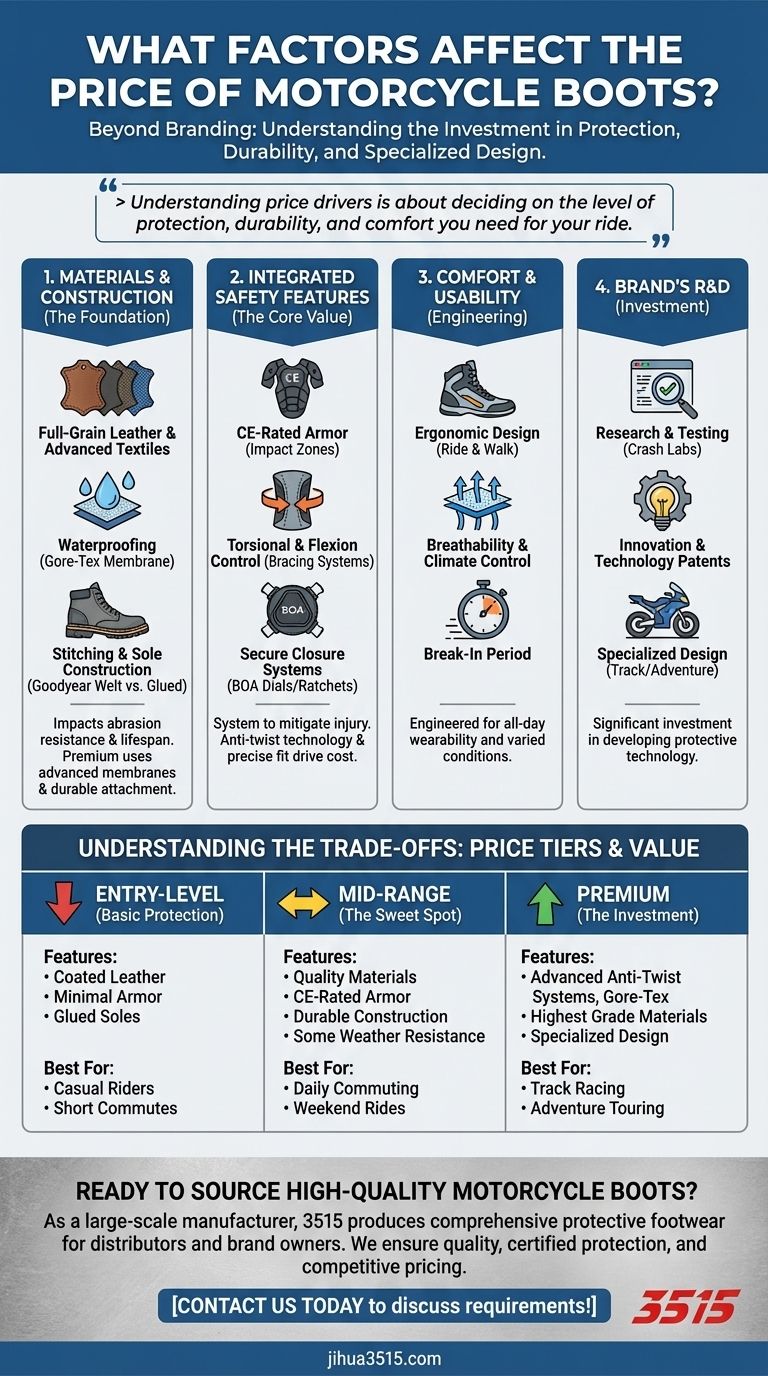
The price of a motorcycle boot is determined by four primary factors: the quality and type of materials used, the level of integrated safety features, the engineering for comfort and usability, and the brand's investment in research and development. More expensive boots are not simply a matter of branding; they represent a significant increase in protective technology, durability, and specialized design.
Understanding the factors that drive a boot's price is about more than just your budget. It's about consciously deciding on the level of protection, durability, and comfort you need for the way you ride.

The Foundation: Materials and Construction
The materials and how they are assembled form the literal foundation of the boot, directly impacting its abrasion resistance, weather protection, and lifespan.
Leather vs. Advanced Textiles
Full-grain leather is the traditional choice, offering excellent abrasion resistance and molding to your foot over time. Modern boots often use advanced textiles like Cordura or proprietary microfibers, which can offer comparable protection while being lighter, more flexible, and requiring no break-in period.
The Role of Waterproofing
A truly waterproof boot requires more than a simple coating. Premium boots incorporate a dedicated waterproof and breathable membrane, such as Gore-Tex, laminated between the boot's inner and outer layers. This complex construction adds significant cost but provides reliable all-weather performance.
Stitching and Sole Construction
High-quality boots feature double or triple stitching in critical stress areas to prevent seams from bursting during an impact. The sole is also a key indicator of quality; more expensive boots use durable, oil-resistant compounds and are often attached with a rugged Goodyear welt or molded construction, while cheaper boots rely on simple glue that can fail over time.
The Core Value: Integrated Safety Features
This is where the biggest price differences emerge. Safety isn't just about a thick piece of leather; it's a system of components working together to mitigate injury.
Armor and Reinforcement
At a minimum, a good boot has reinforced toe and heel boxes. As price increases, you gain CE-rated armor, which is certified to absorb and distribute impact forces. This armor is strategically placed over the ankles, shins, and heels, with higher-end boots using more advanced, energy-absorbing materials.
Torsional and Flexion Control
The most significant safety feature in premium boots is an external or internal bracing system. These "exoskeletons" are designed to allow for normal forward and backward flex (for shifting and braking) while preventing the ankle from twisting, hyper-extending, or bending sideways in a crash. This technology is a direct result of extensive R&D and is a primary driver of cost.
Secure Closure Systems
Basic boots use simple laces and zippers. Mid-range and premium boots utilize more secure and adjustable systems, such as ratcheting buckles or BOA dial systems. These provide a more precise fit, ensuring the boot and its armor stay in the correct position during an accident.
Understanding the Trade-offs
Choosing a boot means balancing cost against specific protective features. Understanding what is sacrificed at lower price points is crucial for making an informed decision.
The Entry-Level Compromise
Boots in the lower price tier provide a fundamental level of protection, far superior to standard shoes. However, they typically use less durable materials (like coated leather instead of full-grain), have minimal armor, and lack any advanced anti-twist systems. Their soles are usually glued on, making them less durable.
The Mid-Range Sweet Spot
This category offers the best balance of price and protection for most riders. You can expect to find quality materials, comprehensive CE-rated armor in key impact zones, durable sole construction, and often some form of weather resistance. They provide a major leap in safety over entry-level options.
The Premium Investment
Top-tier boots are built for the most demanding situations, like track racing or adventure touring. The high cost is justified by the inclusion of advanced torsional control systems, the highest grade of materials, premium waterproof membranes like Gore-Tex, and designs that are highly specialized for a specific riding discipline.
Making the Right Choice for Your Riding
Your decision should be guided by your riding style, frequency, and the conditions you expect to face.
- If your primary focus is daily commuting or casual weekend rides: A mid-range boot with certified ankle armor and durable construction offers the best value and a necessary level of protection.
- If your primary focus is long-distance touring or riding in all weather: Prioritize boots with a proven waterproof membrane and features built for all-day walking and riding comfort.
- If your primary focus is performance track or canyon riding: Do not compromise. Invest in a premium boot with advanced torsional (anti-twist) protection and comprehensive CE-rated armor.
Ultimately, choosing the right motorcycle boot is a direct investment in your own safety and your ability to confidently enjoy every ride.
Summary Table:
| Price Tier | Key Features | Best For |
|---|---|---|
| Entry-Level | Basic protection, coated leather, minimal armor | Casual riders, short commutes |
| Mid-Range | Quality materials, CE-rated armor, durable soles | Daily commuting, weekend rides |
| Premium | Advanced anti-twist systems, Gore-Tex, specialized design | Track racing, adventure touring |
Ready to Source High-Quality Motorcycle Boots?
As a large-scale manufacturer, 3515 produces a comprehensive range of motorcycle boots for distributors, brand owners, and bulk clients. Our production capabilities encompass all types of protective footwear, from durable commuter boots to advanced racing models with integrated safety features. We ensure quality materials, certified protection, and competitive pricing to meet your market's demands.
Contact us today to discuss your specific requirements and get a quote!
Visual Guide
Related Products
- Wholesale Tactical Boots High-Traction & Reflective for Bulk & Brand Orders
- High Performance Fire-Retardant Waterproof Safety Boots
- Durable Goodyear Welt Leather Work Boots for Wholesale & Private Label
- Wholesale High-Traction Camo Boots - Custom Manufacturer for Brands
- Wholesale Waterproof Tactical Boots Custom Suede & High-Traction Soles
People Also Ask
- How do tactical boots protect against injuries? Discover the Integrated Safety System
- How do manufacturing processes for electronic textiles balance durability with wearing comfort? Innovation in Footwear
- How does the extraction of sociodemographic factors via NLP influence the design of tactical boots and work shoes?
- What are the consequences of wearing ill-fitting tactical boots? Avoid Injury and Boost Performance
- What types of boots are used by Bravo in SEAL Team? Salomon & Merrell for Elite Performance



















