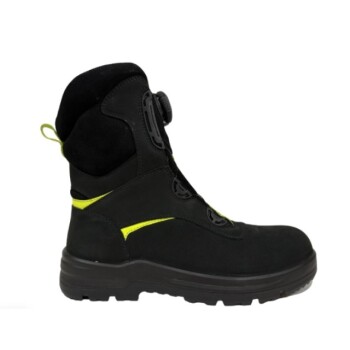
The structural safety of high-top footwear is derived primarily from the physical extension of the material above the ankle joint. This design acts as a mechanical constraint, providing lateral support that physically limits the range of motion during high-stress activities.
The high-top structure serves as a "hardware-based" preventative method, significantly reducing the probability of ankle inversion—the rolling motion that causes sprains—during jumping, landing, and sharp cuts.
The Mechanics of Ankle Stabilization
Limiting Joint Inversion
The primary safety mechanism of high-top basketball shoes and tactical boots is the reduction of ankle inversion. By encasing the ankle, the footwear resists the outward rolling force that typically leads to ligament damage.
Support During Dynamic Movement
Safety is most critical during dynamic actions such as frequent jumping, landing, or rapid lateral changes in direction. The high-top structure reinforces the joint against the high-impact forces generated during these maneuvers.
Hardware-Based Constraint
Unlike low-top shoes which rely solely on muscular control, high-tops provide a physical barrier. This acts similarly to an ankle brace, offering external structural integrity to the user's foot and lower leg assembly.
The Critical Role of Fit
The Necessity of a Snug Fit
For the structural safety features to function correctly, the boot must fit snugly without being restrictive. If the footwear is too loose, the foot will slide inside, negating the stability provided by the high-top collar.
Maintaining Stability and Arch Support
Safety extends beyond the ankle collar; proper arch support and cushioning are essential for overall stability. These features ensure the foot remains aligned, allowing the high-top structure to do its job effectively.
Understanding the Trade-offs
Balancing Constraint and Circulation
While a secure fit is vital for safety, there is a risk of overtightening the footwear. Boots or shoes that are too tight can restrict circulation and cause discomfort, which distracts the user and can lead to long-term foot issues.
The Timing of Fit Assessment
A common pitfall is sizing footwear when the foot is at its smallest. Feet tend to swell throughout the day, meaning a boot that fits perfectly in the morning may become dangerously tight by evening.
Making the Right Choice for Your Safety
To maximize the protective benefits of high-top footwear, you must prioritize both the structural design and the specific fit conditions.
- If your primary focus is injury prevention: Prioritize high-top models with a rigid upper structure that physically limits lateral ankle movement during jumps and cuts.
- If your primary focus is long-duration comfort: Ensure you try on boots at the end of the day when your feet are slightly swollen to guarantee a fit that remains safe yet non-restrictive over time.
Select the footwear that offers the firmest mechanical support without compromising your circulation or natural foot alignment.
Summary Table:
| Safety Feature | Functional Mechanism | User Benefit |
|---|---|---|
| High-Top Collar | Physical lateral constraint | Prevents ankle inversion and rolling |
| Hardware Support | External structural barrier | Reduces stress on ligaments during cuts |
| Snug Fit Design | Internal foot alignment | Minimizes sliding and improves stability |
| Impact Arch Support | Force distribution | Maintains alignment during heavy landings |
Partner with 3515 for Professional-Grade Protective Footwear
As a premier large-scale manufacturer serving global distributors and brand owners, 3515 leverages decades of engineering expertise to deliver superior safety across all footwear categories. Our high-top tactical boots and safety shoes are designed with the precise mechanical constraints required to protect users in high-stress environments.
Whether you need robust Safety Shoes, tactical boots, or high-performance athletic sneakers, we offer comprehensive production capabilities to meet your bulk requirements. Contact us today to discuss your wholesale needs and discover how our flagship series can add value to your brand portfolio.
References
- J.P. Sharma, Parveen. A Scenario of Sports Facilities & Their Role in Preventing Injuries in Sports. DOI: 10.55948/ijered.2016.4201
This article is also based on technical information from 3515 Knowledge Base .
Related Products
- High-Traction Suede Tactical Boots Wholesale & Custom Manufacturing
- Durable Leather High-Ankle Tactical Boots for Wholesale & Custom Manufacturing
- Durable High-Ankle Tactical Boots Wholesale Manufacturer for Custom & Bulk Orders
- Durable High-Ankle Tactical Boots for Wholesale & Custom Manufacturing
- Wholesale Tactical Boots High-Traction & Reflective for Bulk & Brand Orders
People Also Ask
- Why is sequential analysis utilized to evaluate tactical boots? Master Dynamic Boot Development and Ergonomic Performance
- How does the material of tactical boots affect their performance? Choose the Right Material for Your Mission
- How do tactical boots differ from regular boots? Performance, Durability & Design Explained
- How do military uniforms and tactical boots impact the prediction of thermal risk? Essential Safety Insights
- What are the benefits of integrating FES and sEMG into tactical boots? Safety, Reliability & Field-Ready Performance