At its core, a wingtip is not separate from a brogue; it is a specific, and perhaps the most recognizable, style of brogue. The key difference lies in its distinctive toecap, which is shaped like a "W" or an "M" and extends along the sides of the shoe, resembling wings.
The term "brogue" refers to the decorative perforations on a shoe, while "wingtip" describes a particular shape of the shoe's toecap. Therefore, a wingtip is a type of full brogue, distinguished from other brogues (like semi-brogues or quarter-brogues) by the unique design of its toe.
First, What Exactly is a "Brogue"?
To understand the wingtip's place, you must first understand the concept of broguing. It's a detail with a surprisingly practical history.
The Origins of Broguing
The term broguing refers to the decorative perforations (small holes) punched into the leather overlays of a dress shoe.
These holes were originally functional, designed centuries ago in the wet terrain of Scotland and Ireland to allow water to drain from the shoes.
From Function to Fashion
Over time, as shoes became more refined, this functional feature was retained for its purely decorative, stylistic appeal.
The fundamental principle to remember is this: the more broguing a shoe has, the less formal it is considered. The perforations add visual texture and a sense of rugged heritage, moving it away from the sleekness of a plain dress shoe.
The Spectrum of Brogue Styles
The differences between brogue styles are defined by the amount and placement of these perforations. The wingtip sits at the more decorated, and thus more casual, end of this spectrum.
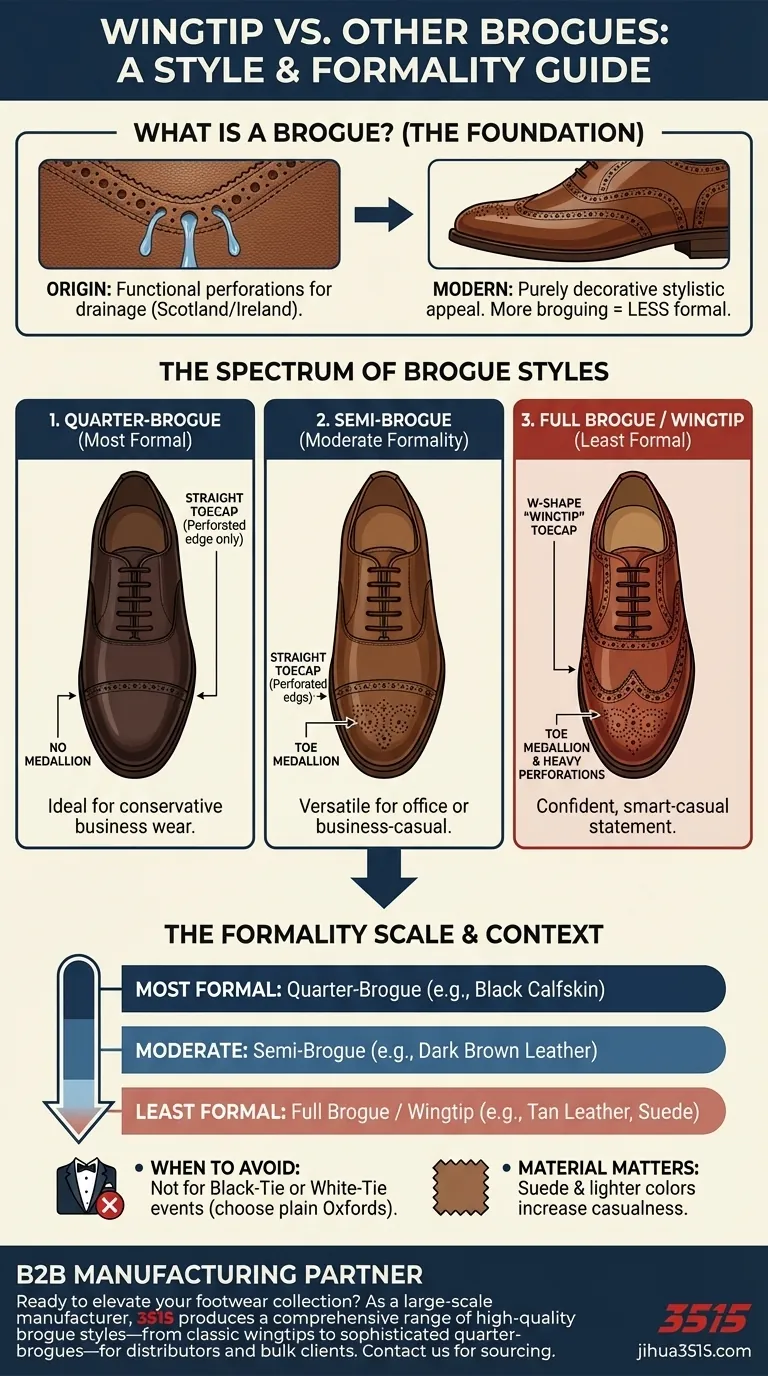
The Full Brogue (The Wingtip)
This is the style most people picture when they hear "brogue." It is defined by its pointed toecap with extensions that run along the sides of the shoe.
Viewed from above, this toecap forms a distinctive 'W' or 'M' shape, which gives the shoe its "wingtip" name. A full brogue is heavily perforated along its seams and typically features a decorative pattern on the toe, known as a medallion.
The Semi-Brogue (or Half-Brogue)
The semi-brogue is more restrained and, consequently, more formal than a wingtip.
It features a straight-line toecap (not a 'W' shape) but is still decorated with broguing along the cap's edge and a medallion on the toe. It offers a balance between decoration and formality.
The Quarter-Brogue
This is the simplest and most formal style of brogue.
Like the semi-brogue, it has a straight toecap. However, it only features perforations along the edge of the cap, with no medallion on the toe itself. This makes it the most suitable brogue for conservative business environments.
Understanding the Trade-offs: Formality and Versatility
Choosing the right brogue depends entirely on the context and the level of formality you need to achieve.
The Formality Scale
You can easily rank brogues from most to least formal:
- Quarter-Brogue (Most formal)
- Semi-Brogue
- Full Brogue / Wingtip (Least formal)
Even the most formal quarter-brogue is considered less formal than a plain-toe Oxford, which has no perforations at all.
Material and Color Matter
The material dramatically impacts the shoe's formality. A black calfskin quarter-brogue is a business staple, while a brown suede wingtip is decidedly casual.
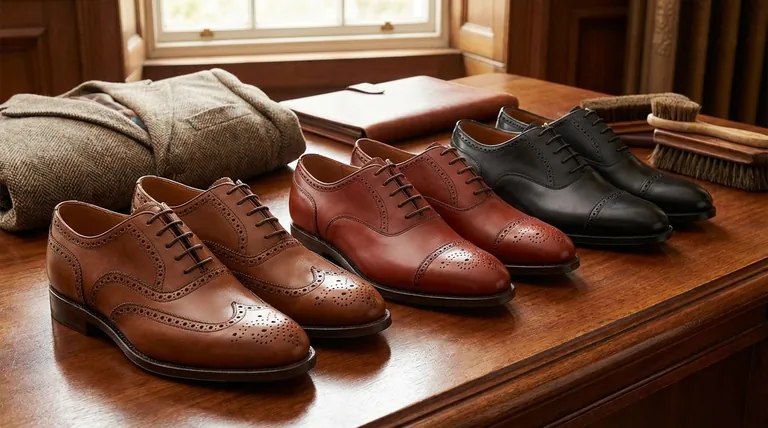
Brown wingtips, for example, have a classic association with more relaxed country wear, such as tweed jackets.
When to Avoid Brogues
Because of their decorative nature, brogues are generally not appropriate for the most formal dress codes, such as black-tie or white-tie events. For these occasions, a simple, unadorned shoe like a patent leather Oxford is required.
Making the Right Choice for Your Goal
Selecting the right style is about matching the shoe's character to the occasion.
- If your primary focus is conservative business wear: The Quarter-Brogue is your most reliable choice, offering a touch of detail without sacrificing formality.
- If your primary focus is a versatile business-casual staple: The Semi-Brogue provides the perfect balance, easily dressing up for the office or down for the weekend.
- If your primary focus is a confident, smart-casual statement: The Wingtip is the ideal option, bringing a bold and classic pattern to your look, especially in brown leather or suede.
Understanding these distinctions allows you to move beyond simply wearing shoes to strategically building a cohesive and appropriate wardrobe.
Summary Table:
| Brogue Style | Toecap Shape | Key Features | Formality Level |
|---|---|---|---|
| Full Brogue (Wingtip) | W or M shape | Perforations along seams, toe medallion | Least Formal (Casual/Smart-Casual) |
| Semi-Brogue (Half-Brogue) | Straight line | Perforations along cap edge, toe medallion | Moderate (Business-Casual) |
| Quarter-Brogue | Straight line | Perforations along cap edge only, no medallion | Most Formal (Conservative Business) |
Ready to elevate your footwear collection? As a large-scale manufacturer, 3515 produces a comprehensive range of high-quality brogue styles—from classic wingtips to sophisticated quarter-brogues—for distributors, brand owners, and bulk clients. Our production capabilities encompass all types of shoes and boots, ensuring durability, style, and competitive pricing. Let us help you source the perfect footwear for your market. Contact us today to discuss your needs!
Visual Guide
Related Products
- Wholesale Perforated Comfort Dress Shoes | Custom Derby Shoe Manufacturer
- Wholesale Durable Camouflage Canvas Shoes with High-Traction Cleated Rubber Sole
- Lightweight Breathable Training Shoes for Wholesale & Custom OEM Manufacturing
- Premium Lightweight Safety Shoes for Wholesale & Bulk Orders
- Premium Suede Sport Safety Shoes for Wholesale & Bulk Orders
People Also Ask
- How do comfort dress shoes differ from traditional dress shoes? Discover the Ergonomic Advantage
- What are the recommended construction methods for quality dress shoes? Goodyear Welt vs. Blake Stitch Explained
- What are some quick tips for achieving a mirror shine on dress shoes? Speed Up Your Shine with Pro Hacks
- What is aniline leather and why is it considered high quality for dress shoes? Discover the Pinnacle of Luxury
- What role do socks play in improving the comfort of dress shoes? Essential Tips for All-Day Wear