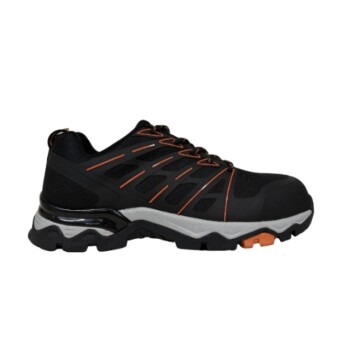
The identification success rate of safety shoes relies heavily on the precise calibration of antenna gain and radiation patterns. Because these tags are located at ground level and move erratically, the antenna must cast a beam that covers "unfavorable angles" while possessing enough signal strength to overcome environmental interference.
Success depends on balancing beam focus and coverage area. Because safety shoes are low to the ground and constantly changing orientation, the system requires sufficient power and a calibrated radiation pattern to penetrate environmental obstructions like metal or moisture.
The Role of Antenna Characteristics
The physical behavior of the RFID signal is dictated by the antenna's design. This is particularly critical for safety shoes, which present a unique tracking challenge due to their location on the body.
Calibrating Gain and Beam Range
Antenna gain directly influences the distance and width of the detection zone.
While higher gain increases the range, it must be carefully balanced to ensure the beam covers the specific area where feet are moving.
If the gain is not matched to the installation height, the reader may miss tags passing through the periphery of the zone.
The Impact of Radiation Patterns
The radiation pattern determines the three-dimensional shape of the detection field.
Since safety shoes are attached to moving feet, the tag orientation changes constantly relative to the antenna.
An optimized radiation pattern ensures that the reader maintains a connection even when the tag is presented at "unfavorable angles."
Environmental Challenges and Power
Industrial environments introduce interference that can severely degrade identification rates. The antenna setup must be robust enough to overpower these local obstacles.
Overcoming Ground-Level Obstructions
Safety shoes operate at the lowest point of the body, placing them near wet floors and metal structures.
These elements can reflect or absorb RF energy, creating dead zones in the detection field.
The antenna's position and characteristics must account for this ground-level clutter to maintain a consistent read rate.
The Necessity of High Transmission Power
To counter environmental damping and angular misalignment, higher transmission power is often requisite.
For example, using a 30 dBm transmission power provides the energy density needed to penetrate difficult environments.
This power level ensures high identification success rates for moving shoes, even when the physical path between the antenna and tag is less than ideal.
Understanding the Trade-offs
Optimizing an RFID system is rarely about maximizing a single specification; it is about compromise.
Gain vs. Coverage Area
High-gain antennas project energy further, but they typically create a narrower beam.
In a confined industrial walkway, a beam that is too narrow might miss a shoe if the worker steps slightly outside the center line.
You must trade maximum distance for a wider beam width to catch moving targets effectively.
Power vs. Interference
While 30 dBm helps read tags at bad angles, maximizing power can cause issues in dense facilities.
Excessive power might trigger "cross-reads," picking up safety shoes from adjacent lanes or workstations.
The goal is to use enough power to overcome wet floors and metal, without saturating the surrounding area.
Making the Right Choice for Your Goal
To ensure the safety and tracking of personnel, your antenna configuration must match the specific constraints of your facility.
- If your primary focus is consistent tracking of moving workers: Prioritize an antenna with a radiation pattern designed for wide coverage to handle the "unfavorable angles" of moving feet.
- If your primary focus is overcoming environmental interference: Ensure your system is capable of 30 dBm transmission power to push through signal loss caused by wet floors or metal grids.
The most effective system treats the antenna, installation height, and power output as a single, calibrated unit.
Summary Table:
| Feature | Impact on Safety Shoe Tracking | Key Considerations |
|---|---|---|
| Antenna Gain | Determines detection zone distance and width | High gain adds range but narrows the beam |
| Radiation Pattern | Manages tag orientation and "unfavorable angles" | Must provide wide coverage for moving feet |
| Transmission Power | Overcomes signal loss from metal or wet floors | 30 dBm is ideal for penetrating interference |
| Installation Height | Defines the physical path to ground-level tags | Must be calibrated to avoid dead zones |
Elevate Your Personnel Tracking with 3515 Footwear Solutions
As a large-scale manufacturer serving distributors and brand owners, 3515 offers comprehensive production capabilities for all footwear types, anchored by our flagship Safety Shoes series. Our extensive portfolio covers work and tactical boots, outdoor shoes, training shoes, and sneakers, as well as Dress & Formal shoes to meet your diverse bulk requirements.
Integrating RFID technology into high-performance footwear requires a partner who understands the technical demands of industrial environments. We provide the manufacturing expertise needed to ensure your safety footwear is compatible with advanced tracking systems, overcoming environmental interference with ease.
Ready to scale your production? Contact us today to discuss how our manufacturing excellence can support your brand's growth!
References
- Maria Verde, Giampaolo Raimondi. A smart combination of IoT and blockchain enabling technologies to measure and improve workplace safety in dairy farm. DOI: 10.21014/actaimeko.v12i4.1634
This article is also based on technical information from 3515 Knowledge Base .
Related Products
- Premium Suede Sport Safety Shoes for Wholesale & Bulk Orders
- Premium Lightweight Safety Shoes for Wholesale & Bulk Orders
- Wholesale Anti-Smash & Puncture-Proof Safety Shoes Custom Manufacturing for Brands
- Premium KPU Injection Athletic Style Safety Shoes
- Premium Safety Shoes with Rotating Buckle Safety Sneakers
People Also Ask
- What industries have specific OSHA footwear requirements? Ensure Compliance & Protect Your Workforce
- What are the primary functions of professional safety shoes? Maximize Safety in Water Supply Confined Spaces
- What role do specialized safety shoes play in preventing falls? Engineering Stability in Industrial Environments
- How do gait analysis algorithms ensure accuracy in footwear? Master Step Length Precision for Boots & Sneakers
- Why should ergonomics and comfort be prioritized when selecting safety shoes? Boost Compliance & Worker Health