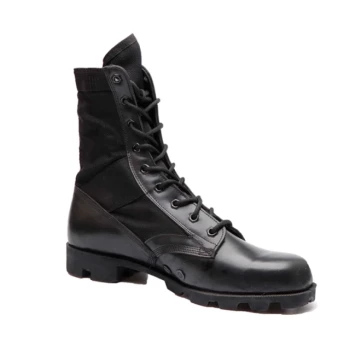
In the high-stakes environment of an armored vehicle, professional tactical boots serve as a critical stabilization interface between the operator and the chassis. These specialized shoes provide essential foot support and utilize high-friction outsole designs that allow the driver to firmly grip the floor. This traction is vital during severe turbulence or the initial stages of a rollover, ensuring the operator maintains control when external forces attempt to displace them.
Specialized footwear acts as an integral component of the vehicle's overall protection system, specifically working to delay occupant displacement caused by centrifugal forces and reduce collision risks by maintaining proper driving posture.
The Mechanics of Operator Stability
Counteracting Centrifugal Forces
During high-speed maneuvers or the onset of a rollover, centrifugal forces act violently on the vehicle's occupants.
The primary function of tactical footwear in this scenario is to "delay displacement." By anchoring the feet firmly to the chassis floor, the driver can resist these forces longer than they could with standard footwear.
Maintaining Correct Posture
Safety in an armored vehicle is heavily dependent on the driver staying in the optimal driving position.
Tactical training shoes provide the structural foot support necessary to brace effectively. This stability ensures that the driver remains aligned with the vehicle's controls and safety systems, rather than slipping out of position during impact or turbulence.
Critical Design Features
High-Friction Outsole Technology
The effectiveness of these boots relies on advanced outsole designs.
Drawing from principles used in industrial safety footwear, these soles utilize specific rubber compounds and geometric tread patterns. This maximizes the coefficient of friction, ensuring a lock-step grip on metal chassis floors that may be slick or vibrating intensely.
Structural Support and Agility
Unlike heavy industrial boots designed for static protection (like mining or foundry work), tactical footwear balances protection with agility.
The design focuses on supporting the ankle and arch under high stress. This allows the driver to exert significant downward pressure for bracing without risking injury or foot fatigue, effectively turning the legs into shock absorbers.
Understanding the Trade-offs
The Limits of Manual Bracing
It is critical to understand that footwear is a supplementary safety measure, not a replacement for restraint systems.
While high-friction soles delay displacement, they cannot overcome the extreme G-forces of a catastrophic rollover on their own. They are designed to buy the driver split-second control before the primary safety restraints take over.
Specificity of Application
Not all "safety shoes" are suitable for armored vehicle operations.
Boots designed for other extremes—such as heavy insulation for cold or heat resistance for welding—may lack the tactile sensitivity required for driving. The bulk of a general-purpose safety boot can impede pedal operation, creating a new safety hazard.
Making the Right Choice for Your Goal
To select the correct footwear, you must analyze your specific role within the vehicle.
- If your primary focus is Vehicle Operation: Prioritize high-friction rubber compounds and moderate ankle support to ensure pedal sensitivity and a firm grip on the chassis floor.
- If your primary focus is Crew Safety/Passenger: Prioritize structural stability and heavy traction, as your main goal is to brace against the chassis to prevent injury from turbulence.
Professional tactical footwear is not merely a uniform requirement; it is a calibrated tool that connects the human operator to the vehicle's safety architecture.
Summary Table:
| Feature | Function in Armored Vehicles | Key Benefit |
|---|---|---|
| High-Friction Outsole | Grips metal chassis floors | Prevents foot slippage during turbulence |
| Structural Support | Stabilizes ankle and arch | Reduces fatigue and injury during bracing |
| Tactile Sensitivity | Optimized pedal interface | Ensures precise control over vehicle movements |
| Traction Geometry | Delays occupant displacement | Keeps driver in the optimal safety position |
Elevate Your Fleet's Safety Standard with 3515 Footwear
As a large-scale manufacturer serving global distributors and brand owners, 3515 offers comprehensive production capabilities for all footwear types. Our flagship Safety Shoes series and high-performance Tactical & Training boots are engineered specifically for specialized operating conditions, providing the critical stabilization and grip required for armored vehicle crews.
From tactical agility to industrial-grade protection, our extensive portfolio covers work boots, outdoor shoes, and formal footwear to meet your diverse bulk requirements. Partner with 3515 to provide your customers with the ultimate interface between operator and machine.
Contact our expert team today to discuss your bulk production needs.
References
- K. S. Tan, M.S. Solah. Head Injuries In Rollover of Military Armoured Vehicle. DOI: 10.31098/cset.v2i2.571
This article is also based on technical information from 3515 Knowledge Base .
Related Products
- High-Traction Suede Tactical Boots Wholesale & Custom Manufacturing
- Wholesale Waterproof Tactical Boots Custom Suede & High-Traction Soles
- Durable High-Ankle Tactical Boots Wholesale Manufacturer for Custom & Bulk Orders
- Wholesale Tactical Boots High-Traction & Reflective for Bulk & Brand Orders
- Durable Leather High-Ankle Tactical Boots for Wholesale & Custom Manufacturing
People Also Ask
- Why is sequential analysis utilized to evaluate tactical boots? Master Dynamic Boot Development and Ergonomic Performance
- How does the material of tactical boots affect their performance? Choose the Right Material for Your Mission
- How do tactical boots differ from regular boots? Performance, Durability & Design Explained
- How do military uniforms and tactical boots impact the prediction of thermal risk? Essential Safety Insights
- What are the benefits of integrating FES and sEMG into tactical boots? Safety, Reliability & Field-Ready Performance