
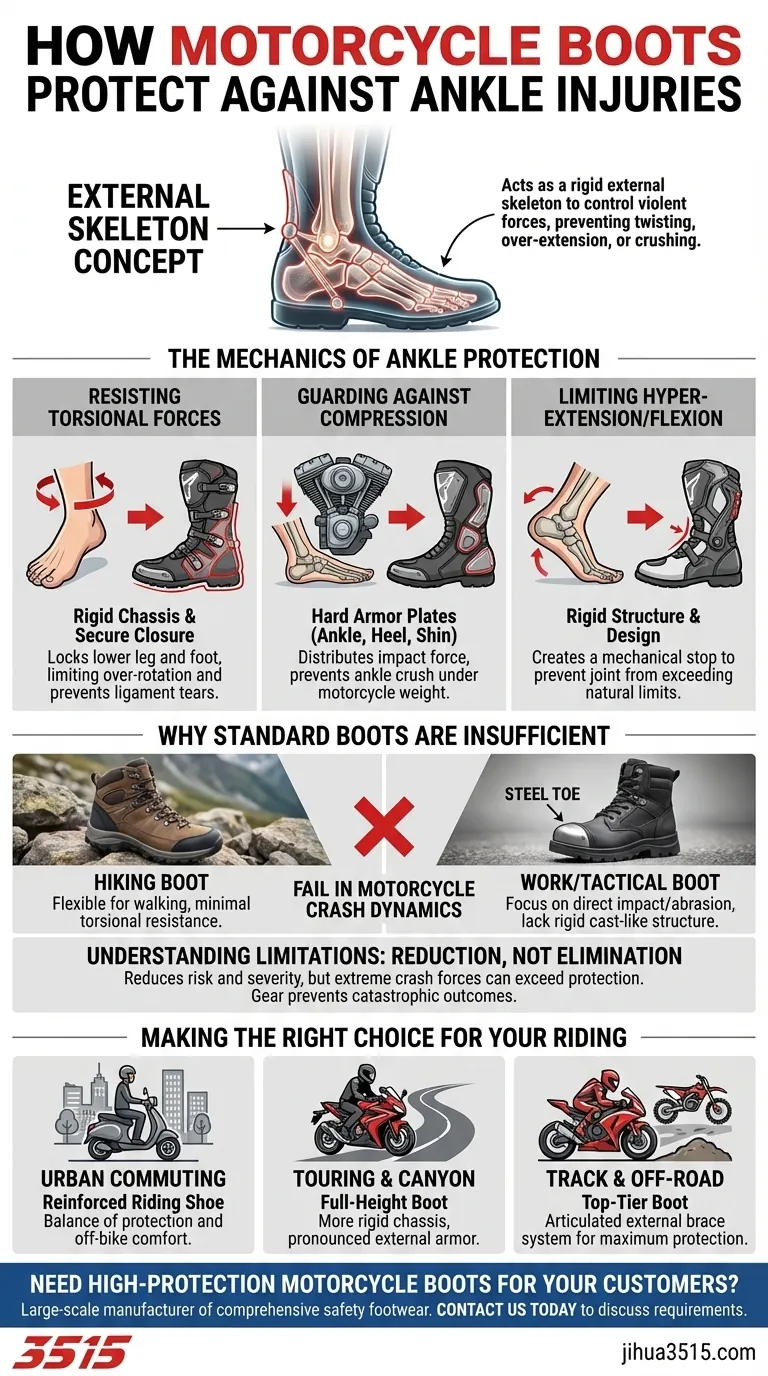
At its core, a motorcycle boot protects your ankle by acting as an external skeleton. It combines rigid armor and a secure, cast-like fit to control the violent forces of a crash. This design specifically prevents the ankle from twisting, over-extending, or being crushed by the weight of the motorcycle or impact with an object.
The primary goal of a motorcycle boot is not just to absorb impact, but to rigidly control the ankle's range of motion. It is engineered to prevent the joint from moving in ways it was never meant to during the extreme torsional and compressive forces of an accident.
The Mechanics of Motorcycle Ankle Protection
A motorcycle accident subjects the lower leg to a unique combination of forces. The boot's design is a direct response to these specific threats, going far beyond what standard footwear can offer.
Resisting Torsional Forces
Your ankle is highly susceptible to twisting, a common dynamic when your foot is planted while the rest of your body is in motion during a fall.
Proper motorcycle boots feature a rigid chassis and a secure closure system using buckles or strong bindings. This structure locks the lower leg and foot together, severely limiting over-rotation and preventing ligament tears or spiral fractures.
Guarding Against Compression and Impact
In many accidents, the motorcycle can fall onto the rider's leg, pinning it against the ground or another object.
To counter this, boots incorporate hard armor plates made of plastic or composite materials around the ankle bones (malleolus), heel, and shin. This armor distributes the force of a direct impact and prevents the ankle from being crushed under the bike's weight.
Limiting Hyper-Extension and Flexion
The boot's structure is intentionally designed to limit the ankle's forward and backward range of motion.
This rigidity prevents the joint from being forced beyond its natural limits, a common cause of severe sprains and fractures. It effectively creates a mechanical stop to protect the ligaments and bones from being over-stressed.
Why Standard Boots Are Insufficient
Many riders mistakenly believe that any sturdy over-the-ankle boot, like one for hiking or tactical use, offers adequate protection. While these boots are durable, they are designed for entirely different purposes and fail to address the primary risks of motorcycling.
Hiking Boots Protect from the Ground Up
A hiking boot's main purpose is to provide stability on uneven terrain and shield the foot from sharp rocks. It is flexible to allow for walking and offers minimal resistance to the torsional forces of a motorcycle crash.
Work and Tactical Boots Protect from Direct Impact
Steel-toed work boots are designed to protect from falling objects, while tactical boots focus on abrasion and puncture resistance. Neither possesses the rigid, cast-like structure necessary to prevent the ankle from twisting or being crushed by the multi-hundred-pound leverage of a motorcycle.
Understanding the Limitations: Protection Is Not Absolute
It is critical to have a realistic understanding of what protective gear can and cannot do. Even with the highest level of protection, severe accidents can result in injury.
The Role of Extreme Forces
Motorcycle boots significantly reduce the risk and severity of injury, but they cannot eliminate it. The forces involved in a high-speed crash or an awkward fall can exceed what any wearable device can withstand.
A Real-World Example
As noted in experience reports, a rider can still suffer broken bones, such as a fractured fibula, while wearing high-quality protective boots. However, the gear likely prevented a far more catastrophic outcome, such as a compound fracture, dislocation, or amputation.
Making the Right Choice for Your Riding
The level of protection you need is directly related to the level of risk you face. Assess your primary riding environment to select the appropriate gear.
- If your primary focus is urban commuting: A reinforced riding shoe or short boot with integrated ankle armor provides a good balance of protection and off-bike comfort.
- If your primary focus is touring or spirited canyon riding: A full-height boot with a more rigid chassis and pronounced external armor is necessary to handle higher speeds and greater risks.
- If your primary focus is track riding or serious off-roading: A top-tier boot with an articulated external brace system offers the maximum possible protection against torsional and compressive forces.
Choosing the right motorcycle boot is a deliberate decision to manage the specific risks inherent to riding.
Summary Table:
| Protection Feature | How It Works | Key Component |
|---|---|---|
| Resists Twisting | Locks foot and lower leg together to prevent over-rotation. | Rigid Chassis & Secure Closure |
| Guards Against Crushing | Distributes impact force from the motorcycle's weight. | Hard Armor Plates (Ankle/Heel/Shin) |
| Limits Hyper-Extension | Creates a mechanical stop to prevent joint over-stress. | Rigid Structure & Design |
Need high-protection motorcycle boots for your customers?
As a large-scale manufacturer, 3515 produces a comprehensive range of safety footwear for distributors, brand owners, and bulk clients. Our production capabilities encompass all types of protective boots, ensuring durability, advanced armor integration, and compliance with safety standards.
Contact us today to discuss your specific requirements and leverage our manufacturing expertise for your product line.
Visual Guide
Related Products
- Wholesale Tactical Boots High-Traction & Reflective for Bulk & Brand Orders
- High Performance Fire-Retardant Waterproof Safety Boots
- Durable Goodyear Welt Leather Work Boots for Wholesale & Private Label
- Wholesale High-Traction Camo Boots - Custom Manufacturer for Brands
- Heavy-Duty Waterproof Nubuck Safety Boots Safety Shoes for Bulk Supply
People Also Ask
- How do tactical boots protect against injuries? Discover the Integrated Safety System
- What are the important features of tactical boots for military operators? A Guide to Mission-Critical Footwear
- How should you break in and clean tactical boots? A Step-by-Step Guide for Peak Performance
- What are the primary benefits of wearing tactical boots for everyday use? Get All-Day Comfort & Durability
- How do social media interactivity features enhance procurement engagement for tactical and work boots?



















