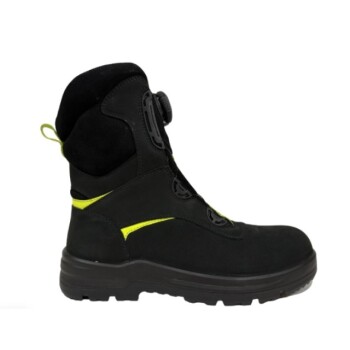
High-top tactical boots function as a critical physical intervention in rail construction by stabilizing the worker during movement across hazardous terrain. By providing superior ankle support on uneven ground and amidst sharp debris, these boots prevent physical injuries that often act as the catalyst for broader operational errors.
The core function of this footwear is to break the chain of causality: while environmental factors may cause a lapse in perception, the boots prevent that lapse from turning into a physical injury, thereby stopping the subsequent transition into an operational mistake.
The Physical Reality of Rail Sites
Navigating Hazardous Terrain
Rail transit construction sites are inherently complex environments characterized by uneven ground and the presence of sharp debris.
Workers must constantly navigate these physical irregularities, which increases the baseline risk of trips, slips, and falls.
Support During Critical Movements
The risk of injury is heightened when workers are navigating obstacles or reacting to emergencies.
During these high-stress moments, the stability of the foot and ankle is paramount to maintaining control and safety.
How Support Translates to Error Reduction
The Role of Ankle Stabilization
High-top tactical boots are specifically designed to provide superior ankle support compared to standard footwear.
This structural support is essential for lowering the risk of sprains when the foot lands awkwardly on uneven surfaces or debris.
Blocking the Error Chain
The primary reference highlights a specific psychological and physical sequence: an "environmental perception failure" (not seeing a hazard) often leads to an "operational mistake."
Physical injury is the bridge between these two states.
By preventing the injury (the sprain) despite the perception failure (stepping on the hazard), the boots effectively block the transition to a larger operational error.
Understanding the Limitations
Addressing the Symptom, Not the Source
It is important to recognize that while high-top boots mitigate the consequences of stepping on hazards, they do not remove the hazards themselves.
The boots act as a passive safety barrier; they do not improve the worker's environmental perception or visibility of the debris.
The Scope of Protection
The boots are effective specifically against injuries induced by environmental factors like ground unevenness.
They are a physical countermeasure, intended to keep the worker operational even after a misstep occurs.
Making the Right Choice for Your Goal
To effectively utilize this equipment in your safety strategy, consider the following:
- If your primary focus is Injury Prevention: Prioritize high-top boots for all personnel working on ground-level tasks to directly mitigate the risks posed by sharp debris and uneven terrain.
- If your primary focus is Operational Continuity: View these boots as a mechanism to maintain workflow during emergencies, ensuring that minor environmental hazards do not escalate into work-stopping errors.
By stabilizing the worker, you stabilize the operation.
Summary Table:
| Feature | Benefit in Rail Construction | Impact on Operational Error |
|---|---|---|
| High-top Design | Superior ankle stabilization on uneven ballast | Prevents sprains that disrupt focus |
| Structural Support | Maintains control during emergency reactions | Stops minor slips from escalating |
| Debris Protection | Barriers against sharp trackside materials | Reduces physical injury catalysts |
| Passive Safety | Mitigates environmental perception failures | Breaks the chain between hazard and mistake |
Secure Your Workforce with 3515’s Professional Footwear Solutions
Operational stability begins from the ground up. As a leading large-scale manufacturer serving global distributors and brand owners, 3515 delivers the high-performance footwear required to navigate the world's most challenging environments. Our flagship Safety Shoes series, alongside our specialized tactical boots, provides the critical ankle support and durability necessary to maintain operational continuity in rail and heavy construction sectors.
From work boots and training shoes to formal dress footwear, our comprehensive production capabilities ensure your bulk requirements are met with precision and quality. Contact us today to discuss how our footwear can enhance your safety protocols and reduce operational risks.
References
- Bing Tang, Wei Lü. EXPLORING THE RISK TRANSMISSION CHARACTERISTICS AMONG UNSAFE BEHAVIORS WITHIN URBAN RAILWAY CONSTRUCTION ACCIDENTS. DOI: 10.3846/jcem.2022.16924
This article is also based on technical information from 3515 Knowledge Base .
Related Products
- High-Traction Suede Tactical Boots Wholesale & Custom Manufacturing
- Durable Leather High-Ankle Tactical Boots for Wholesale & Custom Manufacturing
- Durable High-Ankle Tactical Boots Wholesale Manufacturer for Custom & Bulk Orders
- Durable High-Ankle Tactical Boots for Wholesale & Custom Manufacturing
- Wholesale Tactical Boots High-Traction & Reflective for Bulk & Brand Orders
People Also Ask
- Why is sequential analysis utilized to evaluate tactical boots? Master Dynamic Boot Development and Ergonomic Performance
- How does the material of tactical boots affect their performance? Choose the Right Material for Your Mission
- How do tactical boots differ from regular boots? Performance, Durability & Design Explained
- How do military uniforms and tactical boots impact the prediction of thermal risk? Essential Safety Insights
- What are the benefits of integrating FES and sEMG into tactical boots? Safety, Reliability & Field-Ready Performance