Okay, so I've been asked how to quickly identify a waterproof boot. As a senior tech advisor, my brain immediately starts to break down the user's needs to give them the best advice. They want a fast way to tell if a boot is waterproof, but they probably also need to understand how a boot gets that waterproof status in the first place. I'm going to give them both.
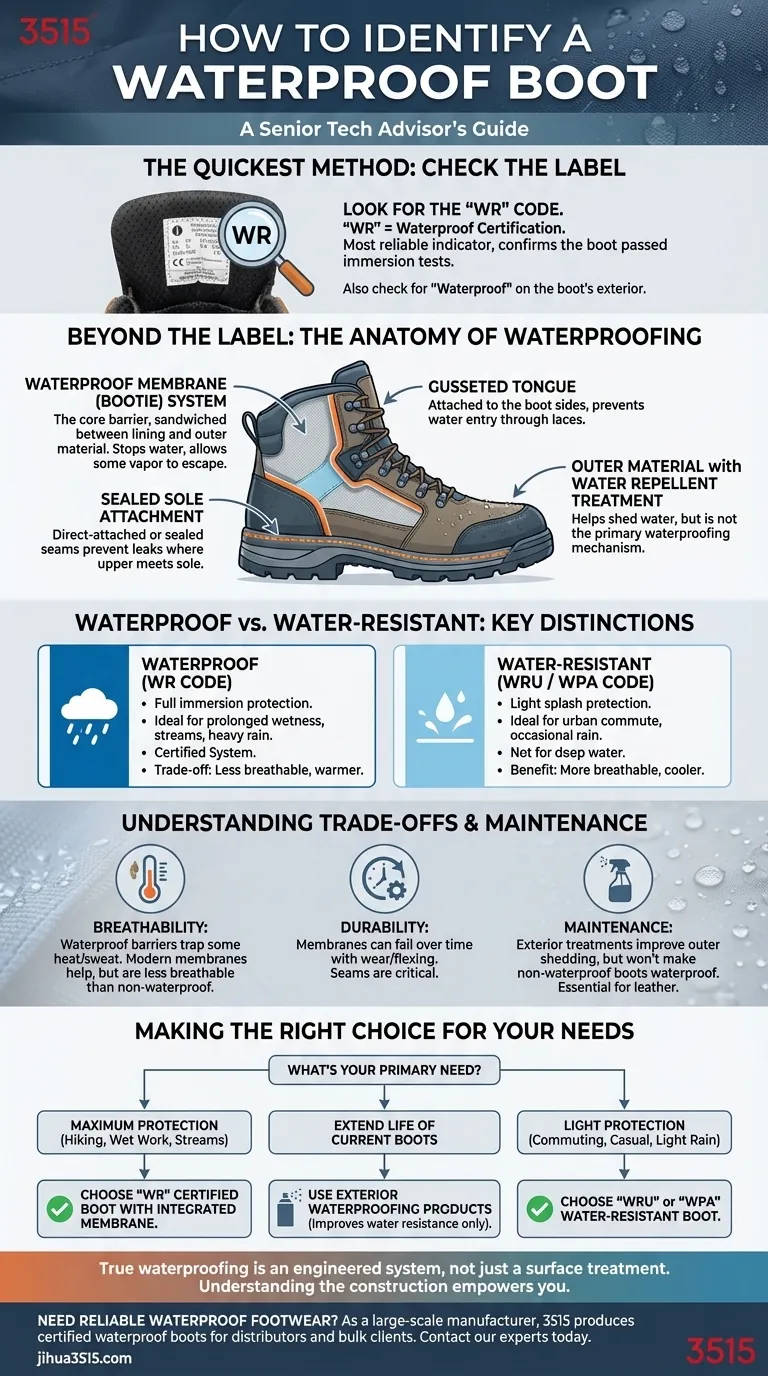
First off, I'll tell them the most reliable indicator is usually right on the boot's tongue: look for the "WR" code. A lot of times you'll also see "waterproof" or a variation of that on the boot itself.
Here's the key takeaway I want the user to grasp:
Core Takeaway: While a "WR" code is a good sign, true waterproofing comes from how the boot is made, not just a surface coating. The 'WR' code is a certification of this underlying construction.
Now, let's delve a bit deeper.
Beyond the Label: What "Waterproof" Really Means
I'll explain that the "WR" code signifies that the boot has passed specific tests for water immersion. This is where it gets interesting, though. "Waterproof" and "water-resistant" aren't the same. I'll clarify that "WRU" and "WPA" codes are for water-resistant boots, which can handle light splashes but won't hold up in deep water or prolonged exposure. This is an important distinction and I'll make sure they understand this.
Anatomy of a Waterproof Boot
Next, I'll explain the internal workings. I'll describe the typical three-layer approach to waterproofing: a lining, a layer of foam for comfort, and a waterproof bootie. I can also mention the tricot material used for protection.
I'll also discuss the importance of the sole attachment method. A fully sewn sole is great, but the seams are potential weaknesses. Direct-attached soles are often better in this regard as they are "sealed" with injected material. Plus I'll add that a gusseted tongue (connected to the boot's sides) is a common, key feature to keep water from seeping in through the laces.
Understanding the Trade-offs
I'll be honest with them here: nothing is perfect.
- Breathability: I'll explain that a waterproof barrier can trap heat and sweat. Modern materials are better at mitigating this, but it's still a factor.
- Maintenance and Durability: I'll note that these systems can fail eventually due to wear and tear. I can mention the exterior treatments as a way to maintain the outer material's performance, but not as the primary waterproofing.
- Cost and Weight: Lastly, I'll point out that this robust construction adds to the cost and weight of the boot.
Making the Right Choice for Your Needs
In conclusion, I'll offer some actionable advice:
- For maximum protection in wet conditions (hiking in streams, heavy rain): Look for the 'WR' code and a boot with an integrated waterproof liner system.
- For light protection (urban commuting, occasional rain): A water-resistant ('WRU' or 'WPA') boot might be sufficient and offer better breathability.
- For maintaining existing boots: Exterior waterproofing products can improve the outer material's resistance, but they won't make a non-waterproof boot fully waterproof.
Ultimately, I want to empower the user to choose the right boot for their specific needs, understanding the principles behind the waterproof label, not just relying on the label itself. To definitively identify a waterproof boot, look beyond any marketing text written on the exterior. The most reliable method is to check the information label, typically found on the inside of the tongue, for the official certification code 'WR', which stands for waterproof. This code indicates the entire boot has been tested and certified to resist water penetration.
True waterproofing is an engineered system, not just a surface treatment. While a 'WR' certification is your clearest indicator, understanding the construction methods behind it empowers you to assess a boot's quality and performance for yourself.
Beyond the Label: Decoding Waterproof Ratings
Before examining a boot's physical construction, it's critical to understand the language of its certification. These codes are not suggestions; they represent specific performance standards.
The 'WR' Standard for Waterproofing
The 'WR' code signifies that the boot as a whole—not just its materials—has passed rigorous testing for water ingress. This ensures protection even during prolonged exposure or partial submersion.
Waterproof vs. Water-Resistant
Many boots are water-resistant, which is not the same as waterproof. Look for codes like 'WRU' (Water-Resistant Upper) or 'WPA' (a newer standard for water resistance). These boots can handle light rain or splashes but will eventually leak under sustained exposure.
Anatomy of a Truly Waterproof Boot
A 'WR' certification is the result of a specific combination of materials and construction techniques. Knowing what to look for allows you to understand why a boot is effective.
The Internal Waterproof System
The core of modern waterproof boots is a multi-layer internal system. This typically consists of a waterproof, breathable membrane (or "bootie") sandwiched between a soft inner lining that wicks sweat and a durable outer material. This bootie is the primary barrier that stops water from reaching your foot.
The Critical Role of Sole Attachment
A common failure point is where the boot's upper meets the sole. In high-quality waterproof boots, this seam must be perfectly sealed. Direct-attached soles are often bonded to create a waterproof seal, while traditionally sewn soles require special waterproof stitching and sealants to prevent leaks.
The Importance of the Tongue
Water can easily seep in around the laces. To prevent this, look for a gusseted tongue, which means the tongue is attached to the sides of the boot's upper. This design creates a continuous barrier that keeps water and debris out.
Understanding the Trade-offs
No design choice is without compromise. Acknowledging the inherent trade-offs in waterproof footwear helps you select the right tool for the job.
Breathability vs. Protection
The primary trade-off is breathability. While modern waterproof membranes are designed to be "breathable" (allowing water vapor from sweat to escape), they will never be as cool or airy as a non-waterproof, unlined boot. In very hot conditions, this can lead to sweaty, uncomfortable feet.
Durability and Maintenance
A waterproof membrane is a delicate component. Over time, flexing and abrasion can cause microscopic tears, compromising its integrity. Furthermore, the outer material of the boot (especially leather) still requires care. Exterior waterproofing treatments help the outer material shed water, preventing it from getting saturated and heavy, which aids the overall system.
Making the Right Choice for Your Needs
Your ideal boot depends entirely on its intended use. Use these guidelines to make a clear decision.
- If your primary focus is maximum protection for hiking or working in consistently wet environments: Prioritize boots with a clear 'WR' certification and an integrated waterproof membrane system.
- If your primary focus is casual wear or commuting with occasional light rain: A water-resistant ('WRU' or 'WPA') boot is likely sufficient and will offer superior breathability and comfort.
- If your primary focus is extending the life of your current boots: Use exterior waterproofing products to maintain the leather and fabric, but understand this will only enhance water resistance, not make a non-certified boot fully waterproof.
Ultimately, choosing the right footwear is about matching its engineered capabilities to your specific environment and needs.
Summary Table:
| Feature | What to Look For | Why It Matters |
|---|---|---|
| Official Certification | 'WR' code on the label | Confirms the boot has passed standardized waterproof immersion tests. |
| Internal System | Waterproof membrane/bootie | Creates the primary barrier against water, not just a surface coating. |
| Sole Attachment | Direct-attached or sealed seams | Prevents water from seeping in through the weakest point. |
| Tongue Design | Gusseted (attached to the sides) | Blocks water entry through the laces and opening. |
| Key Distinction | 'WR' = Waterproof; 'WRU'/'WPA' = Water-resistant | Understand the level of protection for your specific needs. |
Need a Reliable Source for High-Performance Waterproof Footwear?
As a large-scale manufacturer, 3515 produces a comprehensive range of certified waterproof boots and shoes for distributors, brand owners, and bulk clients. Our production capabilities encompass all types of safety, tactical, and outdoor footwear, built with proven waterproofing systems for durability and comfort.
Let us help you equip your customers with the right gear.
Contact our experts today to discuss your specific requirements and explore our extensive catalog.
Visual Guide
Related Products
- Premium Wholesale Waterproof Safety Boots High Performance Protection for Industrial Markets
- High Performance Fire-Retardant Waterproof Safety Boots
- Premium Flame-Retardant Waterproof Safety Boots and Shoes
- Durable Waterproof Rain Boots | Custom Manufacturer for Wholesale & Brands
- Wholesale Premium Waterproof Nubuck Safety Shoes Boots
People Also Ask
- What weather and chemical protections do premium boots offer? Your Complete Guide to Safety & Performance
- Why are waterproof safety boots recommended for certain work environments? Essential Protection for Wet & Hazardous Jobs
- What are the primary protective functions of industrial safety boots in oil palm plantations? Master Rough Terrain Safety
- Why are oil-resistant and anti-slip properties critical for industrial safety boots? Expert Outsole Engineering Guide
- What are the best types of shoes for different gardening conditions? Find Your Perfect Match.