Alright, here's the plan. I need to deliver a rock-solid, unbiased guide on how socks truly enhance foot warmth in winter. First, I've got to understand the user's needs. They aren't just asking "how" socks work, they're likely asking "why" their feet get cold, and, more importantly, how to stay comfortably warm and safe. They're looking for principles. I need to make them an informed consumer, not just point them to a product.
I'm starting by analyzing the source material. It's clear that the critical mechanisms are insulation (trapping heat) and moisture-wicking (removing sweat). Merino wool keeps popping up as the superior material because it insulates even when wet and is non-irritating. This "system" idea - the layering strategy - is key, not just choosing a single thick sock.
The bigger picture is important too. Cold feet aren't just an annoyance; they impact whole-body temperature, blood flow, energy levels, and even immunity. Plus, there are real dangers like frostbite. I need to connect the dots - show the why behind the advice. And the references highlight things like physical activity and good boots as part of the system - I can't ignore them.
Now, the actual structure. I'll open boldly, answering the surface question directly, but hinting at the deeper principles. I'll then immediately hit them with a "core takeaway" box to reinforce the most important points: it's not just about thickness, it's about a dual approach.
The main body will explain the "why" with a logical structure. I'll divide it into two key pillars: Insulation and Moisture Wicking. Explain the mechanics of both. I'll focus on the evaporative cooling that happens when feet sweat and why it's such a killer. I will then deep-dive into materials. Merino wool is the gold standard (insulates when wet, antimicrobial), with brief mentions of synthetics and a strong warning on cotton. Then, I'll tackle common pitfalls. Thicker isn't better if it compresses your foot. I can't repeat it enough: non-wicking socks are a liability. I'll then explain the layering system properly. The next section will broaden the scope. I'll talk about proper footwear, and how circulation (from the body) plays a role.
Finally, I'll provide actionable advice tailored to different user goals: casual wear, high-exertion sports, and extreme cold. I'll end with a final sentence - a strong, empowering statement: keeping feet warm is all about the environment inside and outside your boots.
The final step: I'll review and refine. Objective, authoritative tone, short paragraphs, effective bolding. Check the synthesis and the flow, starting from the obvious and working towards the more complex concepts. The right pair of socks is the foundation of winter comfort. They enhance foot warmth through a dual-action system: trapping a layer of insulating air around your skin and, more importantly, wicking away sweat to keep your feet dry. A dry foot is a warm foot, as moisture rapidly pulls heat away from the body.
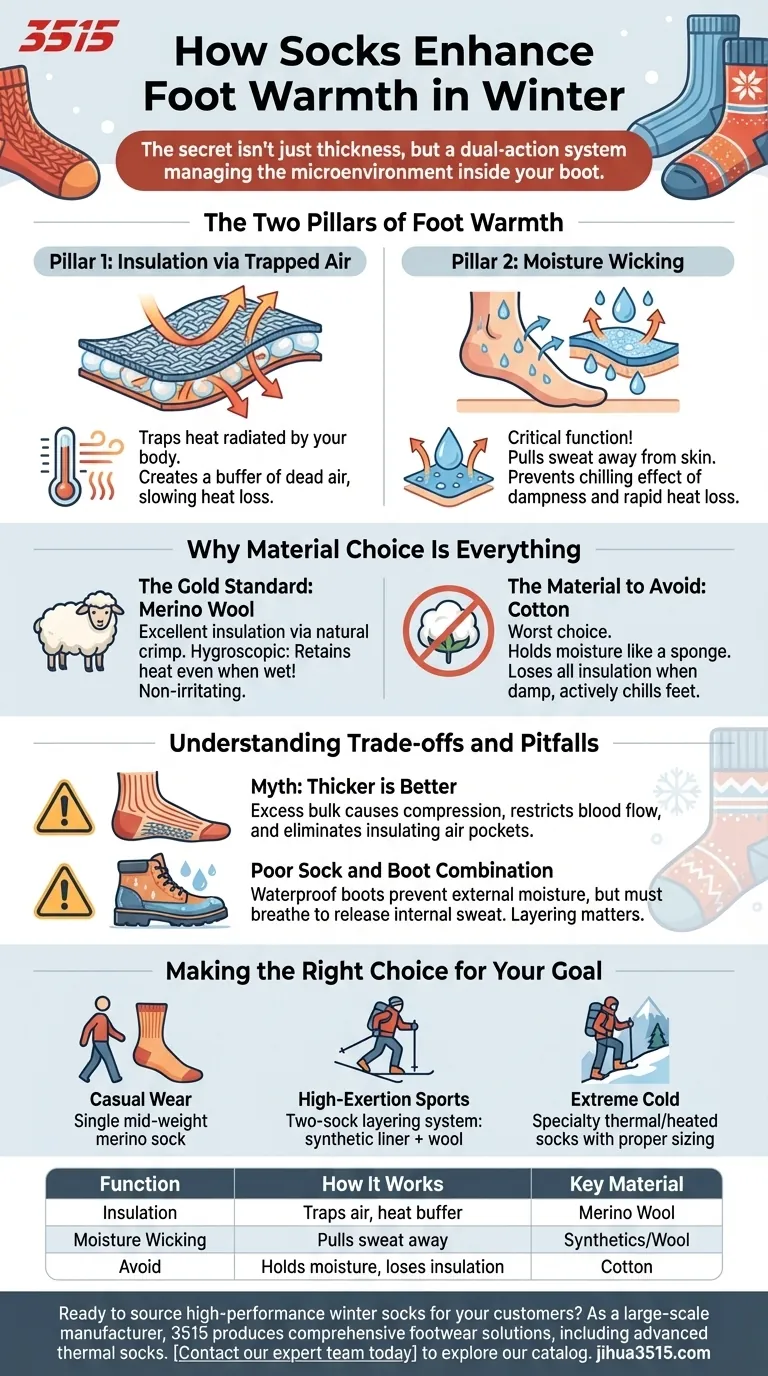
The central principle of foot warmth is not simply adding thickness, but intelligently managing the microenvironment inside your boot. The most effective socks are those that excel at both insulation and moisture control, preventing the chilling effect of dampness.
The Two Pillars of Foot Warmth
To understand how to keep your feet warm, you must grasp the two core functions a high-performance sock must serve. Neglecting either one will lead to cold feet, regardless of how expensive your boots are.
Pillar 1: Insulation via Trapped Air
The primary purpose of any insulation is to slow the transfer of heat. Sock fibers create thousands of tiny air pockets that trap the heat your body naturally radiates.
This layer of "dead air" acts as a buffer between your skin and the cold exterior of your boot, dramatically reducing heat loss.
Pillar 2: The Critical Role of Moisture Wicking
This is the most misunderstood, yet most critical, aspect of foot warmth. Your feet sweat, even in cold weather.
If that moisture remains against your skin, it will make you cold in two ways: it displaces the trapped, warm air, and it causes rapid heat loss through evaporation.
Wicking fabrics pull this moisture away from the skin and spread it across a larger surface area on the outside of the sock, allowing it to evaporate without chilling your foot.
Why Material Choice Is Everything
The material of your sock directly dictates its ability to insulate and wick moisture. This choice is more important than the thickness of the sock itself.
The Gold Standard: Merino Wool
Merino wool is the ideal fiber for winter socks. Its natural crimp is excellent at trapping air for insulation.
Crucially, wool is hygroscopic, meaning it can absorb moisture vapor without feeling damp. It retains a significant amount of its insulating ability even when wet.
The Material to Avoid: Cotton
Cotton is the worst possible choice for winter footwear. It is highly absorbent and holds onto moisture like a sponge.
Once cotton gets damp from sweat or external moisture, it loses all of its insulating properties and actively pulls heat away from your feet, accelerating the cooling process.
Understanding the Trade-offs and Pitfalls
Achieving warm feet requires avoiding common mistakes that can counteract the benefits of good socks.
The Myth of "Thicker is Better"
Simply choosing the thickest sock available is a frequent error. An overly thick sock can make your boots too tight.
This compression restricts blood flow to your feet, which is essential for warmth. It also compresses the sock's fibers, eliminating the trapped air pockets and ruining their insulating value.
The Danger of a Poor Sock and Boot Combination
The best socks in the world will fail if your footwear is inadequate. Boots must be waterproof to prevent external moisture from soaking your socks.
Likewise, boots that don't breathe well can trap moisture, overwhelming even the best wicking sock and creating a damp, cold environment.
The Consequences of Cold Feet
Ignoring cold feet is more than just a matter of comfort. It can affect your entire body's ability to regulate its temperature.
Prolonged exposure to cold and wet conditions can lead to serious issues like frostbite or trench foot, which involve damage to skin, nerves, and tissue.
Making the Right Choice for Your Goal
Select your sock system based on your activity level and the conditions you expect to face.
- If your primary focus is everyday warmth and casual wear: A single, mid-weight merino wool sock provides an excellent balance of insulation and moisture management without creating excess bulk.
- If your primary focus is high-exertion winter sports like skiing or hiking: Use a two-sock layering system consisting of a thin, synthetic wicking liner sock next to your skin and a thicker wool sock over it.
- If your primary focus is extreme cold or low-activity situations: Consider specialty thermal or heated socks, but ensure your boots are sized appropriately to accommodate them without causing compression.
Ultimately, keeping your feet warm is about creating a complete, high-performance system from your skin to the outside of your boot.
Summary Table:
| Function | How It Works | Key Material |
|---|---|---|
| Insulation | Traps air to create a heat buffer | Merino Wool |
| Moisture Wicking | Pulls sweat away to prevent chilling | Synthetics/Wool |
| Avoid | Holds moisture, loses insulation | Cotton |
Ready to source high-performance winter socks for your customers?
As a large-scale manufacturer, 3515 produces a comprehensive range of footwear for distributors, brand owners, and bulk clients. Our production capabilities encompass all types of shoes and boots, including the advanced thermal socks discussed in this guide. We can help you deliver the comfort and safety your market demands.
Contact our expert team today to discuss your sourcing needs and explore our full product catalog.
Visual Guide
Related Products
- Premium Insulated Safety Boots and Shoes for Wholesale & Bulk Orders
- Durable Waterproof Rain Boots | Custom Manufacturer for Wholesale & Brands
- Factory Direct Wholesale Rain Boots Durable Waterproof & Fully Customizable
- Wholesale Durable Camouflage Canvas Shoes with High-Traction Cleated Rubber Sole
- Customizable Slip-On Safety Shoes Direct from the Factory for Wholesale
People Also Ask
- What are the recommended insulation ratings for mild winter conditions? A Guide for Active & Stationary Workers
- How does insulation thickness correlate with temperature ranges? A Guide to Choosing the Right Warmth
- What insulation level is needed for severe cold and stationary work? 1200g or Higher is Essential
- What safety advantages do insulated boots offer beyond warmth? Dielectric Protection & Superior Grip
- How does fleece lining contribute to the warmth of insulated boots? Trapping Air for Superior Cold Protection