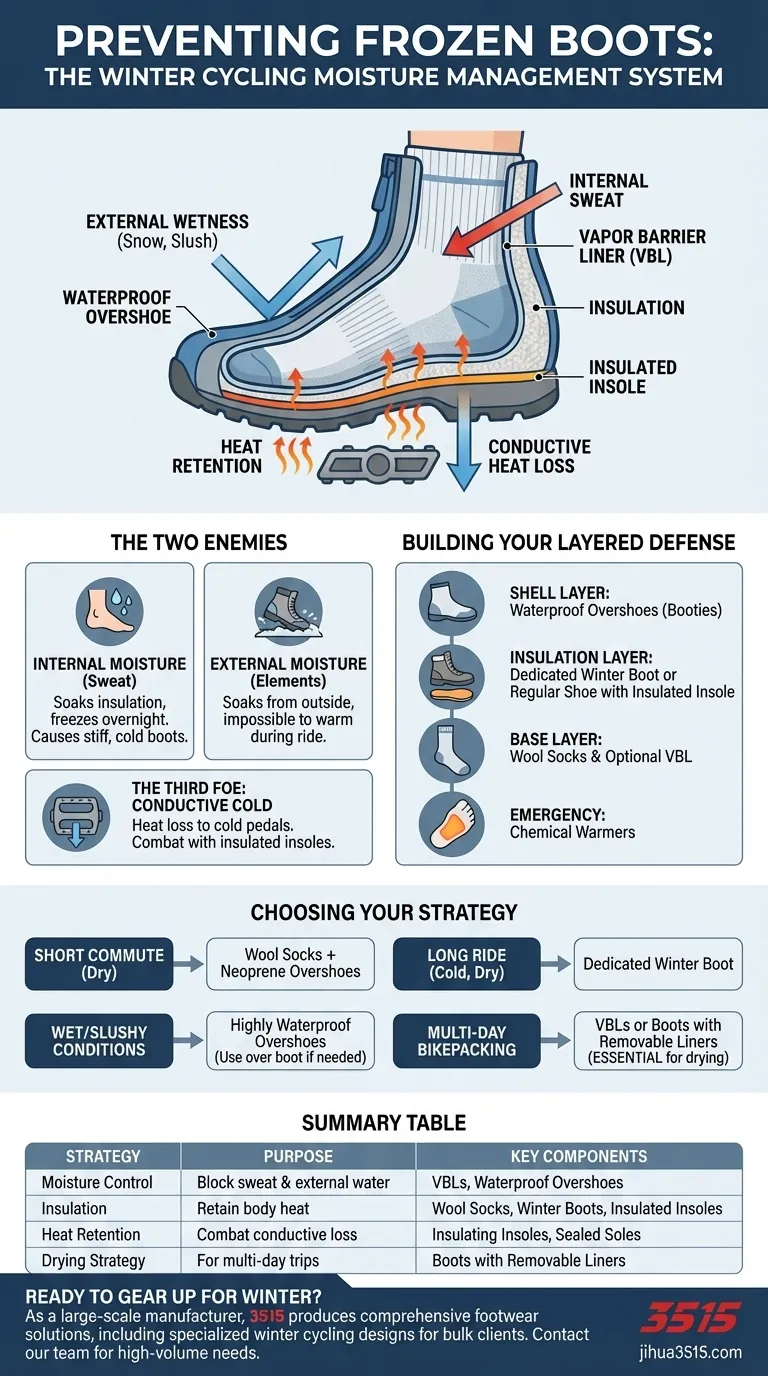
To prevent your boots from freezing during winter cycling, you must aggressively manage moisture from two sources: external wetness and internal sweat. This is accomplished by creating a sealed system using waterproof overboots (booties) to block snow and slush, and by using vapor barrier liners (VBLs) to stop sweat from soaking your boot's insulation. For multi-day trips, using boots with removable liners that can be dried overnight is also a critical strategy.
The core challenge is not simply the cold, but the moisture that compromises your insulation. Frozen boots are a symptom of a failed moisture management system. The solution is to think in layers, controlling sweat from the inside and blocking the elements from the outside.
The Two Enemies of Warm Feet: Moisture and Cold
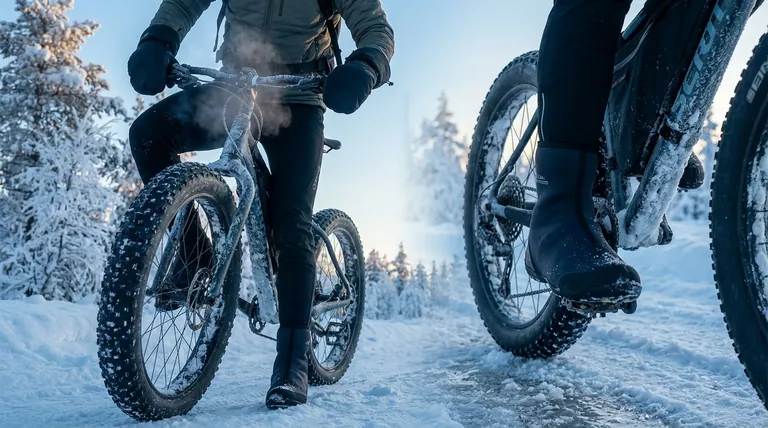
To build an effective defense, you must first understand what you are fighting. Your feet face a two-front war against internal moisture (sweat) and external conditions (water and conductive heat loss).
Internal Moisture: The Insidious Threat
Your feet sweat, even in frigid temperatures. This moisture travels into your socks and boot insulation.
Wet insulation loses its thermal properties, making your feet cold. On multi-day trips, this trapped moisture will freeze solid overnight, creating a stiff, uncomfortable, and blister-causing boot.
External Moisture: The Obvious Foe
Snow, slush, and rain are constant threats in winter riding. Once your boots are soaked from the outside, it is nearly impossible to get them warm or dry during a ride.
A well-sealed boot and overboot system is your primary line of defense against the elements.
Conductive Heat Loss: The Cold Connection
Your feet also lose a significant amount of heat directly through the bottom of your shoe to the metal cleat and pedal. This constant contact with a cold object acts as a heat sink.
Insulating insoles and sealing any ventilation holes in the sole of your shoe are effective ways to combat this conductive cooling.
Building Your Foot Protection System
There is no single magic bullet. A successful strategy relies on a layered system that can be adapted to the day's specific conditions.
The Foundation: Socks
Wool is the material of choice. It insulates effectively even when damp.
If your shoes are tight, avoid thick socks that can restrict blood flow and make your feet colder. A thin merino liner sock under a medium-weight wool sock is often more effective than a single bulky pair.
The Insulation Layer: Shoes and Insoles
For short commutes, your standard cycling shoes might suffice with other layers. However, dedicated winter cycling boots offer superior insulation and weather resistance.
Regardless of your shoe, adding an insulated insole made of wool or foam is a simple and effective upgrade to fight heat loss through the sole.
The Shell Layer: Overshoes (Booties)
Overshoes, or booties, are a critical component. Neoprene booties are excellent, providing a thermal barrier that blocks wind and water.
For extreme conditions, some riders even use two pairs of booties—a thinner one covered by a heavier, waterproof one—to create a robust outer shell.
The Emergency Layer: Chemical Warmers
For the coldest days, disposable chemical toe warmers can be a ride-saver. Place them on top of your socks over your toes for the most effective warmth without creating pressure spots on the bottom of your foot.
Understanding the Trade-offs: Dedicated Boots vs. Covers
Choosing between a dedicated winter boot and a system of overshoes over your regular shoes involves clear trade-offs.
The Case for Dedicated Winter Boots
Winter-specific boots offer the best insulation and a seamless, integrated design. This all-in-one system is convenient and generally provides the most warmth for truly frigid, dry conditions.
The Downsides of Winter Boots
They are a significant investment and can be difficult to dry out completely between daily rides. Many are also designed for two-bolt SPD-style cleats, potentially requiring a pedal change.
The Flexibility of Overshoes
Using overshoes allows you to adapt your existing cycling shoes for a wide range of temperatures. This is a more versatile and budget-friendly approach.
The Limits of Overshoes
While effective, even the best overshoes can be less warm than a dedicated boot. They can also be fussy to put on and are another item to manage and dry. Waterproof socks can help but may trap sweat, trading one problem for another.
Making the Right Choice for Your Ride
Your ideal system depends entirely on your riding goals and conditions.
- If your primary focus is short, dry commutes: A quality pair of wool socks and neoprene overshoes over your regular cycling shoes is often sufficient.
- If your primary focus is long, cold, but dry rides: A dedicated winter cycling boot offers the most reliable warmth and simplicity.
- If your primary focus is wet, slushy conditions: Highly waterproof overshoes are non-negotiable, even when worn over winter boots for maximum protection.
- If your primary focus is multi-day bikepacking: A system with vapor barrier liners (VBLs) or boots with removable liners is essential to prevent your insulation from freezing overnight.
Ultimately, building a reliable system to keep your feet warm and your boots dry is the key to unlocking a full season of winter riding.
Summary Table:
| Key Strategy | Purpose | Key Components |
|---|---|---|
| Moisture Control | Block sweat & external water | Vapor Barrier Liners (VBLs), Waterproof Overshoes |
| Insulation | Retain body heat | Wool Socks, Dedicated Winter Boots, Insulated Insoles |
| Heat Retention | Combat conductive heat loss | Insulating Insoles, Sealed Shoe Soles |
| Drying Strategy | For multi-day trips | Boots with Removable Liners |
Ready to Gear Up for Winter?
As a large-scale manufacturer, 3515 produces a comprehensive range of footwear for distributors, brand owners, and bulk clients. Our production capabilities encompass all types of shoes and boots, including specialized designs for demanding activities like winter cycling.
If you are looking for reliable, high-volume footwear solutions, contact our team today to discuss how we can meet your specific needs.
Visual Guide
Related Products
- Premium Insulated Safety Boots and Shoes for Wholesale & Bulk Orders
- High Performance Fire-Retardant Waterproof Safety Boots
- Premium Flame-Retardant Waterproof Safety Boots and Shoes
- Durable Waterproof Rain Boots | Custom Manufacturer for Wholesale & Brands
- Factory Direct Wholesale Rain Boots Durable Waterproof & Fully Customizable
People Also Ask
- What are the recommended insulation ratings for mild winter conditions? A Guide for Active & Stationary Workers
- How does insulation thickness correlate with temperature ranges? A Guide to Choosing the Right Warmth
- What insulation level is needed for severe cold and stationary work? 1200g or Higher is Essential
- What safety advantages do insulated boots offer beyond warmth? Dielectric Protection & Superior Grip
- How does fleece lining contribute to the warmth of insulated boots? Trapping Air for Superior Cold Protection