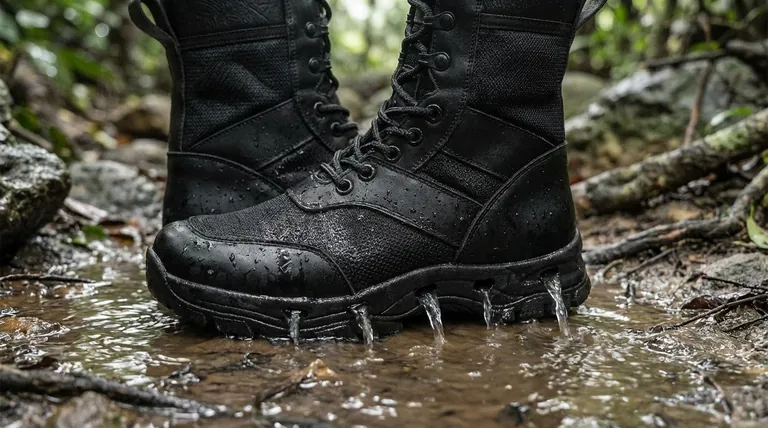
You’ve just equipped a large team with brand-new tactical boots, specified for durability in wet environments. They look the part. They have all the right features on the spec sheet, including drain holes. But a few weeks into deployment, the reports are grim. The boots are waterlogged, heavy, and causing serious foot issues. The very feature designed to help has become the source of the failure.
For any brand owner, distributor, or procurement manager, this scenario is a costly nightmare.
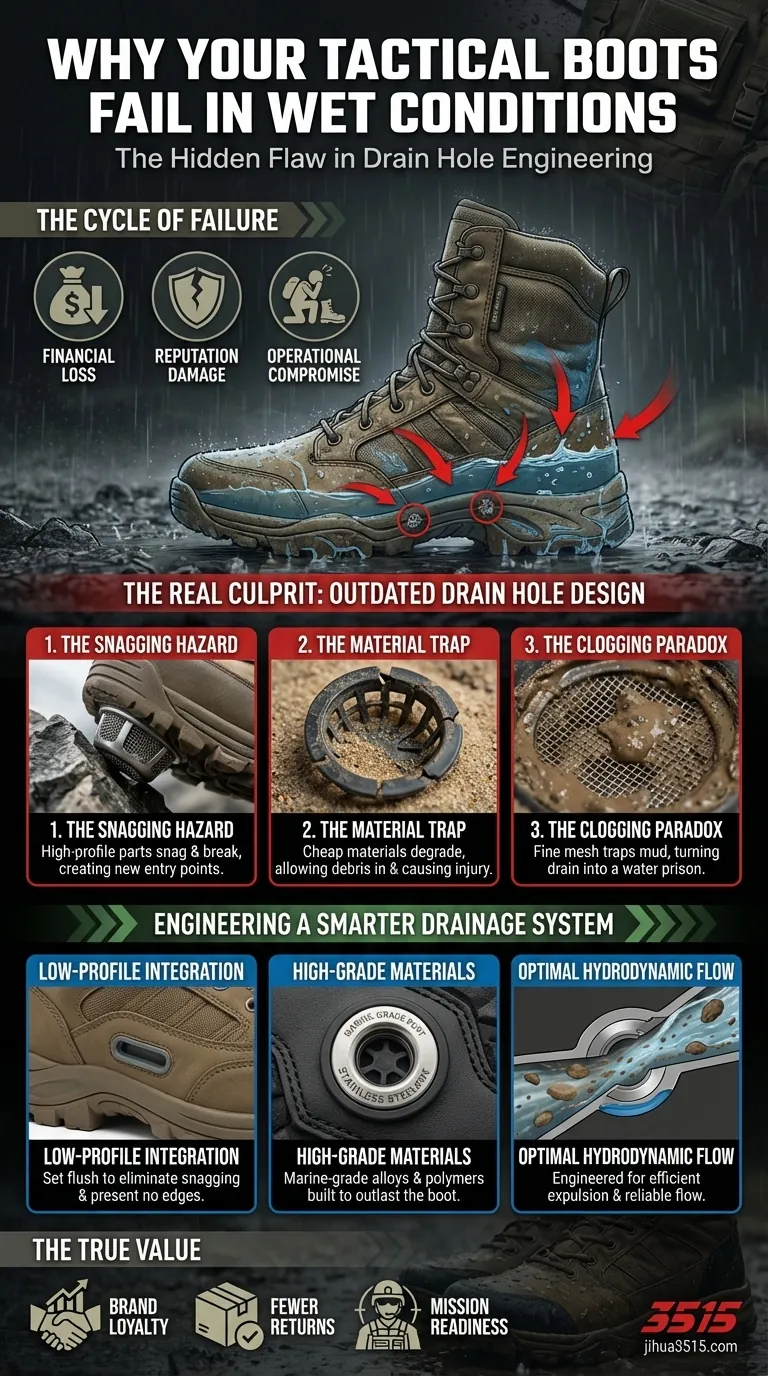
The Cycle of Failure: Why "Tougher" Boots Keep Letting You Down
This isn't an isolated incident. It’s a frustratingly common story in the performance footwear industry. When boots designed for wet conditions fail, the typical response is to look for surface-level fixes: demand a boot with a thicker sole, specify more stitching, or switch to a supplier who promises a "tougher" material.
But these are shots in the dark. They often lead to a cycle of trial and error that fails to address the real problem, resulting in severe consequences:
- Financial Loss: The initial investment is wasted, and the cost of replacement, shipping, and potential contract penalties skyrockets.
- Reputation Damage: Your brand or agency becomes associated with unreliable gear. Trust, once lost, is incredibly difficult to regain.
- Operational Compromise: For teams in the field, this is more than an inconvenience. Waterlogged boots increase fatigue, cause debilitating blisters and sores, and can directly compromise mission readiness and safety.
The frustrating part is that these boots are failing despite having the "correct" features. The problem lies deeper.
The Real Culprit: It’s Not the Water, It’s the Exit Strategy
The surprising truth is that the problem isn't water getting into the boot—in a jungle or swamp, that’s inevitable. The real problem is a catastrophic failure of the water's exit strategy. The culprit is the outdated engineering of the common drain hole.
For decades, this tiny component has been a major point of failure, but its flaws are often misunderstood. It fails in three specific ways:
1. The Snagging Hazard: A High-Profile Mistake
Traditional drain holes often used bulky, protruding metal or plastic strainers. While they looked tough, their high profile made them magnets for snagging on rocks, roots, and debris. A single impact could bend or break the strainer, rendering the drainage system useless or, worse, creating a new entry point for sharp objects.
2. The Material Trap: Designed to Degrade
The materials used in older strainers were often an afterthought—cheap alloys or brittle plastics. Constant exposure to moisture, grit, and friction caused them to corrode, crack, and break down far faster than the leather and nylon of the boot itself. A broken strainer doesn't just stop working; it allows sand and pebbles inside, creating friction that leads directly to injury.
3. The Clogging Paradox: The Exit Becomes a Prison
The most critical failure is in the design of the strainer itself. To block debris, the mesh must be fine. But make it too fine, and it instantly clogs with mud and silt. Once clogged, the drain hole transforms from an escape route into a one-way valve that traps water inside the boot. The boot's weight doubles, and the foot remains submerged, accelerating skin breakdown.
Trying to fix this by simply adding more poorly designed holes only multiplies the points of failure. The solution isn't more holes; it's a smarter system.
From Flaw to Feature: Engineering a Smarter Drainage System
To permanently solve this problem, you need a manufacturing partner who understands that a boot is a system of interconnected parts, not just a collection of features. The design of the drainage port must be as thoughtfully engineered as the sole and upper.
This is where manufacturing philosophy makes all the difference. At 3515, we address the root cause of drainage failure by building solutions directly into our production process:
- To combat snagging, we manufacture boots with low-profile, integrated drainage ports. These are set flush with the boot's material, presenting no edges to catch on the environment. They drain effectively without creating a new vulnerability.
- To prevent material degradation, we utilize high-grade, corrosion-resistant materials. Depending on the boot's specific requirements, this includes marine-grade stainless steel and durable, impact-resistant polymers that are built to outlast the boot itself.
- To eliminate clogging, our drainage ports are engineered for optimal hydrodynamic flow. They are designed with non-clogging geometries that expel water and silt efficiently while reliably blocking larger debris.
This isn't about adding a component; it's about engineering a functional system based on a deep understanding of why the old methods failed. It's the difference between a boot that just has drain holes and one that actually works.
Beyond Dry Feet: The True Value of Dependable Gear
Solving the drainage problem isn't just about preventing wet feet. It's about unlocking a new level of performance, reliability, and trust for your entire operation. When this fundamental issue is properly addressed at the manufacturing level, it creates a ripple effect of positive outcomes:
- For Brand Owners: You can confidently stand behind your product's performance in the most demanding conditions, reducing warranty claims and building powerful brand loyalty.
- For Distributors: You can provide your clients with gear that works as advertised, leading to fewer returns and a reputation for sourcing only the best.
- For Bulk Clients & Agencies: You equip your teams with footwear that enhances their effectiveness and endurance, ensuring they can focus on the mission, not on their gear.
The effectiveness of a boot often comes down to the details that are easiest to overlook. The drainage system is a perfect example of how a small, well-engineered component can be the difference between success and failure. If your current footwear solutions are plagued by issues that seem minor but cause major operational headaches, it's time to partner with a manufacturer who understands that excellence is engineered from the ground up. Let's discuss how our production capabilities can build true reliability into your next footwear contract. Contact Our Experts.
Visual Guide
Related Products
- Durable Leather Tactical Boots Wholesale & Custom Manufacturing for Brands
- High-Traction Suede Tactical Boots Wholesale & Custom Manufacturing
- Durable Leather High-Ankle Tactical Boots for Wholesale & Custom Manufacturing
- Durable Mid-Cut Tactical Boots for Wholesale & Private Label
- Wholesale Waterproof Tactical Boots Custom Suede & High-Traction Soles
Related Articles
- Why Your Tactical Boots Wear Out So Fast—And the Procurement Mistake Behind It
- The Agility-Protection Paradox: Deconstructing Safety in Modern Tactical Footwear
- Why Your Tactical Boots Keep Failing—And Why 'Tougher' Isn't the Answer
- How Tactical Boots Deliver Long-Term Value: A Cost & Performance Breakdown
- The Procurement Officer's Gamble: Why 'Tough Enough' Isn't Good Enough for Tactical Boots















