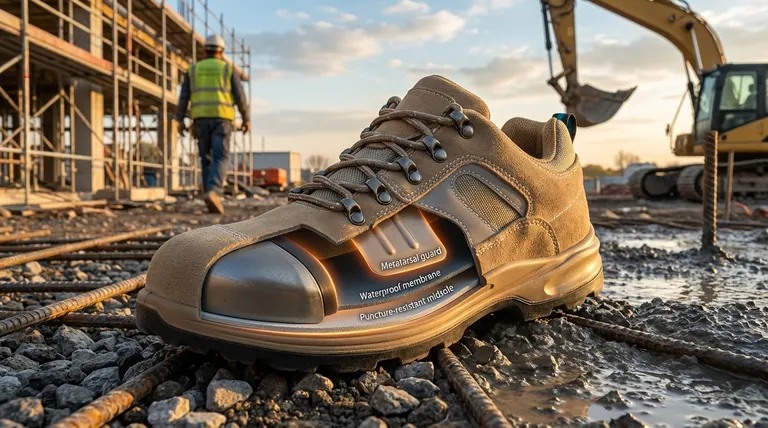
The All-Features Fallacy
We have a cognitive bias for "more." When faced with a choice, we often gravitate toward the option with the longest feature list. We assume the product with the most capabilities is inherently the best, the safest.
This is a dangerous assumption when choosing a work boot.
The most effective boot isn't the one with every conceivable layer of protection. It's the one with the precise architecture for the hazards you face daily. A heavily insulated, steel-plated boot is a liability in a commercial kitchen, just as a simple slip-resistant shoe is useless on a demolition site.
Safety isn't about invulnerability; it's about intelligent defense.
Protection Against Invisible Forces
The most critical safety features are often those that guard against unseen or unpredictable hazards. The steel toe protects against the obvious threat of gravity, but what about electricity, punctures, and slips?
The Duality of Electricity: EH vs. ESD
An electrician and a microchip fabricator both work with electricity, but their needs are polar opposites.
-
Electrical Hazard (EH) boots are insulators. They are engineered to impede the flow of electricity, providing a barrier against accidental contact with live circuits. They save the wearer.
-
Electrostatic Dissipative (ESD) boots are conductors. They prevent the buildup of static electricity on the body, safely discharging it into the ground. They save the sensitive equipment.
Choosing the wrong one isn't just ineffective; it's catastrophic.
The Ground Beneath Your Feet
A standard sole protects you from the terrain, but not from what's in the terrain. Nails, scrap metal, and rebar present a constant threat on construction sites.
Puncture-resistant boots solve this by embedding a protective plate—either steel or a flexible composite material—into the midsole. It’s a hidden shield, an engineered certainty against a sudden, piercing injury from below.
The Problem of Gravity
A safety toe is non-negotiable for protecting against falling objects. But it only covers the tips of your toes. A heavy pipe or a dropped engine block can easily crush the delicate metatarsal bones on the top of the foot.
Metatarsal guards extend that shield upward, creating a comprehensive zone of impact protection that follows the anatomy of the foot.
Mastering the Environment
Beyond sudden impacts, a boot must function as a personal environmental control system, managing water, temperature, and traction for hours on end.
Waterproof vs. Water-Resistant
These terms are not marketing synonyms; they represent a fundamental difference in design.
- Water-resistance is a topical treatment. It can handle a light drizzle but will fail under sustained exposure.
- Waterproofing is an architectural feature. It involves a sealed, internal membrane that creates an impermeable barrier. For anyone working in mud, rain, or deep puddles, this is the only real solution.
The Physics of a Footstep
Slips and falls remain one of the most common causes of workplace injury.
Slip-resistant outsoles are a masterclass in material science and fluid dynamics. They use softer rubber compounds for better grip and feature intricate tread patterns designed to channel liquids away from the point of contact, maximizing the surface area connected to the ground.
The Engineering Trade-Off
Every added feature introduces a trade-off, typically in weight, flexibility, or breathability. This is where understanding your primary risk is paramount.
-
Protection vs. Comfort: A steel midsole is heavier and less flexible than a composite one. A fully waterproof boot is less breathable than a vented one. The goal is not to eliminate these trade-offs, but to choose the ones that make sense for your workday.
-
The Mandate of Certification: A feature without certification is just a claim. Legitimate Personal Protective Equipment (PPE) is tested against established standards, like ASTM F2413 in the U.S. This mark is your only guarantee that the boot's architecture will perform as designed.
Designing for the Task, Not the Ego
The process of selecting the right boot is an exercise in honest self-assessment. What is the single greatest risk you face? Start there, and build your ideal boot around that core requirement.
| Feature | Primary Benefit | Ideal For |
|---|---|---|
| Electrical Hazard (EH) | Reduces risk of electric shock | Electricians, utility workers |
| Puncture-Resistant Midsole | Protects against sharp objects | Construction, demolition, waste management |
| Metatarsal Guard | Shields top of foot from impacts | Heavy industry, manufacturing, welders |
| Slip-Resistant Outsole | Improves traction on slick surfaces | Kitchens, auto shops, healthcare |
| Waterproof Membrane | Keeps feet dry in wet conditions | Outdoor work, plumbing, agriculture |
| Thermal Insulation | Retains heat in cold environments | Cold storage, winter construction |
As a large-scale manufacturer, we at 3515 understand this complex interplay of materials, design, and specific workplace hazards. We specialize in producing the full spectrum of safety footwear, enabling distributors and brand owners to equip their clients with boots engineered for their exact needs. We don’t just build boots; we build tailored safety solutions.
To ensure your team has the precise protection it needs, Contact Our Experts
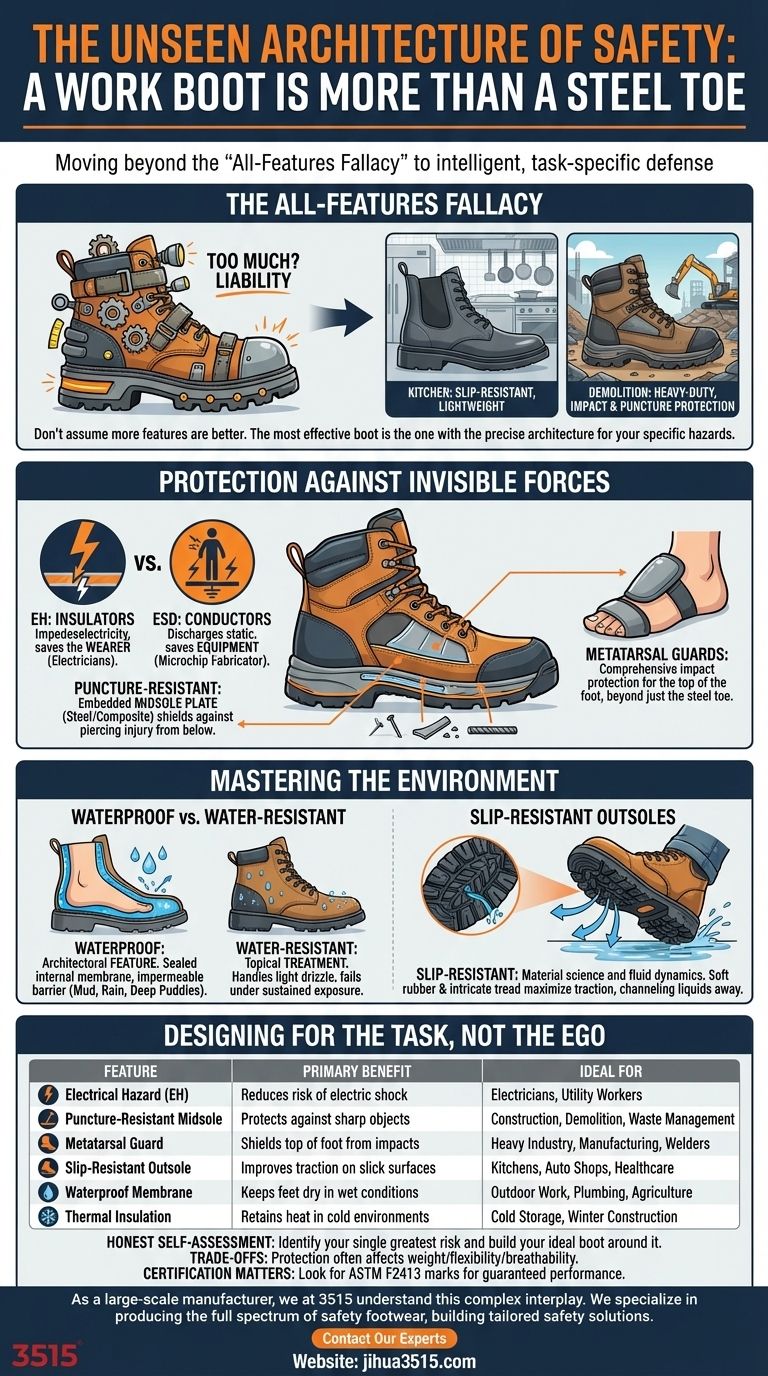
Visual Guide
Related Products
- Durable Leather Work Boots for Wholesale & Custom Manufacturing
- Durable Leather Work Boots for Wholesale & Custom OEM Manufacturing
- Durable Leather Work Boots Wholesale Manufacturer & Custom Factory
- Durable Leather Moc Toe Work Boots for Wholesale & Custom Manufacturing
- Wholesale Durable 6-Inch Work Boots | Custom & Private Label Manufacturer
Related Articles
- How Job-Specific Work Boot Designs Enhance Safety and Efficiency
- How Work Boots Engineer Safety: The Science Behind Impact and Compression Protection
- The Unseen Physics of Failure: Why Work Boots Are Your Most Critical PPE
- How to Extend Work Boot Lifespan: Science-Backed Care for Safety & Savings
- How Work Boots Became Everyday Heroes: Comfort, Health & Style Combined