The Last Line of Defense
A worker's boot is the final, critical interface between them and their environment. It’s the point of contact with uneven ground, unseen hazards, and immense physical forces. Yet, we often choose this crucial piece of equipment with less thought than we give our casual sneakers.
The small tag filled with codes—I/C, EH, PR, SR—is not a list of features. It is a language. It is a highly compressed summary of engineering decisions, material science, and regulatory standards, all designed to answer one question: "How will this boot protect you when things go wrong?"
Understanding this language transforms your perspective. You stop buying a boot and start selecting a piece of precision-engineered Personal Protective Equipment (PPE).
The Grammar of Protection
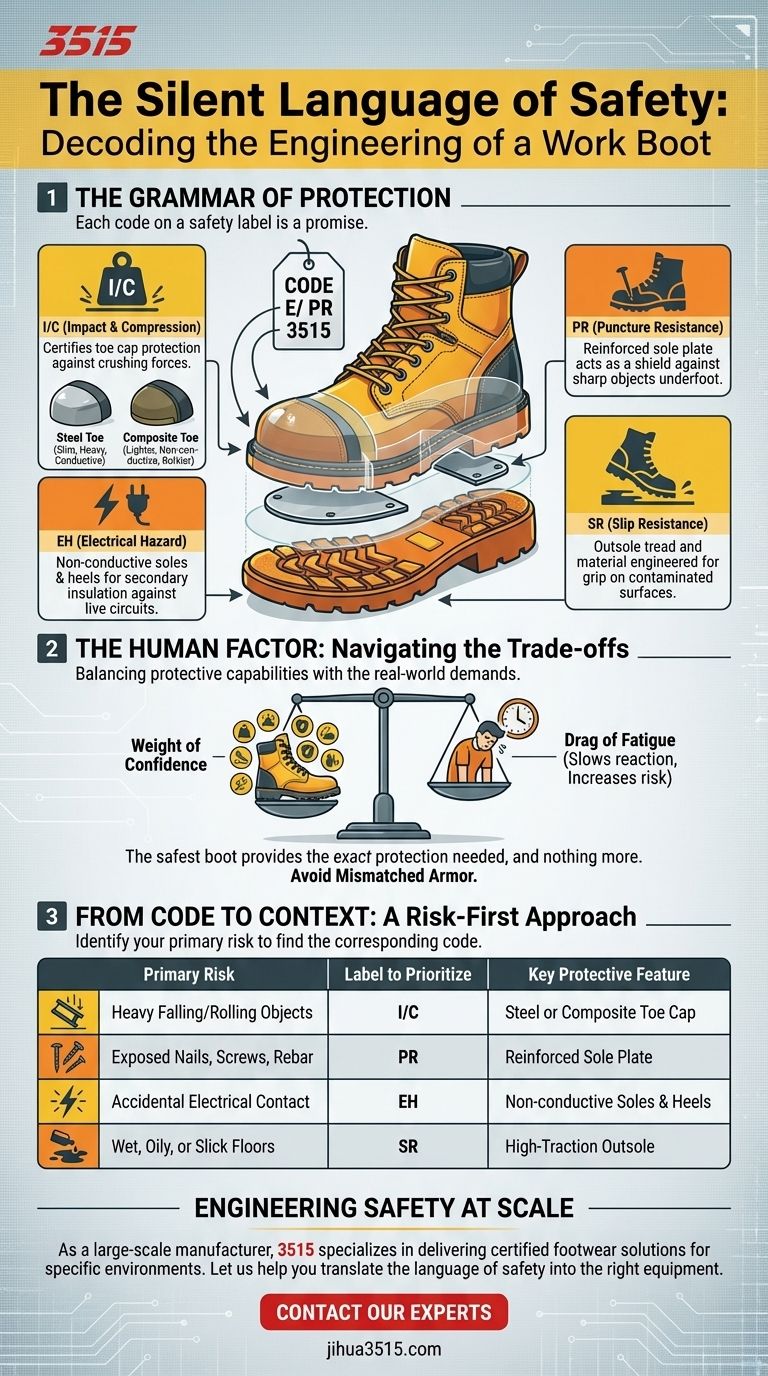
Each code on a safety label is a promise. It communicates a specific defense mechanism built into the boot's architecture. To ignore them is to walk onto a job site unable to read the warning signs.
More Than Just a Steel Toe
The most famous feature, the protective toe, is where most people’s knowledge begins and ends.
- Impact (I) & Compression (C): These ratings certify the toe cap's ability to protect against heavy falling objects and crushing forces. The choice between a traditional steel toe and a modern composite toe is a classic engineering trade-off. Steel offers maximum protection in a slim profile but is heavy and conducts temperature. Composite is lighter and non-conductive but can be bulkier.
The psychological pull of the "steel toe" is strong, but focusing on it alone is like judging a book by its cover. The most severe risks are often the ones you can't see.
Guarding Against Unseen Threats
The most insidious dangers are often hidden underfoot.
-
Puncture Resistance (PR): For anyone on a construction or demolition site, an upturned nail or piece of rebar is a constant threat. A PR-rated boot has a reinforced sole plate that acts as a shield, preventing sharp objects from penetrating the foot from below.
-
Electrical Hazard (EH): For electricians and maintenance workers, the environment itself can be energized. EH-rated boots are built with non-conductive soles and heels, providing a secondary source of insulation against accidental contact with live circuits. It's an invisible shield against an invisible threat.
The Physics of a Sure Footing
Falls, slips, and trips are among the most common workplace accidents. A boot's outsole is not just a layer of rubber; it's a carefully designed system for managing friction.
- Slip Resistance (SR): This rating confirms the outsole has been tested for performance on surfaces contaminated with water, oil, or other liquids. The tread pattern, depth, and material compound are all engineered to channel fluid away and maintain a grip, turning a potentially hazardous floor into a manageable surface.
The Human Factor: Navigating the Trade-offs
There is no single "safest" boot. The concept of safety is always contextual. Choosing the right boot requires balancing its protective capabilities with the real-world demands of the job.
The Weight of Confidence vs. The Drag of Fatigue
A boot loaded with every possible safety feature—steel toe, puncture plate, metatarsal guard—offers immense psychological comfort. But that protection has mass.
Over an eight-hour shift, the extra weight of an over-specified boot leads to physical fatigue. And fatigue is a safety risk in itself. It slows reaction times, impairs judgment, and increases the likelihood of an accident. The safest boot is often the one that provides the exact protection needed, and nothing more.
The Risk of Mismatched Armor
Using the wrong tool for the job is inefficient; using the wrong PPE is dangerous. An electrician wearing heavy, rigid construction boots may be protected from punctures they'll never encounter, but their lack of flexibility and heightened fatigue could make them less agile while working at height or in a tight space.
The goal is not maximum protection. The goal is optimal protection for a specific set of known risks.
From Code to Context: A Risk-First Approach
Making the right choice starts with a simple question: "What is the most likely way I could get hurt today?" By identifying your primary risk, you can instantly find the corresponding code.
| Primary Risk | Label to Prioritize | Key Protective Feature |
|---|---|---|
| Heavy Falling/Rolling Objects | I/C (Impact & Compression) | Steel or Composite Toe Cap |
| Exposed Nails, Screws, Rebar | PR (Puncture Resistance) | Reinforced Sole Plate |
| Accidental Electrical Contact | EH (Electrical Hazard) | Non-conductive Soles & Heels |
| Wet, Oily, or Slick Floors | SR (Slip Resistance) | High-Traction Outsole |
Engineering Safety at Scale
For distributors, brand owners, and organizations responsible for worker safety, navigating this landscape of standards, materials, and human factors is a significant challenge. Ensuring every team has the optimal footwear for their specific environment is not just a matter of compliance—it's a fundamental part of risk management.
As a large-scale manufacturer, 3515 specializes in this precise task. We produce a comprehensive range of certified footwear, encompassing every category of protection. Our capabilities allow us to engineer and deliver specific solutions, from EH-rated boots for utility contractors to PR-rated models for construction crews, ensuring your workforce is equipped with exactly the protection they need.
Let us help you translate the language of safety into the right equipment for your team. Contact Our Experts
Visual Guide
Related Products
- Durable Leather Work Boots for Wholesale & Custom Manufacturing
- Durable Leather Work Boots for Wholesale & Custom OEM Manufacturing
- Durable Leather Work Boots Wholesale Manufacturer & Custom Factory
- Durable Leather Moc Toe Work Boots for Wholesale & Custom Manufacturing
- Wholesale Durable 6-Inch Work Boots | Custom & Private Label Manufacturer
Related Articles
- How Job-Specific Work Boot Designs Enhance Safety and Efficiency
- How Work Boots Engineer Safety: The Science Behind Impact and Compression Protection
- The Unseen Physics of Failure: Why Work Boots Are Your Most Critical PPE
- How to Extend Work Boot Lifespan: Science-Backed Care for Safety & Savings
- How Work Boots Became Everyday Heroes: Comfort, Health & Style Combined