The Confidence of a Sure Footing
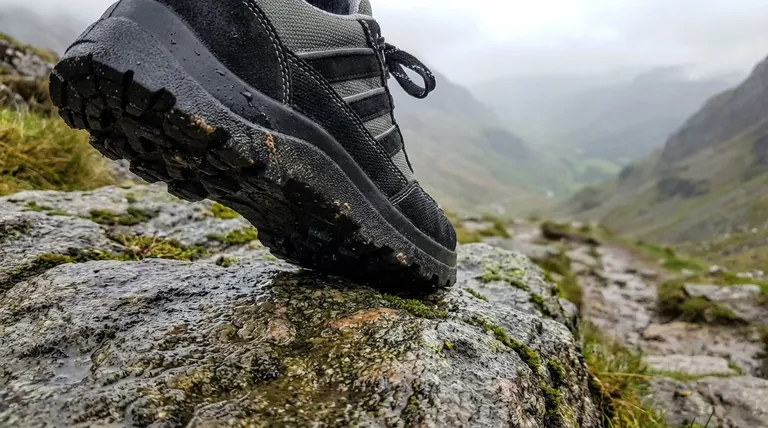
Picture a hiker traversing a wet, angled slab of granite. Below is a steep drop. In that moment, their entire focus narrows to a single point of contact: the rubber sole of their boot. Their safety, and more importantly, their confidence to proceed, depends entirely on the predictable friction generated by that sole.
This isn't just about preventing a slip. It's about a psychological contract. The hiker trusts that the shoe will behave as expected. True safety on the trail comes not from brute force, but from this engineered predictability—a stable, reliable connection between a person and an unpredictable world.
Deconstructing Predictability: The Anatomy of an Outsole
The bottom of a hiking shoe, the outsole, is not a simple piece of rubber. It is a highly engineered system designed to interpret and dominate terrain. Each component serves a distinct purpose in creating that predictable grip.
The Chassis: A Rigid Foundation
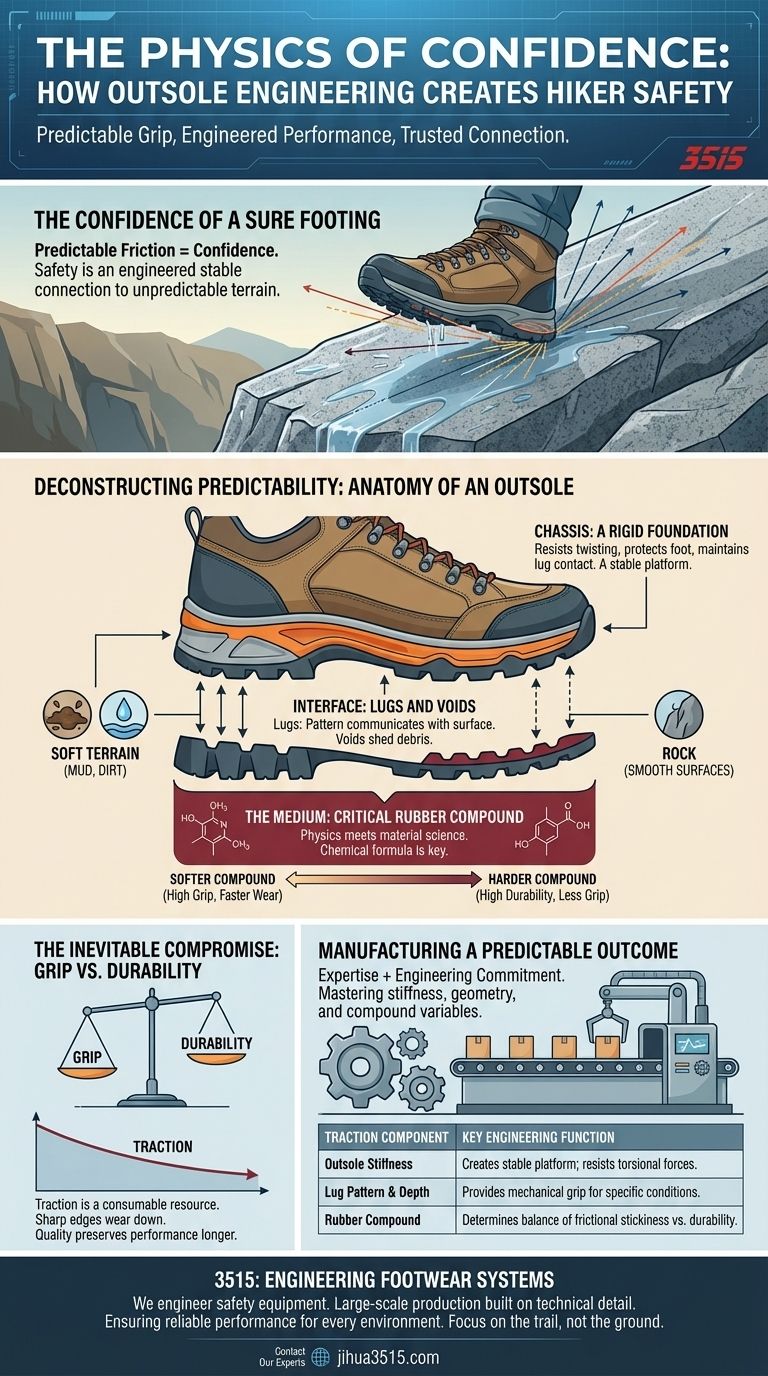
The first principle of control is stability. A rugged, stiff outsole acts as the shoe's chassis. It resists twisting when you step on uneven ground or the edge of a rock.
This rigidity serves two functions: it protects the foot from being bruised by sharp objects, and it creates a consistent, stable platform. This ensures the lugs—the gripping elements—remain in optimal contact with the ground, preventing the micro-instabilities that lead to imbalance and falls.
The Interface: Lugs and Voids
Lugs are the knobs and indentations on the outsole. Their pattern is a language designed to speak to specific surfaces.
- Deep, widely-spaced lugs are designed for soft terrain. They dig into mud, loose dirt, or gravel, while the wide spacing allows the shoe to shed debris efficiently. A clogged tread is a useless tread.
- Shallower, high-surface-area lugs are for rock. They maximize the amount of rubber in contact with a smooth surface, functioning like the tires on a race car to create friction-based grip.
The design of this interface dictates how the shoe will communicate with the ground.
The Medium: The Critical Rubber Compound
The specific chemical formula of the rubber is where physics meets material science. This is the primary trade-off in outsole engineering.
- Softer Rubber Compounds offer phenomenal "sticky" grip. They conform to the micro-texture of rock, providing superb traction on slick surfaces. The cost is durability; they wear down faster.
- Harder Rubber Compounds are built for longevity. They can withstand thousands of miles of abrasive trail but may offer less adhesion on wet, smooth terrain.
The choice of compound is a deliberate engineering decision that defines the shoe's core mission.
The Inevitable Compromise: Engineering for an Imperfect World
No single shoe can be perfect for every condition. Understanding this is key to appreciating the engineering challenge. The goal is not to create one perfect shoe, but to create the right shoe for a specific purpose.
The Grip-Durability Spectrum
Every hiking shoe exists somewhere on a spectrum between maximum grip and maximum durability. A shoe for a rock scrambler has a different mission than a boot for a long-distance thru-hiker. For brand owners and distributors, the critical task is to source footwear that aligns precisely with their customers' intended use. This requires a manufacturer who understands how to navigate this spectrum.
The Slow Decay of Trust
Traction is a consumable resource. Over hundreds of miles, the sharp, biting edges of the lugs wear down and become rounded. The rubber hardens with age and exposure. This isn't just physical wear; it's an erosion of the shoe's ability to provide predictable grip.
This slow decay is why initial manufacturing quality is so critical. A well-designed and properly cured outsole will maintain its performance characteristics for far longer, preserving that essential bond of trust between the hiker and their gear.
Manufacturing a Predictable Outcome
Achieving the right balance of outsole stiffness, lug geometry, and rubber compound is not an accident. It is the result of deep manufacturing expertise and a commitment to performance engineering. For distributors and brands, providing genuinely safe footwear means partnering with a manufacturer who masters these variables.
At 3515, we engineer footwear systems. We understand that for your customers, a shoe is a piece of safety equipment. Our large-scale production capabilities are built on a foundation of getting these technical details right, ensuring every pair delivers the reliable performance required for its designated environment.
| Traction Component | Key Engineering Function |
|---|---|
| Outsole Stiffness | Creates a stable platform; resists torsional forces on uneven ground. |
| Lug Pattern & Depth | Provides mechanical grip tailored for specific conditions (mud vs. rock). |
| Rubber Compound | Determines the balance of frictional 'stickiness' vs. long-term durability. |
Ultimately, a great hiking shoe gives a hiker the freedom to focus on the trail ahead, not the ground beneath their feet. It turns an unpredictable surface into a stable path forward.
For footwear engineered to deliver that confidence, trail after trail, Contact Our Experts.
Visual Guide
Related Products
- Durable Rubber Sole Outdoor Shoes Wholesale & Custom Manufacturing
- Wholesale High-Traction Camo Boots - Custom Manufacturer for Brands
- Wholesale Durable Camouflage Canvas Shoes with High-Traction Cleated Rubber Sole
- Wholesale Durable Camo Canvas Shoes with High-Traction Rubber Soles
- Premium Lightweight Safety Shoes for Wholesale & Bulk Orders
Related Articles
- How Rubber-Soled Shoes Master All Seasons: The Science of Traction and Adaptability
- Why Vulcanized Soles Dominate High-Performance Footwear: A Technical Deep Dive
- How Vulcanized Shoe Construction Delivers Unmatched Durability and Flexibility
- Vulcanized Shoes Decoded: When They Shine and When to Choose Alternatives
- How Precision in Vulcanized Shoe Finishing Defines Durability and Comfort