The Manager's Dilemma
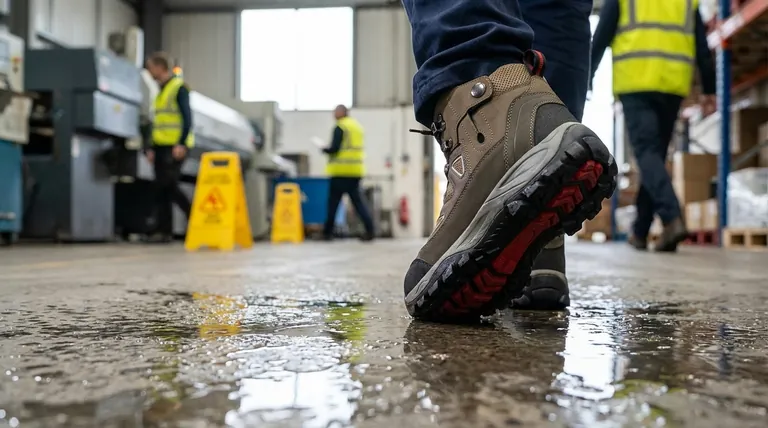
A safety manager is staring at an incident report. A worker slipped on a wet floor, resulting in a serious fall. The details are frustratingly familiar.
But one detail stands out: the employee was wearing brand new, fully "compliant" safety boots. The paperwork all checked out. The boots were certified to ASTM F2413-18. Yet, here was the injury report.
This scenario reveals a dangerous psychological trap in workplace safety: the belief that "compliance" equals "comprehensive protection." It’s the tendency to check a box without understanding the system behind the standard.
A System of Two Halves
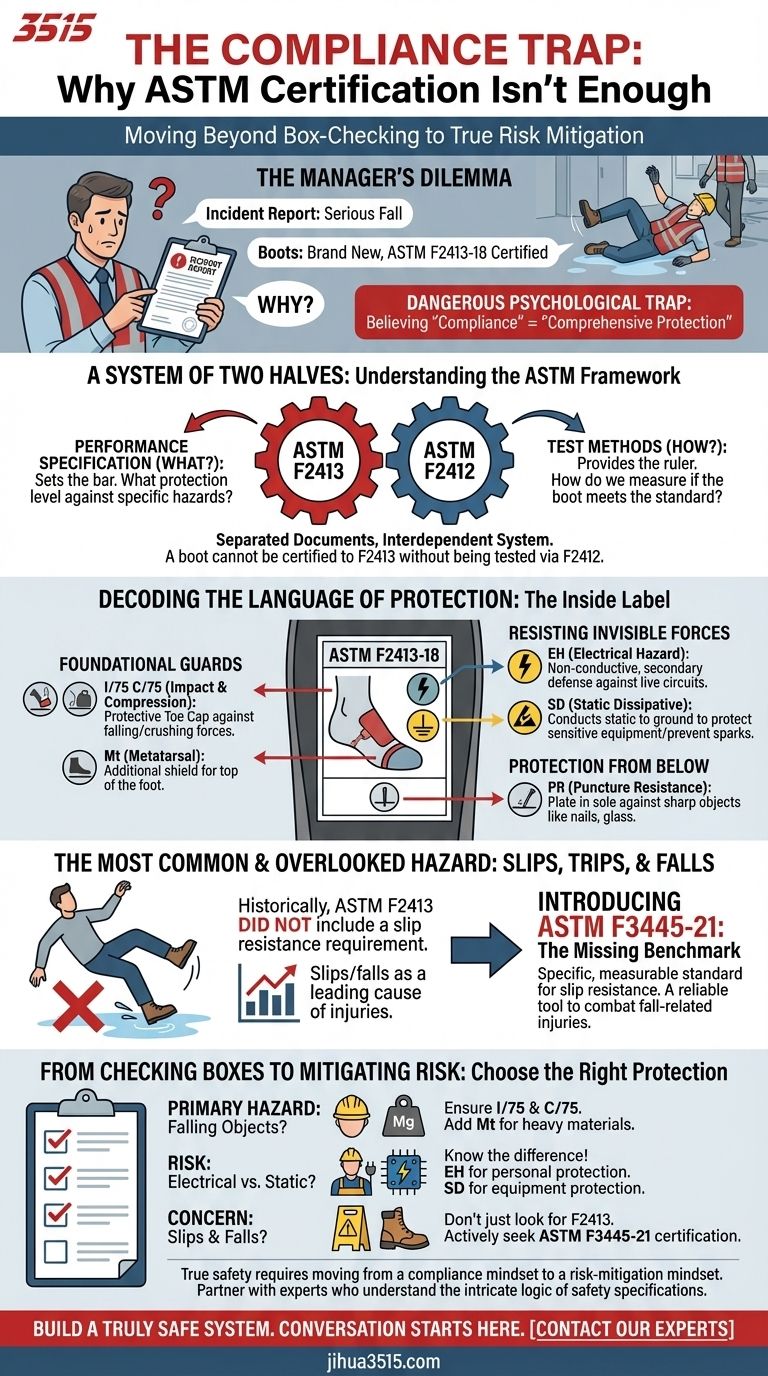
To navigate safety footwear, you must understand that the ASTM standards are built on two interdependent pillars. They are separate documents that function as a single system.
-
ASTM F2413: The Performance Specification. This is the standard everyone knows. It sets the performance requirements. It answers the question: What level of protection must this boot provide against a specific hazard?
-
ASTM F2412: The Test Methods. This is the procedural rulebook. It details the precise laboratory methods for testing the protections defined in F2413. It answers: How do we measure if the boot has met the performance standard?
In short, F2413 sets the bar. F2412 provides the ruler. A boot cannot be certified to the first without being rigorously tested according to the second.
Decoding the Language of Protection
The ASTM F2413 standard requires a clear label inside each shoe, acting as a concise summary of its capabilities. Understanding this language allows you to move beyond generic compliance and match footwear to your actual worksite risks.
H3: The Foundational Guards
-
Impact (I) & Compression (C): This is the most basic requirement, referring to the protective toe cap. It guards against falling objects (impact) and crushing forces from rolling equipment (compression).
-
Metatarsal (Mt): This provides an additional shield over the delicate bones on the top of the foot, crucial in environments where objects can drop or roll onto the entire foot.
H3: Resisting Invisible Forces
-
Electrical Hazard (EH): This footwear is designed with non-conductive, shock-resistant soles and heels. It’s a secondary line of defense against accidental contact with live electrical circuits.
-
Static Dissipative (SD): Engineered to reduce the buildup of static electricity by conducting it safely to the ground. This isn't for protecting the wearer from shock, but for protecting sensitive electronic equipment or preventing sparks in flammable environments.
H3: Protection from Below
- Puncture Resistance (PR): This indicates a puncture-resistant plate built into the sole to protect the foot from stepping on sharp objects like nails, scrap metal, or glass.
The Most Common—and Overlooked—Hazard
Here we return to our safety manager's dilemma. The most common pitfall in specifying safety footwear is assuming a single standard covers everything.
Historically, ASTM F2413 did not include a requirement for slip resistance.
This is a monumental gap. Slips, trips, and falls are consistently one of the leading causes of disabling workplace injuries. The human tendency is to assume a rugged "safety boot" is inherently "non-slip." The standards, however, made no such promise.
To address this critical oversight, a new, dedicated standard was introduced: ASTM F3445-21. This standard provides a specific, measurable benchmark for slip resistance, finally giving safety professionals a reliable tool to combat fall-related injuries.
From Checking Boxes to Mitigating Risk
True safety isn't about buying a certified product; it's about deploying the right certified product for your environment. It requires moving from a compliance mindset to a risk-mitigation mindset.
- Is your primary hazard falling objects? Ensure the I/75 and C/75 ratings are on the label. If heavy materials are a risk, add Metatarsal (Mt) protection.
- Are electricians or assembly workers at risk? You must know the difference between Electrical Hazard (EH) for personal protection and Static Dissipative (SD) for equipment protection. They are not interchangeable.
- Are slips and falls your main concern? Don't just look for F2413. Actively seek out footwear that is also certified to the ASTM F3445-21 slip resistance standard.
Navigating these intersecting standards for a large workforce can be complex. The process demands a partner who understands not just manufacturing, but the intricate logic of safety specifications. As a large-scale producer, 3515 builds footwear to meet these exact ASTM performance criteria, ensuring that the boot you specify provides the protection you expect.
Building a truly safe system starts with a conversation about your unique operational risks. Contact Our Experts
Visual Guide
Related Products
- Wholesale Durable Safety Boots Manufacturer Customizable Steel Toe Work Boots
- Premium Wholesale Wheat Nubuck Safety Boot with Rapid Lacing System
- Premium Wholesale Tactical Style Safety Shoes Boots with Quick Lacing
- Wholesale Leather Safety Boots with Customizable Protective Toe
- Wholesale Durable Safety Boots | Custom Steel Toe & Puncture-Resistant Manufacturing
Related Articles
- Steel Toe Work Boots: Balancing Safety and Comfort for Demanding Jobs
- The Unseen Engineering: Why Steel Toes Succeed or Fail in Oily Environments
- How to Choose Steel Toe Boots: Safety, Comfort, and Job-Specific Features
- How Modern Steel Toe Boots Achieve Safety Without Sacrificing Comfort
- How to Choose Between Steel and Composite Toe Boots for Workplace Safety