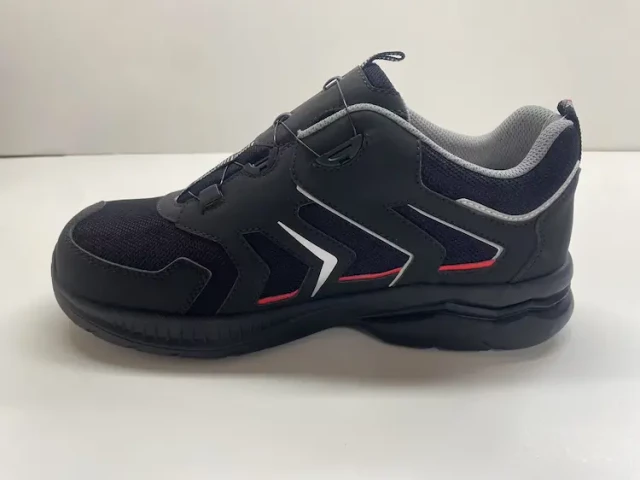
Security guards face unpredictable hazards daily—from slippery floors to unstable surfaces. The right safety shoes can mean the difference between staying upright and risking injury. But with confusing ratings like SB SRC and SRA, how do you pick the best option? This guide breaks down the key differences, testing standards, and workplace scenarios to help you match footwear to your specific risks.
Understanding Slip Resistance Ratings
Slip resistance isn’t a one-size-fits-all feature. The EN ISO 20345 standard categorizes safety shoes based on rigorous testing, with two critical ratings for security professionals:
- SRA: Tested on ceramic tiles with a soapy solution, simulating environments like hospitals or cleaning areas.
- SRC: The highest slip resistance, tested on both ceramic tiles (with soap) and steel plates (with glycerin), ideal for oil-heavy or industrial settings.
Key Takeaway: SRC offers broader protection, but SRA may suffice for controlled, indoor environments.
Key Differences in Testing Conditions
-
SRA Testing:
- Surface: Ceramic tile
- Contaminant: Sodium lauryl sulfate (soap)
- Simulates: Spills in lobbies, restrooms, or food service areas
-
SRC Testing:
- Adds a second test: Steel plates lubricated with glycerin
- Simulates: Machine shops, garages, or kitchens with oily floors
Why It Matters: Security guards patrolling a mall (mostly dry, tiled floors) might prioritize SRA, while those in a factory need SRC’s dual resistance.
Workplace Scenarios Where Each Rating Excels
| Rating | Best For | Risks Addressed |
|---|---|---|
| SRA | Indoor security (e.g., offices, schools) | Wet cleaning spills, polished floors |
| SRC | High-risk sites (e.g., warehouses, parking garages) | Oil, grease, mixed contaminants |
Example: A guard at a hospital faces frequent mopping but minimal oil—SRA is cost-effective. For a patrol officer in a mechanic’s garage, SRC is non-negotiable.
How to Match Safety Shoes to Your Security Role
Step 1: Assess Environmental Hazards
Ask:
-
"How often do I encounter liquids?"
- Occasional spills: SRA
- Constant oils/grease: SRC
-
"Are floors primarily tile, metal, or concrete?"
- Steel surfaces demand SRC’s glycerin resistance.
Pro Tip: Check incident reports for past slip-related injuries to identify patterns.
Step 2: Balance Compliance and Cost
- Regulations: EN ISO 20345 mandates basic slip resistance (SB) for all safety shoes. SRC/SRA are optional upgrades.
- Budget: SRC shoes typically cost more due to advanced materials. Weigh this against injury risks and downtime costs.
Trade-off: For low-risk sites, SRA meets compliance without over-investing.
Final Recommendation
For security guards, prioritize:
- SRC if hazards include oils, industrial fluids, or mixed surfaces.
- SRA for primarily indoor, soap/water exposures.
"The right shoe isn’t just about compliance—it’s about confidence in every step you take."
Upgrade Your Team’s Safety Today
3515 manufactures slip-resistant footwear designed for security professionals. Whether you need SRA for light hazards or SRC for heavy industrial use, our bulk solutions ensure durability and protection. [Contact 3515] to equip your guards with shoes that match their real-world risks.
Related Products
- Premium Suede Sport Safety Shoes for Wholesale & Bulk Orders
- Premium Lightweight Safety Shoes for Wholesale & Bulk Orders
- Wholesale Anti-Smash & Puncture-Proof Safety Shoes Custom Manufacturing for Brands
- Premium KPU Injection Athletic Style Safety Shoes
- Premium Safety Shoes with Rotating Buckle Safety Sneakers
Related Articles
- The Ghost in the Machine: Why an Obsolete Footwear Standard Creates Modern Risk
- Beyond the Steel Toe: The Hidden Ergonomics of Workplace Safety
- Why Traditional Laces Are a Hidden Safety Risk—And What to Do About It
- The True Cost of Skipping Safety Shoes: Long-Term Risks and Smart Protection
- How Safety Shoe Engineering Prevents Workplace Injuries Across Industries



















