The Compliance Trap: Why a Sticker Isn't a Strategy
A worker slips on an oily floor. A box is dropped on a foot. These aren't just isolated incidents of bad luck; they are failures in a system. And often, the single point of failure is a pair of boots chosen to check a box rather than to solve a problem.
The ASTM F2413-18 standard is the bedrock of safety footwear. It provides a crucial, non-negotiable baseline for impact and compression resistance. Psychologically, meeting this standard feels like victory. It provides the comfort of compliance.
But this comfort is a trap. It encourages us to see safety as a checklist, where the goal is to satisfy a regulation. True safety, however, is an engineering discipline. It begins not with a standard, but with a rigorous analysis of the specific environment where work gets done.
Compliance is the floor, not the ceiling.
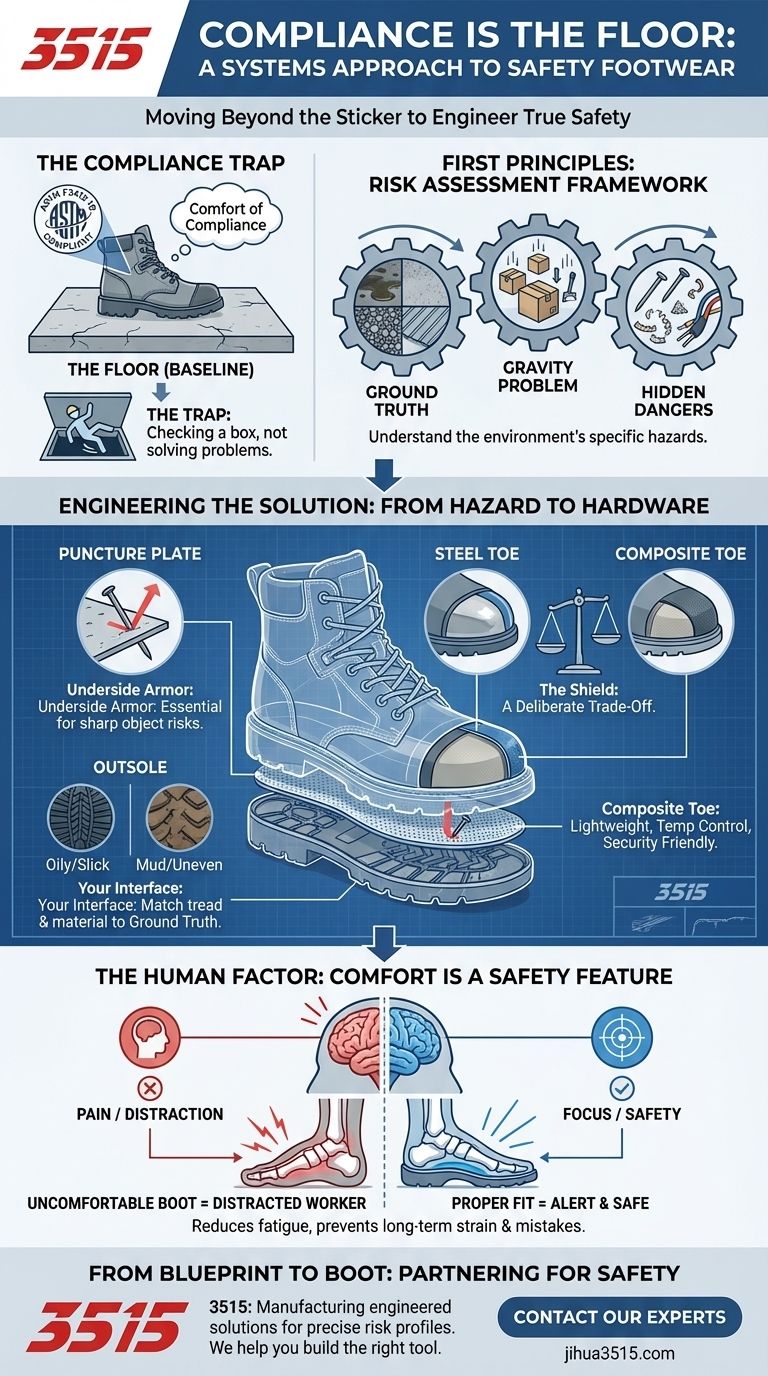
First Principles: A Risk Assessment Framework
Before you can choose the right tool, you must deeply understand the job. A formal risk assessment isn't paperwork; it's a diagnostic process. It's about breaking down the work environment into its fundamental hazards.
Think like a systems engineer debugging a complex machine. You must isolate the variables.
- The Ground Truth: What are your employees walking on for eight to ten hours a day? Is it smooth concrete, slick with oil and water? Is it uneven gravel? Is it a metal roof on a hot day? The surface is the primary interface.
- The Gravity Problem: What are the risks from above? The weight and frequency of falling objects determine the level of impact protection required.
- The Hidden Dangers: Are there stray nails, metal shavings, or other sharp objects on the ground? Is there a risk of contact with live electrical circuits? These threats require specific, dedicated defenses.
Only after mapping these precise hazards can you begin to engineer a solution.
Engineering the Solution: From Hazard to Hardware
With a clear hazard blueprint, selecting footwear transforms from a purchasing decision into a technical specification. Every component of the boot becomes a tool designed to mitigate a specific, identified risk.
The Outsole: Your Interface with the World
Slips, trips, and falls are among the most common workplace injuries. The outsole is the single most important component for preventing them. Its material composition and tread pattern must be matched directly to the "Ground Truth" you identified. A sole designed for mud is useless on an oily shop floor.
The Shield: A Deliberate Trade-Off
The safety toe is the most recognized feature, but the choice between steel and composite materials is a critical engineering trade-off.
| Toe Type | Key Advantages | Best For |
|---|---|---|
| Steel | The traditional standard; can have a thinner profile. | Environments with strict site regulations; maximum impact resistance. |
| Composite | Lighter weight; does not conduct heat/cold; won't trip metal detectors. | Jobs requiring long hours of walking; extreme temperatures; security checkpoints. |
The lighter weight of a composite toe isn't a luxury; it's a performance feature. Over a 10,000-step day, those few ounces translate into a significant reduction in fatigue, which directly impacts worker alertness and safety.
The Underside Armor: Puncture Plates
For environments like construction or demolition sites, a puncture-resistant plate isn't optional. It’s the difference between a minor incident and a debilitating injury.
The Human Factor: Why Comfort Is a Critical Safety Feature
Here is the most overlooked truth in safety equipment: an uncomfortable boot is an unsafe boot.
Heavy-duty safety footwear does not "break in" like a pair of running shoes. An improper fit from day one creates persistent pain and alters a worker's gait, leading to long-term strain.
More immediately, discomfort is a distraction. A distracted worker is a dangerous worker. If an employee is constantly thinking about how much their feet hurt, they are not fully focused on the task at hand. This is how mistakes happen.
A proper fit, adequate cushioning, and arch support aren't amenities. They are core safety features that ensure the equipment is worn correctly and doesn't become a hazard itself.
From Blueprint to Boot: Building a Coherent Safety Program
Viewing safety footwear through this lens—as an engineered solution to a specific set of problems—is the only way to build a truly effective program. It requires a partner who understands this systems-level approach.
As a large-scale manufacturer, 3515 works with distributors, brand owners, and organizations to produce footwear that aligns with precise risk profiles. Our capabilities allow us to create boots that solve for specific variables—from high-traction outsoles for slick environments to lightweight, EH-rated boots for electricians. We don't just supply inventory; we help you manufacture the right tool for the job.
To build a footwear program that moves beyond the compliance floor and truly protects your people, Contact Our Experts.
Visual Guide
Related Products
- Safety Footwear Wholesale Manufacturer for Custom OEM/ODM Production
- Premium Suede Sport Safety Shoes for Wholesale & Bulk Orders
- Premium Safety Shoes with Rotating Buckle Safety Sneakers
- Premium Lightweight Safety Shoes for Wholesale & Bulk Orders
- Puncture-Resistant Velcro Safety Boots for Wholesale & Custom Manufacturing
Related Articles
- How Safety Footwear Materials Dictate Workplace Protection and Long-Term Value
- How to Match Safety Footwear Features to Workplace Hazards: A Risk-Based Guide
- How Safety Footwear Engineering Solves Industry-Specific Environmental Hazards
- Beyond the Logo: Decoding the Critical Shift from ANSI to ASTM in Safety Footwear
- More Than a Mandate: The Engineering and Psychology of Safety Footwear