The Invisible Failure Point
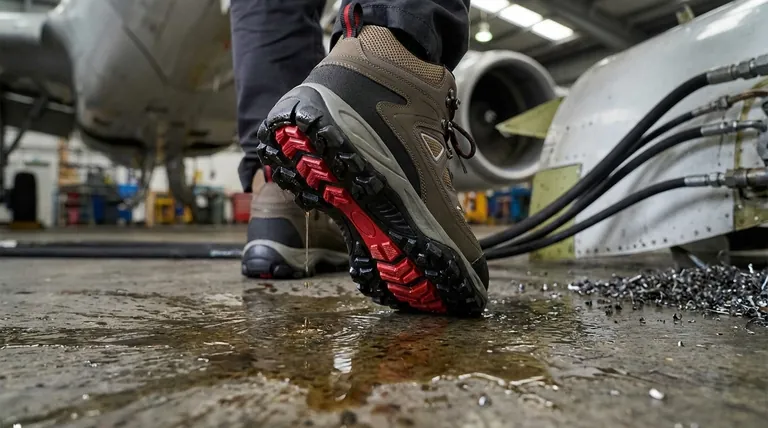
An aircraft technician working on a hangar floor doesn't think about the polymer chains in the soles of her boots. Her focus is on the hydraulics of a landing gear assembly. But the unseen battle is happening under her feet, where every drop of leaked hydraulic fluid, oil, and solvent is actively trying to destroy her only point of contact with the ground.
This is the hidden vulnerability in industrial safety. A boot's failure often isn't a dramatic blowout, but a slow, silent degradation. The sole swells, softens, and loses its grip. It's a failure of the material itself, and it happens long before the tread wears thin.
The Chemistry of Resilience
The challenge for any safety footwear is to withstand this constant chemical assault. This is not a task for ordinary materials. It requires a specific molecular architecture designed for hostility.
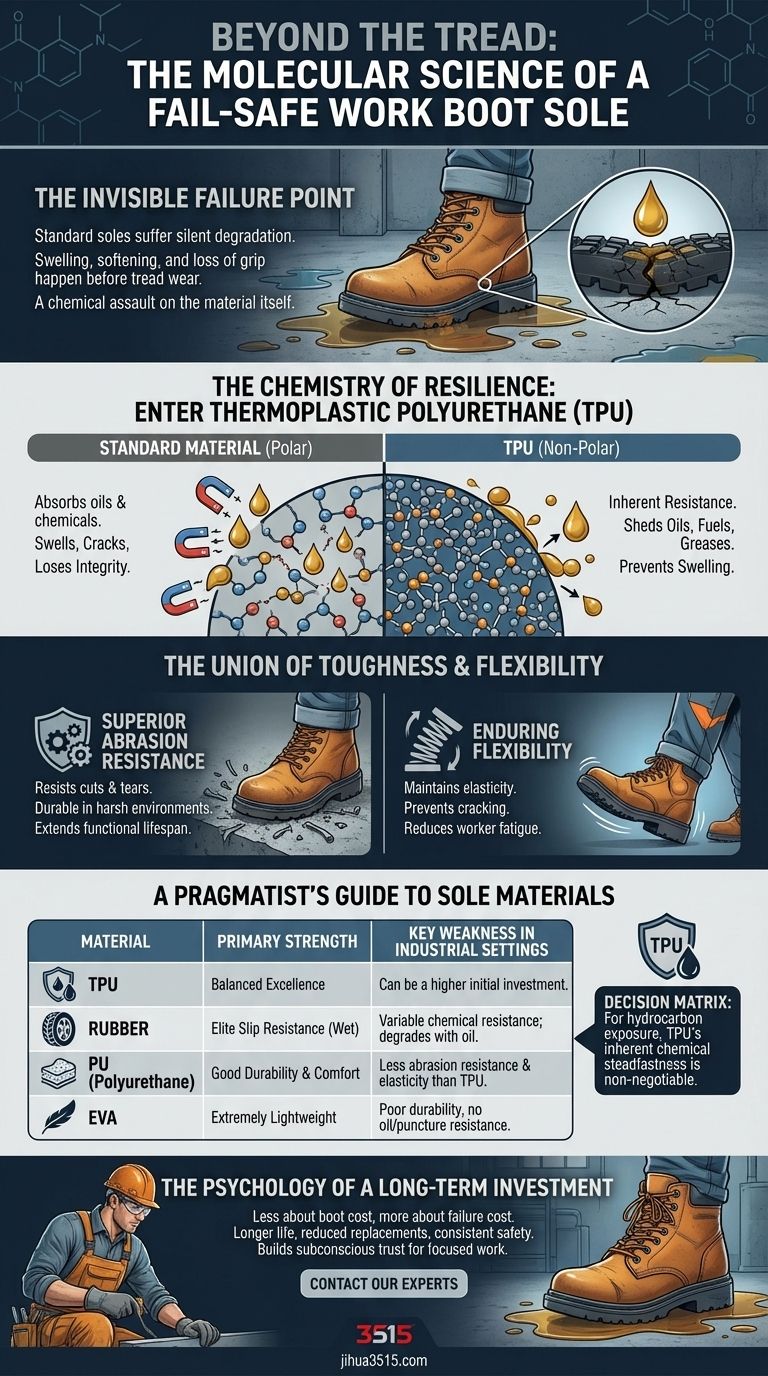
Enter Thermoplastic Polyurethane (TPU). Unlike other materials that might have a surface treatment, TPU's resistance is inherent to its nature. Its polymer structure is non-polar, which means it naturally repels the non-polar molecules found in oils, fuels, and greases. It doesn't absorb them; it sheds them. This prevents the material from swelling, cracking, or losing its structural integrity over time.
The Union of Toughness and Flexibility
The true engineering elegance of TPU lies in its ability to resolve a fundamental paradox: being incredibly tough while remaining remarkably flexible.
- Superior Abrasion Resistance: In environments with rough concrete, metal shavings, and constant scuffing, TPU is exceptionally durable. It resists cuts and tears that would compromise lesser materials, extending the boot's functional lifespan dramatically.
- Enduring Flexibility: Rigidity leads to failure. Stiff materials can crack under the repeated stress of walking, especially in cold temperatures. TPU maintains its elasticity, allowing the foot to move naturally and reducing fatigue over a long shift.
A Pragmatist's Guide to Sole Materials
TPU is a premier solution, but it exists in a landscape of other materials, each with its own profile of strengths and weaknesses. Understanding these trade-offs is crucial for making an informed safety decision, not just a purchasing one.
The choice isn't just about a single feature; it's about the right balance for a specific environment.
| Material | Primary Strength | Key Weakness in Industrial Settings |
|---|---|---|
| TPU | Balanced Excellence | Can be a higher initial investment. |
| Rubber | Elite Slip Resistance (Wet) | Variable chemical resistance; can degrade with oil exposure. |
| PU (Polyurethane) | Good Durability & Comfort | Less abrasion resistance and elasticity than TPU. |
| EVA | Extremely Lightweight | Poor durability and virtually no oil or puncture resistance. |
The decision matrix is clear. For environments defined by hydrocarbon exposure, the inherent chemical steadfastness of TPU is non-negotiable. While a specialized rubber sole might offer a marginal grip advantage on a wet, clean surface, it represents a significant compromise in the presence of oils and chemicals.
The Psychology of a Long-Term Investment
Choosing a TPU sole is less about the cost of a boot and more about the cost of failure.
A boot that lasts twice as long in a harsh environment eliminates the direct cost and logistical friction of replacement. More importantly, it provides a consistent, reliable layer of safety. This builds a subconscious trust between workers and their equipment, allowing them to focus on their tasks without second-guessing the foundation they stand on.
This is the psychology of smart procurement: investing in materials that are engineered for the specific reality of the work environment. Understanding the science behind why a TPU sole resists oil is the first step. The next is partnering with a manufacturer who can execute that science at scale and with uncompromising quality.
As a high-volume producer of industrial footwear, we specialize in building boots designed for the most demanding conditions, leveraging advanced materials like TPU to ensure safety and longevity. If your team operates where chemical and oil resistance is critical, engineering the right sole is the most important decision you can make. Contact Our Experts
Visual Guide
Related Products
- Wholesale Waterproof Tactical Boots Custom Suede & High-Traction Soles
- Durable Rubber Sole Outdoor Shoes Wholesale & Custom Manufacturing
- Wholesale Durable Camouflage Canvas Shoes with High-Traction Cleated Rubber Sole
- Advanced KPU Athletic Safety Shoe with Steel Toe Cap Anti-Slip Rotary Lacing System
- Durable Canvas Work Shoes with Rubber Lug Sole | Wholesale Manufacturer
Related Articles
- The Agility-Protection Paradox: Deconstructing Safety in Modern Tactical Footwear
- Why Your Tactical Boots Wear Out So Fast—And the Procurement Mistake Behind It
- Why Your Tactical Boots Keep Failing—And Why 'Tougher' Isn't the Answer
- How Tactical Boots Solve Real Workplace Challenges in High-Risk Environments
- Camouflage vs. Durability: The False Choice in Tactical Footwear









