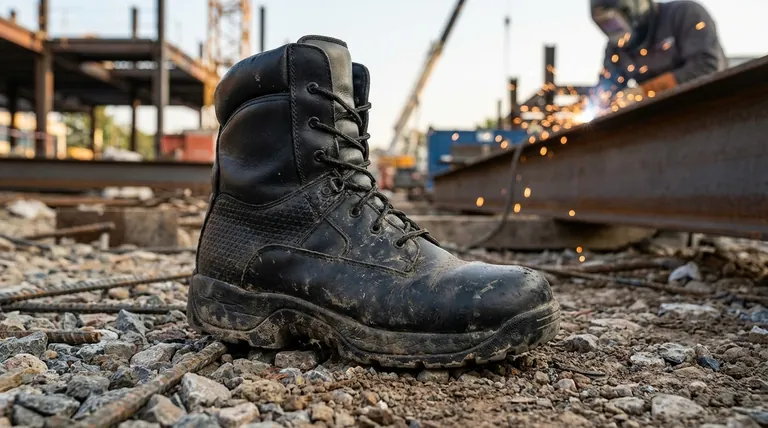
The Invisible Foundation of a Dangerous Job
An electrician kneels in a damp basement, focused entirely on the live panel in front of them. A construction worker navigates a skeleton of steel beams, fifty feet up, their mind on the next rivet.
In these moments of intense concentration, the most valuable piece of equipment is the one they don't have to think about. It's the tool that has already done its job, providing a stable, protective foundation.
This tool is their work boot. And a great work boot isn't just a piece of footwear; it's an engineered system of trust.
The Cognitive Bias of "Tough Enough"
When choosing safety footwear, there's a powerful temptation to rely on simple visual cues. We pick the boot that looks sturdy, assuming its toughness is a proxy for its safety.
This is a cognitive shortcut, substituting a simple judgment for a complex analysis. The reality is that the most effective safety boot isn't the one with the most features, but the one with the correct, certified combination of features designed to mitigate the specific risks of an environment.
Guarding Against Gravity and Negligence
The most immediate threats on any worksite are mechanical: impact from above and puncture from below. The core of a safety boot is engineered to neutralize these two certainties of physics and human error.
The Material Science of the Protective Toe
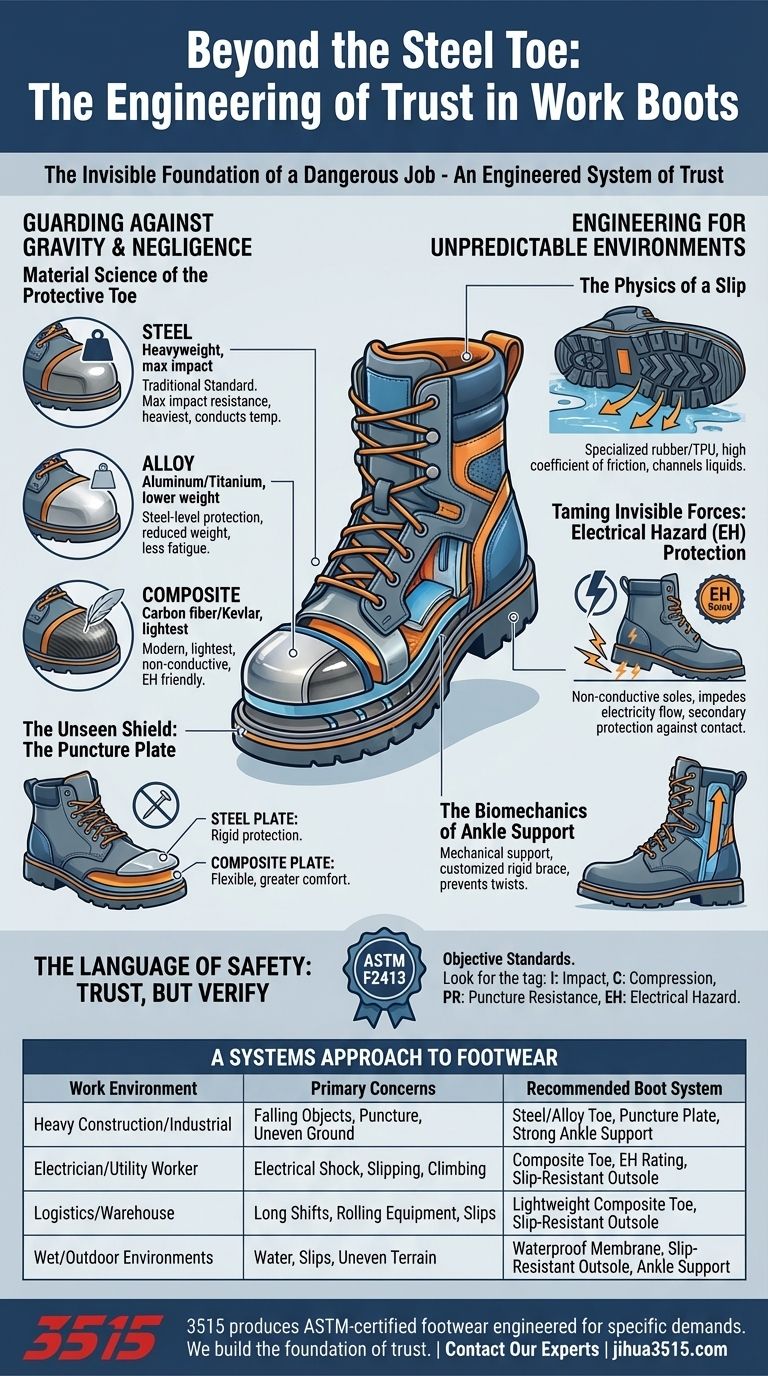
The safety toe is the boot's first line of defense. Its job is to absorb and distribute crushing force, but the material used represents a critical trade-off between absolute protection, weight, and environmental properties.
- Steel: The traditional standard. It offers maximum impact resistance but is the heaviest option and conducts temperature. It's the choice for environments where raw, uncompromising strength is the only priority.
- Alloy: Often aluminum or titanium, providing steel-level protection at a significantly lower weight. This is the solution for reducing fatigue without compromising on impact safety.
- Composite: The modern, intelligent option. Made of non-metal materials like carbon fiber or Kevlar, it's the lightest choice, doesn't conduct electricity or temperature, and is ideal for workers who need EH protection or pass through metal detectors.
The Unseen Shield: The Puncture Plate
A puncture-resistant plate in the midsole protects against the unseen dangers underfoot—upturned nails, sharp scrap metal, rebar. Like the safety toe, the material choice matters. A steel plate offers rigid protection, while a flexible composite fabric plate offers greater comfort and mobility without sacrificing safety.
Engineering for Unpredictable Environments
Beyond direct mechanical impacts, a boot's design must account for the chaotic nature of the work surface itself.
The Physics of a Slip
Slips and falls are a leading cause of workplace injury. A slip-resistant outsole is a feat of material science and design. It uses specialized rubber or TPU compounds with deep, channeled treads engineered to do one thing: maintain a high coefficient of friction by channeling away liquids like water and oil, ensuring the sole remains in contact with the ground.
Taming Invisible Forces: Electrical Hazard (EH) Protection
For anyone working near live circuits, an Electrical Hazard (EH) rating is non-negotiable. This isn't just a feature; it's an integrated insulation system. EH-rated boots are built with non-conductive soles and heels specifically designed to impede the flow of electricity from the ground into your body, offering a secondary source of protection in case of accidental contact.
The Biomechanics of Ankle Support
Uneven terrain is a constant threat to stability. A lace-up boot that extends over the ankle acts as a mechanical support structure. By tightening the laces, a worker creates a customized, rigid brace that works with the natural anatomy of their ankle to prevent twists and sprains.
The Language of Safety: Trust, But Verify
Marketing terms are meaningless. True safety is defined by objective, verifiable standards.
In the United States, the primary certification is ASTM F2413. A tag inside the boot specifying this standard is your guarantee that its features have been rigorously tested. The label will clearly state what it is rated for:
- I: Impact Resistance (for the toe)
- C: Compression Resistance (for the toe)
- PR: Puncture Resistance
- EH: Electrical Hazard Protection
A Systems Approach to Footwear
The right boot is a system perfectly configured for a specific task. Use your primary job function as the final filter.
| Work Environment | Primary Concerns | Recommended Boot System |
|---|---|---|
| Heavy Construction/Industrial | Falling Objects, Puncture, Uneven Ground | Steel or Alloy Toe, Puncture Plate, Strong Ankle Support |
| Electrician/Utility Worker | Electrical Shock, Slipping, Climbing | Composite Toe, EH Rating, Slip-Resistant Outsole |
| Logistics/Warehouse | Long Shifts, Rolling Equipment, Slips | Lightweight Composite Toe, Slip-Resistant Outsole |
| Wet or Outdoor Environments | Water, Slips, Uneven Terrain | Waterproof Membrane, Slip-Resistant Outsole, Ankle Support |
For organizations that understand this systems approach, sourcing footwear that meets these precise, varied demands is critical. As a large-scale manufacturer, 3515 produces a comprehensive range of ASTM-certified footwear, engineered to provide the specific combination of protection your teams require. We build the foundation of trust so your workers can focus on the task at hand.
To ensure your team has the correctly engineered protection for their specific hazards, Contact Our Experts.
Visual Guide
Related Products
- Puncture-Resistant Velcro Safety Boots for Wholesale & Custom Manufacturing
- Wholesale Durable Safety Boots | Custom Steel Toe & Puncture-Resistant Manufacturing
- Premium Grain Leather Safety Boots for Bulk Supply
- Heavy-Duty Waterproof Nubuck Safety Boots Safety Shoes for Bulk Supply
- Premium High-Cut Waterproof Safety Boots Manufacturing & Wholesale Solutions
Related Articles
- The Unseen Engineering: Why Steel Toes Succeed or Fail in Oily Environments
- The Anatomy of Trust: A Systems Approach to Workplace Foot Protection
- The Lacing Paradox: Why the Safest Boots Contain Their Own Greatest Risk
- How Industrial Professionals Can Balance Safety Boot Requirements with Professional Appearance
- How to Choose Safety Boots That Reduce Fatigue Without Sacrificing Protection