A Tale of Two Standards
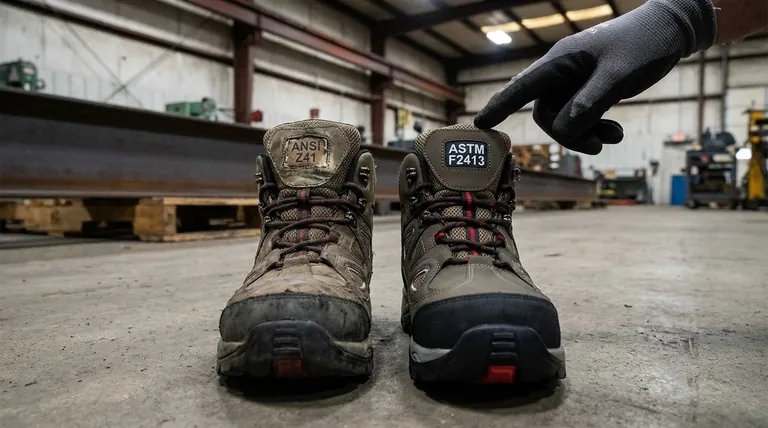
Imagine a seasoned safety manager walking the facility floor. They spot a pair of sturdy, decade-old work boots in a locker, the sole caked with the history of a thousand shifts. The tongue label is faded but legible: "ANSI Z41."
The manager pauses. They know that logo. For years, it was the gold standard, the very symbol of compliance and safety.
Yet, a seed of doubt is planted. Is that symbol still a guarantee of protection, or is it a ghost—an artifact of a system that has since evolved? This quiet moment of uncertainty reveals a critical, often misunderstood, gap in workplace safety: the transition from an old standard to a new one.
The System of Trust
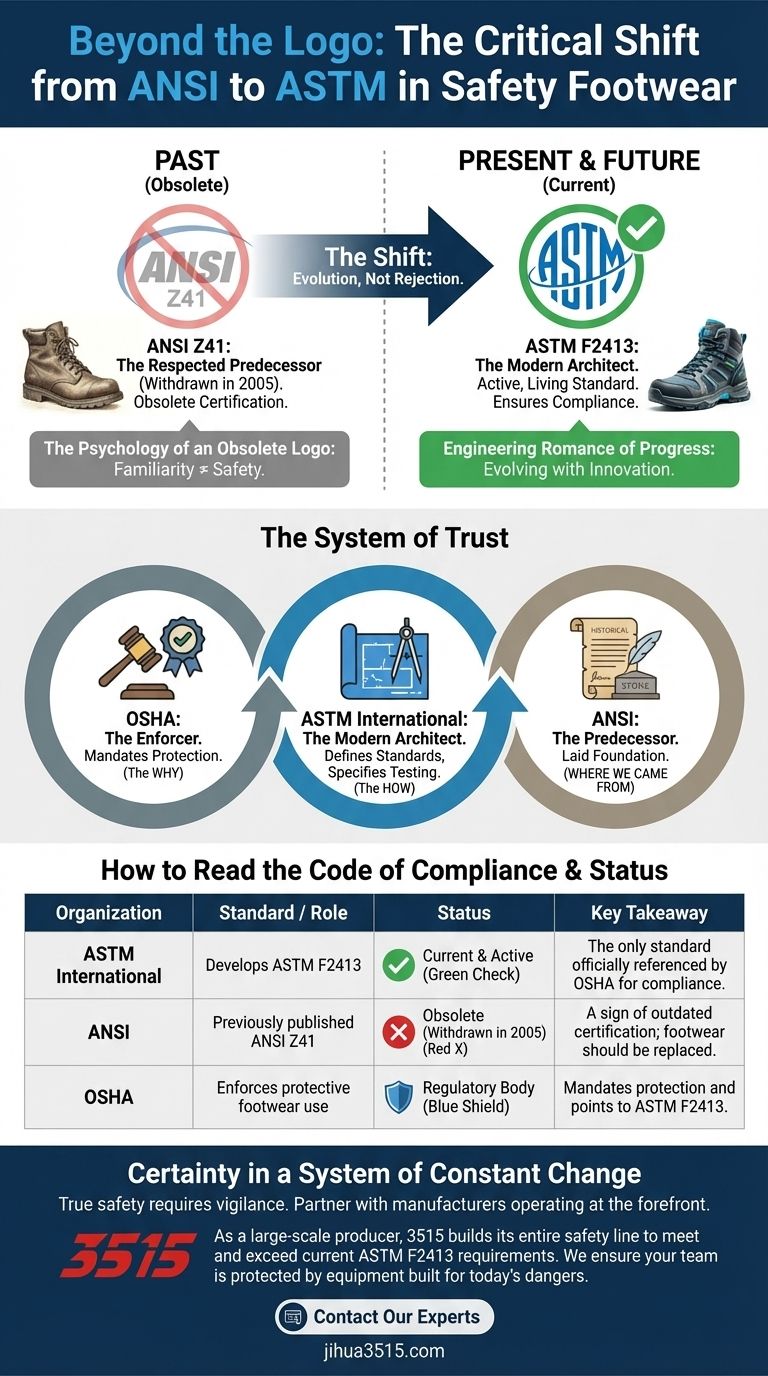
Protecting a workforce isn't about a single rule or piece of equipment. It's about a system of interlocking parts built on trust. In the world of safety footwear, that system is composed of three key players.
OSHA: The Enforcer
The U.S. Occupational Safety and Health Administration (OSHA) doesn't design the boots. Their role is simpler and more profound: they mandate that a shield must exist. OSHA sets the legal requirement for employers to provide protective footwear in hazardous environments. They are the "why."
ASTM International: The Modern Architect
ASTM International (formerly the American Society for Testing and Materials) is the organization that writes the modern blueprint. Their standard, ASTM F2413, is the active, living document that defines what a safety boot must be able to withstand. It specifies the precise testing for impact, compression, and other dangers. ASTM is the "how."
ANSI: The Respected Predecessor
The American National Standards Institute (ANSI) laid the foundation. Their ANSI Z41 standard was the governing document for decades. However, in 2005, it was officially withdrawn and superseded by ASTM F2413. ANSI is the "where we came from," an essential part of the story but not the final chapter.
The Psychology of an Obsolete Logo
The core of the confusion isn't technical; it's psychological. We are wired to trust familiar patterns. The ANSI logo became a cognitive shortcut for "safe." But when the underlying system changes, that shortcut can lead us down a dangerous path.
The shift to ASTM wasn't a rejection of ANSI's principles. It was an evolution. The ASTM process was deemed more agile, better equipped to keep pace with innovations in materials science and manufacturing. It's the engineering romance of progress: honoring a robust foundation while building a more responsive, modern structure upon it.
Any boot marked only with "ANSI Z41" is certified to an obsolete standard. While it may have been compliant at the time of its manufacture, it doesn't guarantee compliance with today's OSHA regulations.
How to Read the Code of Compliance
For anyone responsible for worker safety, clarity is paramount. Navigating the standards doesn't have to be complex. It comes down to looking for one specific label.
- The Mark of Compliance: A boot that meets current OSHA-referenced standards must be labeled as conforming to ASTM F2413. This is your single source of truth.
- The Red Flag: A boot labeled only with ANSI Z41 is a relic. It signifies an outdated certification and should be replaced to ensure your safety program is current.
This simple check cuts through all ambiguity.
| Organization | Standard / Role | Status | Key Takeaway |
|---|---|---|---|
| ASTM International | Develops ASTM F2413 | Current & Active | The only standard officially referenced by OSHA for compliance. |
| ANSI | Previously published ANSI Z41 | Obsolete (Withdrawn in 2005) | A sign of outdated certification; footwear should be replaced. |
| OSHA | Enforces the use of protective footwear | Regulatory Body | Mandates protection and points to the ASTM F2413 standard. |
Certainty in a System of Constant Change
The evolution from ANSI to ASTM highlights a fundamental truth: true safety requires vigilance. It demands that we look beyond the familiar logo and understand the system behind it.
Relying on an outdated standard isn't just a compliance risk; it's a gap in the armor you provide your team. The simplest way to close that gap is to partner with manufacturers who operate at the forefront of the current standard.
As a large-scale producer of occupational footwear, 3515 builds its entire safety line to meet and exceed the current ASTM F2413 requirements. We remove the guesswork by engineering certified, compliant footwear, allowing you to focus on your operations with the confidence that your team is protected by equipment built for today's—not yesterday's—dangers.
Visual Guide
Related Products
- Safety Footwear Wholesale Manufacturer for Custom OEM/ODM Production
- Premium Suede Sport Safety Shoes for Wholesale & Bulk Orders
- Premium Safety Shoes with Rotating Buckle Safety Sneakers
- Premium Lightweight Safety Shoes for Wholesale & Bulk Orders
- Puncture-Resistant Velcro Safety Boots for Wholesale & Custom Manufacturing
Related Articles
- How Safety Footwear Materials Dictate Workplace Protection and Long-Term Value
- How to Match Safety Footwear Features to Workplace Hazards: A Risk-Based Guide
- How Safety Footwear Engineering Solves Industry-Specific Environmental Hazards
- More Than a Mandate: The Engineering and Psychology of Safety Footwear
- How Employers Select Safety Footwear: A Compliance-Focused Guide for Workers


















