The Interface Between Human and Hazard
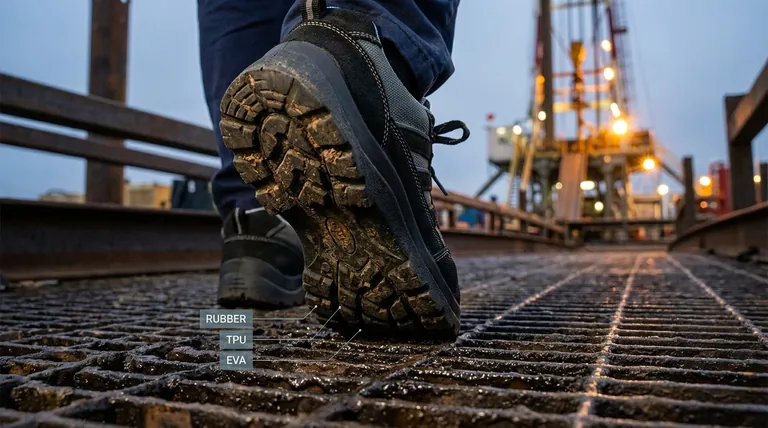
A worker on a drilling rig isn't just standing on a steel platform; they are standing on a thin layer of engineered material. That boot sole is the entire interface between the human body and a world of vibration, impact, and chemical hazards.
The label says "oil-resistant," but this simple term conceals a complex world of engineering trade-offs. The choice of sole material dictates not just a boot's lifespan, but the fatigue in a worker's legs after a ten-hour shift, their stability on a slick surface, and their trust in the equipment that keeps them safe.
Understanding this interface is the first step to building truly effective safety footwear.
The Psychological Weight of a Physical Load
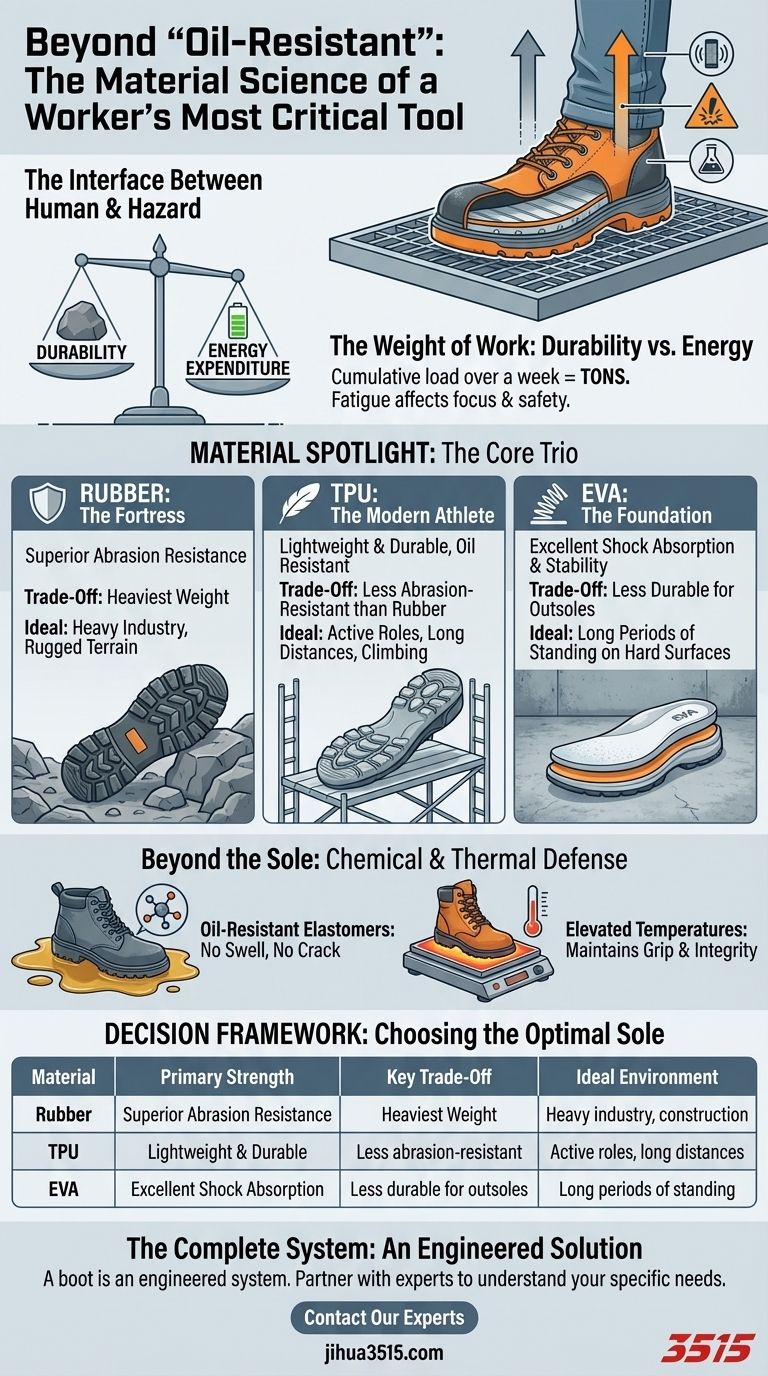
Every gram matters. Over the course of a day, a worker might take over 10,000 steps. A seemingly minor difference in boot weight becomes a cumulative load measured in tons by the end of a week.
This is the classic engineering dilemma between durability and energy expenditure.
The Fortress: Rubber Soles
Rubber is the traditional standard for a reason. It offers unparalleled abrasion resistance. For environments where soles are constantly scraped against rock, rebar, or jagged metal, rubber provides the highest degree of physical integrity.
But this durability comes at the cost of weight. It's a fortress for the foot, but carrying a fortress all day leads to physical fatigue. This fatigue isn't just about sore muscles; it's a cognitive drain that can slow reaction times and impair judgment at the end of a long day.
The Modern Athlete: TPU Soles
Thermo-Polyurethane (TPU) is the engineering response to the weight problem. It delivers formidable durability and oil resistance in a significantly lighter package.
For the worker who is constantly in motion—climbing scaffolds, covering vast factory floors, or walking miles on a pipeline—TPU reduces the cumulative load. The psychological benefit is immense: less fatigue means sustained focus and a lower perceived effort, making demanding jobs more manageable.
The Silent Contract of Stability
For many workers, the primary antagonist isn't a sharp rock but an unyielding concrete floor. Hour after hour, the relentless impact sends shockwaves up the kinetic chain of the body.
The Foundation: EVA Soles
This is where Ethylene-Vinyl Acetate (EVA) excels. Known for its exceptional shock absorption and stability, EVA acts as a cushion. It dampens the constant, micro-trauma of standing on hard surfaces.
While a pure EVA outsole may not have the ruggedness of rubber, its role in the midsole is revolutionary. It creates a stable, predictable foundation. This stability is a form of psychological comfort—the worker trusts their footing implicitly, freeing up cognitive resources to focus on complex tasks.
The Invisible Chemistry of Protection
The term "oil-resistant" is not a binary state. It's a measure of chemical defiance, engineered at a molecular level.
The soles of these boots are made from specific oil-resistant elastomers. These compounds are formulated to ignore hydrocarbons, refusing to swell, crack, or lose their structural integrity.
A critical, often overlooked, factor is performance under elevated temperatures. Low-grade materials can become pliable and lose their grip when exposed to hot oil or machinery. Superior soles maintain their properties, ensuring safety isn't compromised when the environment heats up.
A Framework for Deciding
Choosing the right sole is not about finding the "best" material, but the optimal material for a specific set of challenges. No single formula works for every job.
Material Trade-Offs at a Glance
| Sole Material | Primary Strength | Key Trade-Off | Ideal Environment |
|---|---|---|---|
| Rubber | Superior Abrasion Resistance | Heaviest Weight | Heavy industry, construction, rugged terrain |
| Thermo-Polyurethane (TPU) | Lightweight & Durable | Less abrasion-resistant than rubber | Active roles, long distances, climbing |
| Ethylene-Vinyl Acetate (EVA) | Excellent Shock Absorption | Less durable for outsoles | Long periods of standing on hard surfaces |
This decision framework must also account for the system as a whole. A heavy-duty rubber sole paired with a lightweight nylon upper creates a different performance profile than one paired with thick leather. The entire boot is an engineered system.
Navigating these material trade-offs requires more than a catalog; it requires a manufacturing partner who understands the physics and psychology of work environments. As a large-scale producer of all types of footwear, we specialize in engineering systems that solve for the specific realities your team faces every day. To build the optimal boot for your operational needs, Contact Our Experts.
Visual Guide
Related Products
- Heavy-Duty Goodyear Welted Pull-On Safety Rigger Boot
- Premium Oil Wax Leather Safety Boots for Bulk Purchase
- Premium Wholesale Waterproof Safety Boots High Performance Protection for Industrial Markets
- Wholesale Waterproof Tactical Boots Custom Suede & High-Traction Soles
- Premium Waterproof High-Cut Industrial Safety Boots for Wholesale and Bulk Orders
Related Articles
- Beyond the Tread: The Molecular Battle for Grip on Oily Surfaces
- How to Choose Safety Boot Certifications for Your Industry's Hazards
- How Safety Boot Features Address Industry-Specific Workplace Hazards
- The True Cost of a Safety Boot: Why Your Footwear Budget Is Breaking
- How Safety Boot Engineering Protects Against Workplace Hazards: A Buyer's Guide