The Illusion of Safety
A construction site is a world of controlled chaos. It's a temporary factory assembled in the open air, where immense physical forces are in constant play.
We tend to view safety in binary terms: safe or unsafe. We see a worker in a hard hat and steel-toed boots and register them as "safe." But this is a cognitive shortcut, and a dangerous one.
The reality is that safety is a spectrum. The wrong type of safety boot creates an illusion of security, leaving a worker vulnerable precisely because they believe they are protected. It’s not about wearing any safety shoe; it's about wearing the right one.
A System for Managing Physical Force
At its core, a safety shoe is not just a piece of clothing. It's an engineered system designed to manage and redirect destructive physical forces that are ever-present on a construction site.
Absorbing Kinetic Energy
A falling hammer or a rolling steel pipe isn't just a "heavy object." It's kinetic energy seeking a place to land. An ordinary shoe offers no resistance.
The reinforced toe cap of a safety boot is engineered to withstand and distribute that specific impact, acting as a crucial shock absorber between a concentrated force and the delicate bones of the foot.
Defeating Concentrated Pressure
The ground on a construction site is a minefield of sharp debris: upturned nails, rebar scraps, and sharp-edged metal. These objects represent a different kind of threat—not blunt force, but highly concentrated pressure.
A puncture-resistant midsole is the engineering solution. It acts as a barrier, preventing a nail from channeling the full weight of a worker's body into a single, devastating point of entry.
Mastering Friction
Slips, trips, and falls remain one of the leading causes of serious injury. This is a failure to manage friction.
A worker carrying a heavy load on a slick, muddy surface loses their footing for a split second. What happens next depends entirely on the material science and tread pattern of their boot's sole. Anti-slip soles are engineered to maximize grip on unstable terrain, providing the stability needed to prevent a momentary imbalance from becoming a disabling accident.
The Language of Protection: Decoding Safety Standards
Safety classifications are not bureaucratic labels. They are a precise language describing a boot's engineered capabilities. Misunderstanding this language is like misreading a blueprint.
The Construction Baseline: Why S3 and S5 Are Non-Negotiable
For the rugged, unpredictable environments of construction, mining, and outdoor work, the S3 and S5 ratings are the established standard.
These classifications guarantee the two features that are non-negotiable on most sites: a puncture-resistant midsole and water resistance. They form the baseline defense against the most common physical and environmental hazards.
The Danger of "Good Enough"
The most common mistake is choosing footwear that is "safe" but not "right." An S1P boot might be perfectly adequate for an indoor logistics warehouse, but on a construction site, its lack of water resistance is a critical flaw.
This mismatch creates a dangerous gap between a worker's perceived safety and the actual risks they face, fostering a false sense of security that can lead to preventable harm.
The Second-Order Risks: When the Environment Fights Back
The immediate threats are from impact and puncture. But the secondary, environmental risks can be just as insidious because they attack a worker's focus and physical capabilities.
A worker's feet soaked by morning rain or standing water are more than just uncomfortable. By midday, the cold seeps in, and numbness begins to dull perception. A numb foot can't properly sense the ground, dramatically increasing the risk of a misstep.
This is why water resistance (S3) or full waterproofing (S5) is so critical. It’s not about comfort; it's about preserving the worker's cognitive function and physical control. Similarly, sites with specialized hazards like welding require boots with an Hro rating to defend against extreme heat—a variable a standard boot is not designed to handle.
Engineering the Right Defense for Your Team
Choosing the correct footwear is not a procurement task; it is a critical risk-management decision. It requires mapping the specific, daily hazards your team faces to the precise engineering specifications of their gear.
As a large-scale manufacturer, we at 3515 understand this complexity. We don't just produce footwear; we engineer comprehensive protective solutions. Our capabilities cover the full spectrum of safety footwear, allowing distributors and brand owners to equip their clients with the exact defense system they need.
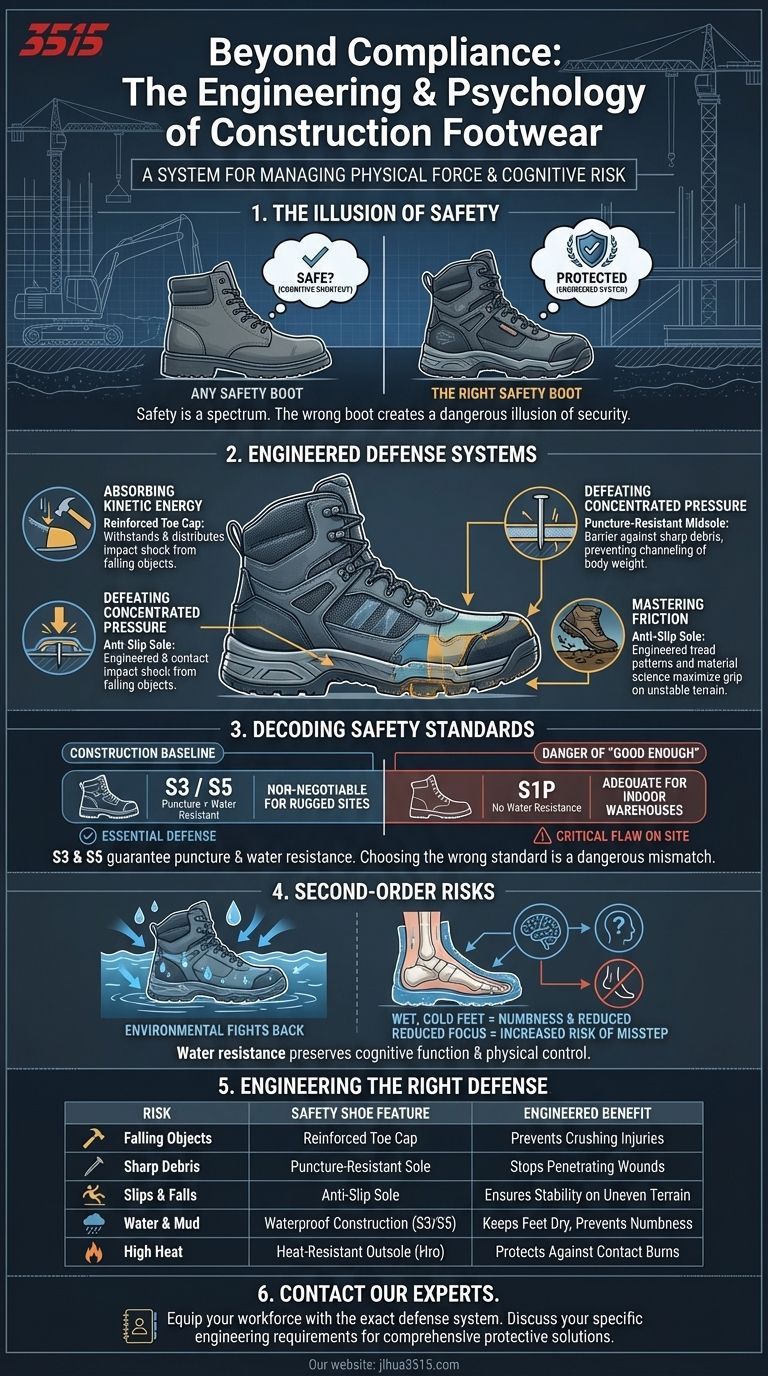
| Risk | Safety Shoe Feature | Engineered Benefit |
|---|---|---|
| Falling Objects | Reinforced Toe Cap | Prevents Crushing Injuries |
| Sharp Debris | Puncture-Resistant Sole | Stops Penetrating Wounds |
| Slips & Falls | Anti-Slip Sole | Ensures Stability on Uneven Terrain |
| Water & Mud | Waterproof Construction (S3/S5) | Keeps Feet Dry, Prevents Numbness |
| High Heat | Heat-Resistant Outsole (Hro) | Protects Against Contact Burns |
Equipping your workforce with the correct classification of safety footwear is the foundational step in building a resilient and safe operation. To discuss the specific engineering requirements for your projects and clients, Contact Our Experts.
Visual Guide
Related Products
- Durable Leather Work Boots Wholesale Manufacturer & Custom Factory
- Safety Footwear Wholesale Manufacturer for Custom OEM/ODM Production
- Puncture-Resistant Velcro Safety Boots for Wholesale & Custom Manufacturing
- Wholesale Durable Safety Boots | Custom Steel Toe & Puncture-Resistant Manufacturing
- Premium Grain Leather Safety Boots for Bulk Supply
Related Articles
- The Unseen Physics of Failure: Why Work Boots Are Your Most Critical PPE
- How Work Boots Engineer Safety: The Science Behind Impact and Compression Protection
- How Job-Specific Work Boot Designs Enhance Safety and Efficiency
- How to Choose Work Boots That Prevent Injuries in High-Risk Jobs
- How Work Boot Components Address Safety and Comfort in High-Risk Jobs