Proper moisture control in walking shoes is the critical factor that separates a comfortable journey from a painful one. It directly prevents the damp, clammy feeling of sweaty feet, drastically reduces the risk of blisters caused by friction on wet skin, and helps regulate your foot temperature in both warm and cool conditions.
Managing moisture is not merely a comfort feature; it is a fundamental strategy for maintaining foot health and performance. The primary goal is to keep the environment inside your shoe as dry and stable as possible, protecting your skin from damage and your body from unnecessary heat loss.
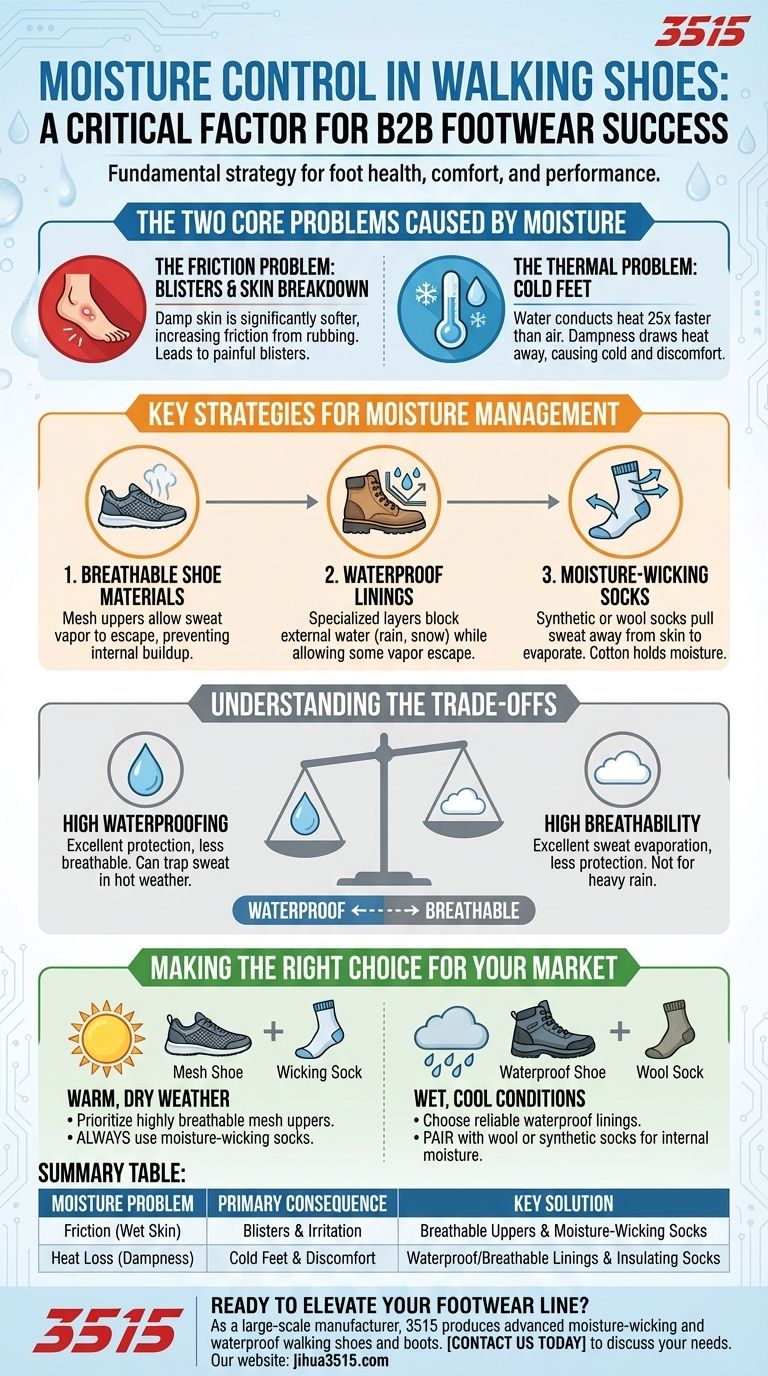
The Two Core Problems Caused by Moisture
Moisture, whether from sweat or the environment, creates two distinct problems inside your shoe. Understanding these issues highlights why controlling moisture is so essential.
The Friction Problem: Blisters and Skin Breakdown
Damp skin is significantly softer and weaker than dry skin. This makes it much more susceptible to the damaging effects of friction.
As you walk, your foot naturally moves inside the shoe. When your skin is wet, this constant rubbing against the sock and shoe lining quickly leads to irritation and the formation of painful blisters.
The Thermal Problem: Cold Feet
Water is a powerful conductor of heat, pulling it away from your body 25 times faster than air.
When your socks and shoes are damp—either from sweat or from rain—they actively draw heat away from your feet. This can lead to feeling uncomfortably cold, even in mild weather, and poses a significant risk in colder temperatures.
Key Strategies for Moisture Management
An effective moisture control system is built on a few key components working together. It’s not just about the shoe, but the entire environment around your foot.
Breathable Shoe Materials
The most common source of moisture is your own sweat. Shoe uppers made from breathable materials, like mesh, allow this sweat vapor to escape before it can saturate your sock.
This ventilation is your first line of defense against internal moisture buildup, especially during vigorous walks or in warm weather.
Waterproof Linings
For walks in wet conditions, a waterproof lining or membrane is essential. These specialized layers are engineered to block external moisture from rain, puddles, or snow from entering the shoe.
Crucially, many modern waterproof membranes are also designed to be breathable, allowing some internal sweat vapor to escape while keeping external water out.
The Critical Role of Socks
Your shoes cannot do the job alone. Moisture-wicking socks are a non-negotiable part of the system.
Unlike cotton socks which absorb and hold moisture against your skin, socks made from synthetic materials or wool pull sweat away from your foot. They move it to the outer surface of the sock, where it can evaporate through the breathable upper of your shoe.
Understanding the Trade-offs
Choosing the right shoe involves balancing competing needs. No single design is perfect for every condition.
Waterproof vs. Breathable
There is always a trade-off between how waterproof a shoe is and how breathable it is.
A shoe with a robust waterproof membrane will offer excellent protection from rain but will inevitably be less breathable than a shoe with an open-mesh design. In hot, dry weather, a highly waterproof shoe can feel warm and trap sweat.
When "Waterproof" Isn't Enough
A waterproof shoe is only effective if water doesn't get in over the top. In heavy downpours or when crossing streams, water can still saturate your socks from the ankle down, rendering the waterproof lining useless.
This reinforces that moisture management is a complete system that includes your choice of socks and sometimes even gaiters to protect the top of the shoe.
Making the Right Choice for Your Walk
Your ideal approach depends entirely on the conditions you expect to face.
- If your primary focus is walking in warm, dry weather: Prioritize highly breathable shoes with mesh uppers and always wear moisture-wicking socks to manage sweat effectively.
- If your primary focus is walking in wet, cool conditions: Choose shoes with a reliable waterproof lining to keep external moisture out, but pair them with wool or synthetic socks to handle internal moisture.
- If your primary focus is preventing blisters above all else: The combination of properly-fitting shoes and high-quality moisture-wicking socks is your most powerful defense.
Ultimately, keeping your feet dry is the foundation for comfortable, pain-free walking, empowering you to go farther and enjoy every step.
Summary Table:
| Moisture Problem | Primary Consequence | Key Solution |
|---|---|---|
| Friction (Wet Skin) | Blisters & Skin Irritation | Breathable Uppers & Moisture-Wicking Socks |
| Heat Loss (Dampness) | Cold Feet & Discomfort | Waterproof/Breathable Linings & Insulating Socks |
Ready to elevate your footwear line with superior moisture control?
As a large-scale manufacturer, 3515 produces a comprehensive range of walking shoes and boots designed with advanced moisture-wicking and waterproof technologies. We help distributors, brand owners, and bulk clients provide their customers with the comfort and performance they demand.
Contact us today to discuss your manufacturing needs and discover how we can bring durable, high-comfort footwear to your market.
Visual Guide
Related Products
- Durable Rubber Sole Outdoor Shoes Wholesale & Custom Manufacturing
- Wholesale Durable Camouflage Canvas Shoes with High-Traction Cleated Rubber Sole
- Premium Suede Sport Safety Shoes for Wholesale & Bulk Orders
- Durable Goodyear Welt Leather Work Boots for Wholesale & Private Label
- Wholesale Comfortable Business Casual Shoes Custom Manufacturing
People Also Ask
- What is the function of the sole in outdoor shoes? Find the Perfect Grip and Support
- What role do outdoor shoes and sneakers play in navigating external terrains? Engineered Stability for Every Surface
- How is AI utilized in the design of outdoor and safety footwear? Harnessing Big Data for Market-Driven Shoe Innovation
- Why is durability important when selecting outdoor shoes? A Guide to Safety & Long-Term Value
- What are the key components of outdoor shoes that affect comfort and sturdiness? A Guide to Durable, High-Performance Footwear