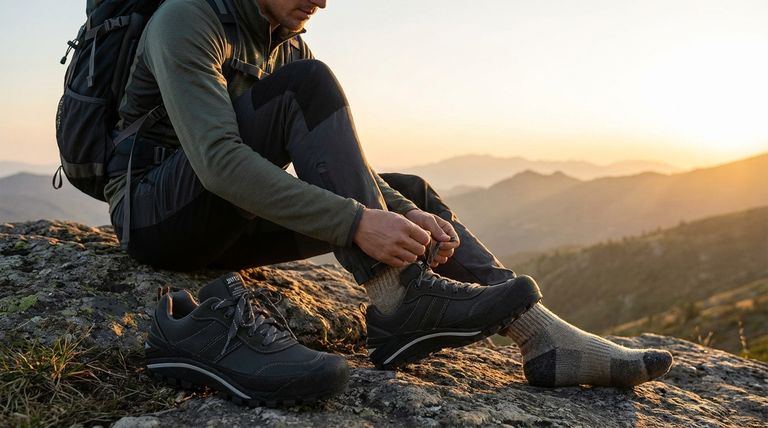
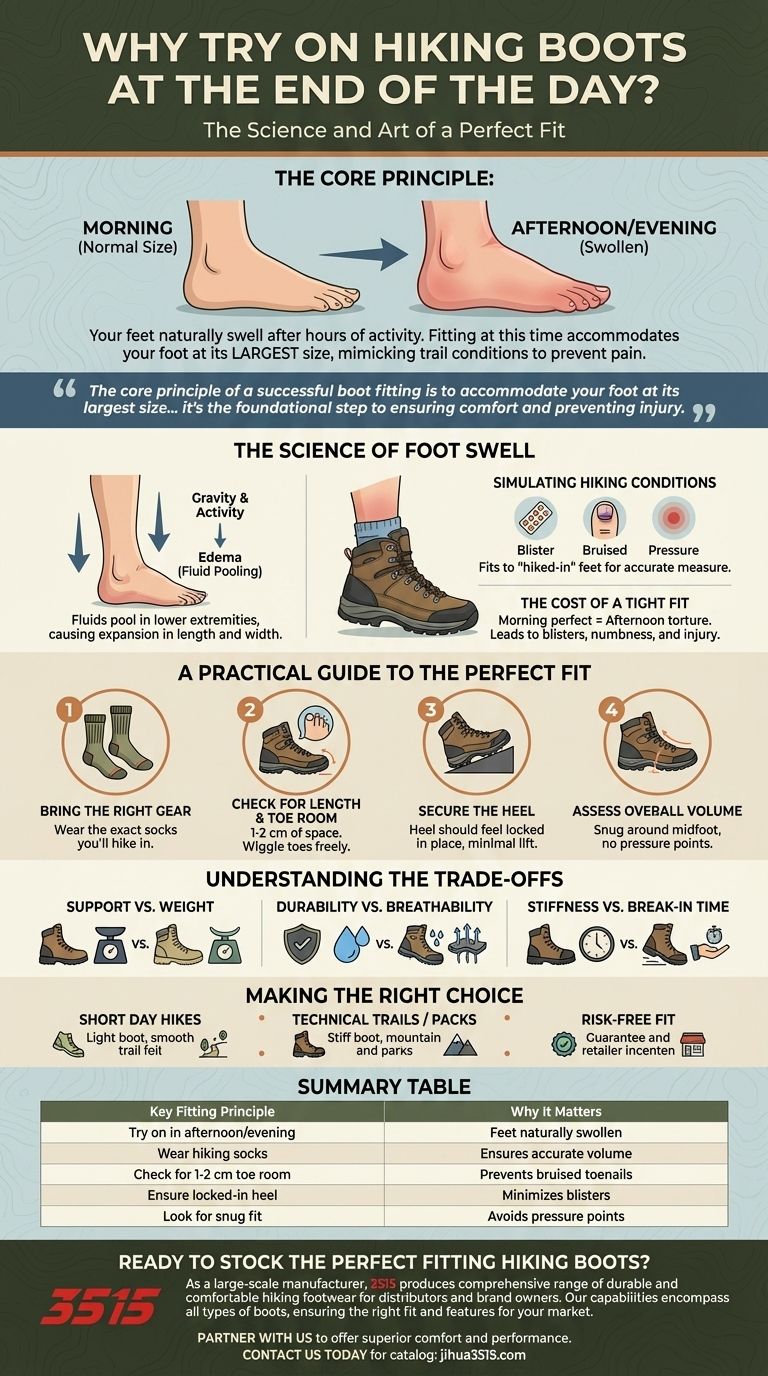
The single most important reason to try on hiking boots at the end of the day is because your feet naturally swell. After hours of being upright and active, your feet will be at their largest, which closely mimics their condition during a hike. Fitting your boots at this time prevents you from buying a pair that will become painfully tight on the trail.
The core principle of a successful boot fitting is to accommodate your foot at its largest size. Trying on boots in the afternoon or evening isn't just a helpful tip—it's the foundational step to ensuring comfort and preventing injury on the trail.
The Science of Foot Swell: Why Timing Matters
Understanding why your feet change size throughout the day is key to appreciating why the timing of your boot purchase is so critical. This isn't a minor detail; it's a physiological reality that directly impacts footwear comfort.
The Effect of Gravity and Activity
Throughout the day, gravity and the simple act of walking cause fluids to pool in your lower extremities. This process, known as edema, causes your feet to expand slightly in both length and width.
Simulating Hiking Conditions
By trying on boots in the late afternoon or evening, you are essentially fitting them to your "hiked-in" feet. This provides the most accurate measure of the space you will need after several hours on the trail, when swelling is most pronounced.
The Cost of a Tight Fit
A boot that feels perfect in the morning can become an instrument of torture by the afternoon. This tight fit leads to pressure points, blisters, bruised toenails, and numbness, derailing an otherwise enjoyable hike.
A Practical Guide to the Perfect Fit
Timing is the first step, but several other checks are required to confirm a boot is right for you. Use this process in the store to properly evaluate any pair of hiking boots.
Bring the Right Gear
Always test boots while wearing the same type of socks you plan to hike in. A thick hiking sock takes up significant volume compared to a casual sock and is essential for an accurate fit assessment.
Check for Length and Toe Room
With the boot on and laced, you should have about 1-2 centimeters of space between your longest toe and the end of the boot. You must be able to wiggle your toes freely without them pressing against the front, especially when walking downhill.
Secure the Heel
Walk around the store, preferably on an incline ramp if available. Your heel should feel locked in place with minimal to no lift. Excessive heel lift is a primary cause of friction and blisters.
Assess Overall Volume
The boot should feel snug and secure around the midfoot and instep, but not restrictive. There should be no major pressure points or pinching anywhere on your foot.
Understanding the Trade-offs
Choosing the right hiking boot involves balancing competing characteristics. There is no single "best" boot, only the best boot for your specific needs and the terrain you plan to cover.
Support vs. Weight
Mid- and high-cut boots offer excellent ankle support, which is critical for stability on rocky, uneven trails. However, this added support comes with an increase in weight, which requires more energy to lift with every step.
Durability vs. Breathability
Tough, durable materials and water-resistant membranes protect your feet from the elements and rough terrain. The downside is that these features often reduce breathability, which can lead to sweaty, uncomfortable feet in warm weather.
Stiffness vs. Break-in Time
Stiffer boots provide the rigidity needed for technical trails and carrying heavier packs. This stiffness protects your feet but means the boots are less flexible and often require a significant break-in period before they feel comfortable.
Making the Right Choice for Your Hike
Your intended use is the ultimate guide to selecting the right boot. By matching the boot's features to your hiking goals, you can ensure comfort and performance.
- If your primary focus is short day hikes on well-maintained trails: A lighter, more flexible day hiking boot with a shorter break-in period is likely sufficient.
- If your primary focus is technical trails or carrying a pack: Prioritize a stiffer, more supportive mid- or high-cut boot and be diligent about achieving a perfect, locked-in fit.
- If your primary focus is finding the right fit without risk: Purchase from a retailer with a 100% satisfaction guarantee, allowing you to return the boots if they don't perform as expected on a real hike.
Ultimately, investing the time to find a proper fit is the most important decision you will make for your hiking comfort and safety.
Summary Table:
| Key Fitting Principle | Why It Matters |
|---|---|
| Try on boots in the afternoon/evening | Your feet are naturally swollen, mimicking trail conditions. |
| Wear your hiking socks | Ensures an accurate fit with the right volume. |
| Check for 1-2 cm of toe room | Prevents bruised toenails, especially on descents. |
| Ensure a locked-in heel | Minimizes lift to prevent blisters. |
| Look for a snug, not tight, fit | Avoids pressure points and numbness. |
Ready to Stock the Perfect Fitting Hiking Boots?
As a large-scale manufacturer, 3515 produces a comprehensive range of durable and comfortable hiking footwear for distributors, brand owners, and bulk clients. Our production capabilities encompass all types of boots, ensuring you get the right fit and features for your market.
Partner with us to offer your customers superior comfort and performance on the trail.
Contact us today to discuss your footwear needs and request a catalog!
Visual Guide
Related Products
- Wholesale High-Traction Camo Boots - Custom Manufacturer for Brands
- Durable Rubber Sole Outdoor Shoes Wholesale & Custom Manufacturing
- Durable Spiked Camouflage Boots Wholesale & Factory Production
- Wholesale Lightweight Tactical Boots Custom Manufacturer for Desert & Combat Use
- Wholesale Waterproof Tactical Boots Custom Suede & High-Traction Soles
People Also Ask
- What are the key features of the new line of camo boots? Built for Extreme Cold & Rugged Terrain
- Are camo boots necessary for hunting success? Prioritize Performance Over Pattern
- What is the technical logic behind using closed-eye testing for tactical boots? Unlocking Peak Footwear Stability
- How does the Rank Score Test identify the primary causes of premature failure in tactical and work boots? Key Insights
- What shoes to wear for a security job? Durable, Protective Footwear for Long Shifts