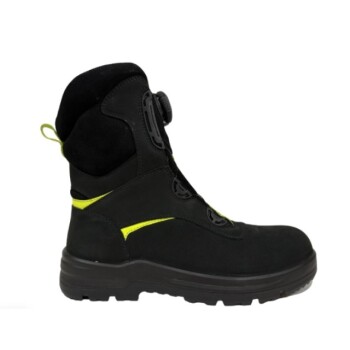
Ultrasonic sensors are the standard choice for smart obstacle-avoidance boots because they offer a superior balance of precision, speed, and cost-effectiveness. By mounting these modules on the front of the footwear, the system can utilize high-frequency sound pulses to accurately measure distances between 2 and 400 centimeters. This capability allows the boots to detect obstacles in real-time and trigger immediate feedback for the user.
Core Takeaway Ultrasonic sensors provide a "digital sense of touch" that works independently of lighting conditions, making them essential for reliable navigation. They act as the primary perception engine, converting physical distance into safety warnings to protect users from collisions and falls.
The Mechanics of Detection
Precision Through Time-of-Flight
Ultrasonic sensors operate on the Time-of-Flight (ToF) principle. They emit ultrasonic pulses and measure the exact time it takes for the sound to bounce off an object and return.
This process allows the system to calculate the distance to an obstacle with high accuracy. The boots can then process this data to determine if an object is within a preset safety distance.
Optimized Detection Range
These sensors are specifically tuned for pedestrian needs, covering a range from 2 to 400 centimeters.
This range is critical for walking speeds. It detects immediate tripping hazards directly in front of the toe (2cm) while simultaneously identifying barriers up to 4 meters away, giving the user ample time to react.
Operational Advantages in Footwear
Immunity to Environmental Lighting
Unlike camera-based systems, ultrasonic sensors function by using sound waves rather than light.
This means they provide consistent reliability regardless of whether the user is walking in bright sunlight, shadows, or total darkness. This is a vital feature for visually impaired users navigating complex environments.
Detecting "Invisible" Hazards
Traditional tools, such as white canes, primarily detect obstacles on the ground.
Ultrasonic sensors fill a critical safety gap by identifying low-lying or hanging obstacles. By scanning the space in front of the user, they can alert the wearer to hazards that might otherwise be missed, significantly reducing the risk of head or upper-body collisions.
Rapid Response and Feedback
The fast response time of ultrasonic modules ensures that the interval between detection and warning is negligible.
Once an obstacle is detected, the microcontroller instantly triggers a warning mechanism. This is typically a haptic feedback system (vibration motors) or a buzzer, providing non-invasive alerts that do not block the user's hearing.
Understanding the Trade-offs
The Need for Complementary Systems
While ultrasonic sensors are excellent for general distance measurement, they rely on sound reflection.
In highly complex scenarios, a single sensor type may face limitations. This is why some advanced designs integrate Infrared (IR) sensors as a complementary technology. IR sensors can provide rapid, short-range verification to ensure no obstacle is missed, creating a redundant safety layer.
Making the Right Choice for Your Goal
When evaluating obstacle-avoidance technology for smart footwear, consider the specific needs of the end-user:
- If your primary focus is reliability in all conditions: Prioritize ultrasonic sensors, as their performance is unaffected by lighting, ensuring safety day or night.
- If your primary focus is comprehensive safety: Look for systems that combine ultrasonic detection with haptic feedback, ensuring the user is alerted to both ground-level and hanging obstacles without relying on audio cues.
Ultrasonic technology transforms footwear from simple protective gear into an intelligent navigation assistant, granting users greater independence and confidence.
Summary Table:
| Feature | Ultrasonic Sensor Performance | Benefit for User |
|---|---|---|
| Detection Range | 2 cm to 400 cm | Detects both immediate tripping hazards and distant barriers |
| Lighting Condition | Completely Independent | Consistent reliability in total darkness or bright sunlight |
| Response Mechanism | Real-time Time-of-Flight (ToF) | Instant haptic or buzzer feedback to prevent collisions |
| Hazard Type | Ground-level & Hanging obstacles | Protects against head-level hazards missed by canes |
| Reliability | High (Independent of light) | Provides a steady 'digital sense of touch' for navigation |
Partner with 3515 for Next-Generation Footwear Solutions
As a leading large-scale manufacturer, 3515 specializes in delivering high-performance footwear for distributors and brand owners worldwide. Our comprehensive production capabilities allow us to integrate advanced technology into our flagship Safety Shoes series and a diverse portfolio including tactical boots, outdoor gear, and sneakers.
Looking to develop smart obstacle-avoidance footwear or source reliable bulk production? We provide the expertise and scale needed to bring innovative footwear to market. Contact us today to discuss your specific requirements and discover the value we bring to your brand.
References
- S.M.R. Islam, A. ALIMUL BARI. A Low-cost Smart Shoe Solution for Real-Time Obstacle Detection and Location Monitoring in Deafblind Users. DOI: 10.11648/j.ajset.20251004.15
This article is also based on technical information from 3515 Knowledge Base .
Related Products
- High Performance Fire-Retardant Waterproof Safety Boots
- Premium Wholesale Tactical Style Safety Shoes Boots with Quick Lacing
- Premium Wholesale Waterproof Safety Boots High Performance Protection for Industrial Markets
- Premium High-Cut Waterproof Safety Boots Manufacturing & Wholesale Solutions
- Durable High-Ankle Tactical Boots for Wholesale & Custom Manufacturing
People Also Ask
- Why are waterproof safety boots recommended for certain work environments? Essential Protection for Wet & Hazardous Jobs
- What roles do 3D vision systems and industrial robots play in the manufacturing of fire safety boots? Smart Automation
- What should you look for to ensure boots are fully waterproof? The Essential 2-Part System
- How should you maintain waterproof boots? A Simple 3-Step Guide to Long-Lasting Performance
- How does boot construction affect waterproofing? The Science Behind Truly Dry Feet