
At its core, impact resistance in a motorcycle boot is the engineered ability to absorb and dissipate the sudden, violent force of a collision. Its primary function is to manage the energy from an impact, preventing that force from being transferred directly to the delicate bones of your feet and ankles, thereby drastically reducing the risk of fractures and other severe injuries.
The most critical role of impact resistance is not simply to act as a hard shield, but to intelligently manage impact energy. A well-designed boot absorbs and distributes force, protecting you from injuries that a simple hard shell cannot prevent.
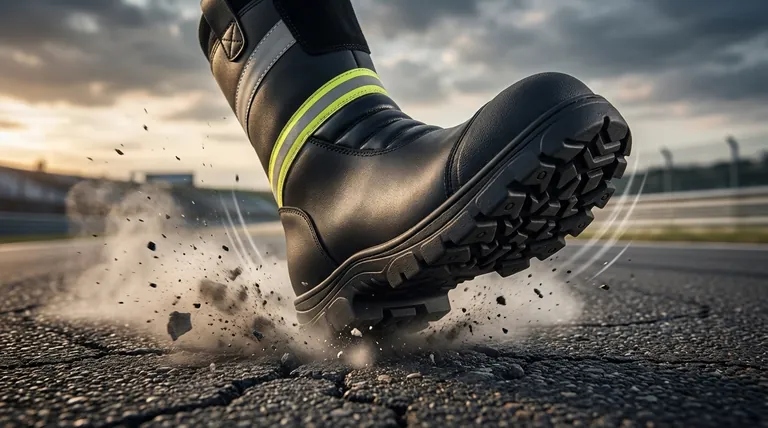
How Impact Resistance Protects You
A common misconception is that a motorcycle boot just needs to be "tough." The reality is more complex, involving a system of materials and structural design working together to manage specific forces.
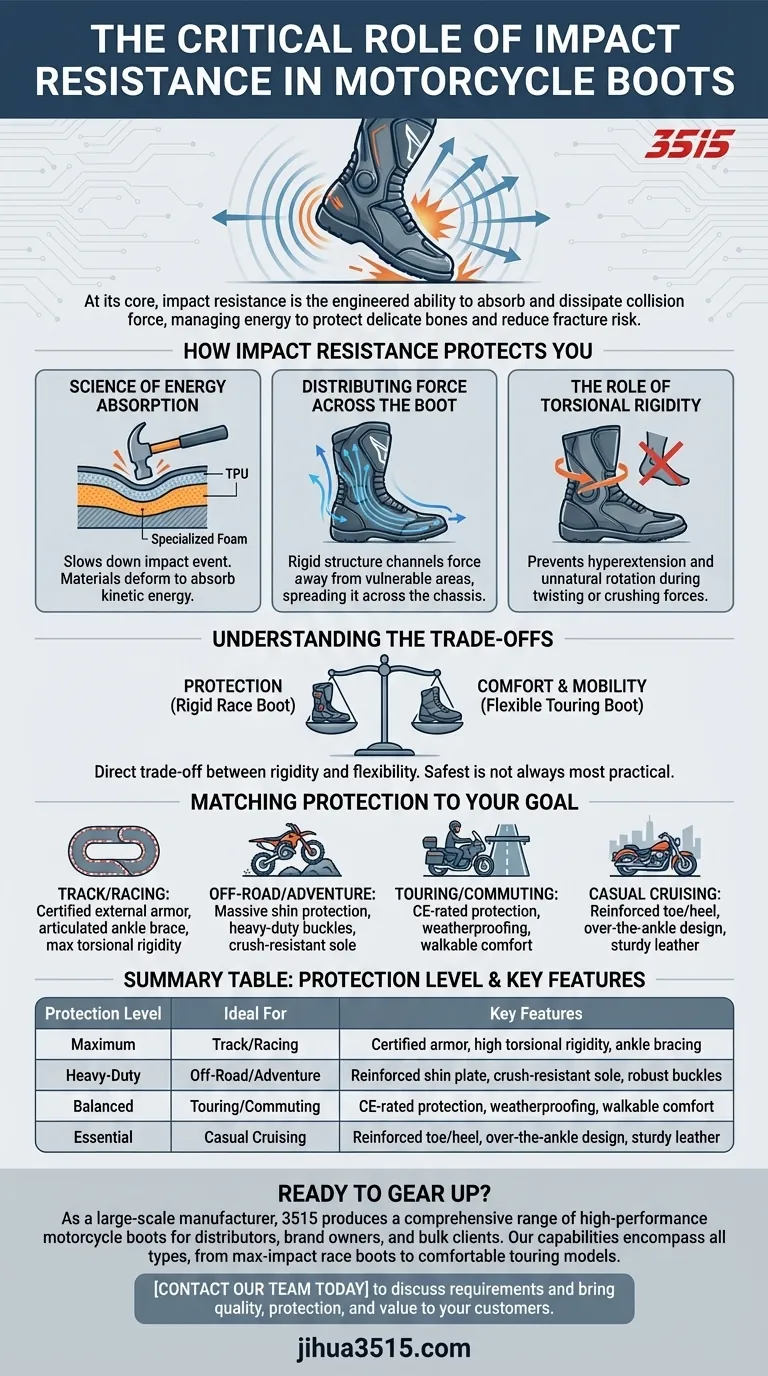
The Science of Energy Absorption
The primary job of impact armor and padding is to slow down the impact event.
Materials like TPU (Thermoplastic Polyurethane) and specialized foams are designed to deform and compress upon impact. This process absorbs kinetic energy that would otherwise shatter bone.
Distributing Force Across the Boot
A boot's rigid structure is engineered to channel forces away from vulnerable areas.
When an impact occurs, the force is spread across the entire chassis of the boot—from the shin plate down to the heel cup and sole—minimizing the concentration of force on any single point, like your ankle bones.
The Role of Torsional Rigidity
Impacts are rarely clean and direct; they often involve twisting and crushing forces, especially if your foot is trapped under the bike.
A boot's structural integrity prevents your ankle from hyperextending or rotating unnaturally. This torsional control is just as critical as direct impact absorption for preventing disabling ligament and joint injuries.
Understanding the Trade-offs
Choosing a boot is an exercise in balancing absolute protection with real-world usability. The safest boot is not always the most practical for every rider.
Protection vs. Comfort and Mobility
There is a direct trade-off between rigidity and flexibility.
A top-tier race boot offers phenomenal impact and torsion resistance but is often stiff and difficult to walk in. A touring or cruiser boot sacrifices some of that ultimate rigidity for all-day comfort and walkability.
Matching Protection to Your Riding Style
The level of impact resistance you need is dictated by the risks you are most likely to face.
A casual cruiser boot is wholly inadequate for the high-speed, high-side risks of a racetrack. Conversely, a full motocross boot is unnecessary and cumbersome for a short commute.
Weather and Environmental Factors
Beyond impact, you must consider the conditions you ride in.
A highly protective boot with poor ventilation can be dangerously distracting and uncomfortable in summer heat. Likewise, a boot without proper waterproofing can lead to misery and loss of focus on a long, rainy tour.
Matching Impact Protection to Your Goal
Your choice should be a deliberate decision based on how and where you ride.
- If your primary focus is track days or performance street riding: Prioritize boots with certified external armor, articulated ankle brace systems, and maximum torsional rigidity.
- If your primary focus is off-road or adventure riding: You need boots with massive shin protection, heavy-duty buckles, and a crush-resistant sole designed for impacts with rocks and terrain.
- If your primary focus is long-distance touring or daily commuting: Seek a balance of certified protection (look for a CE rating), all-day walking comfort, and weather resistance like a waterproof membrane.
- If your primary focus is casual cruising: Choose sturdy, over-the-ankle leather boots with, at a minimum, a reinforced toe box, heel cup, and ankle protection.
Ultimately, selecting the right boot is a critical investment in your ability to walk away from the unexpected.
Summary Table:
| Protection Level | Ideal For | Key Features |
|---|---|---|
| Maximum | Track/Racing | Certified armor, high torsional rigidity, ankle bracing |
| Heavy-Duty | Off-Road/Adventure | Reinforced shin plate, crush-resistant sole, robust buckles |
| Balanced | Touring/Commuting | CE-rated protection, weatherproofing, walkable comfort |
| Essential | Casual Cruising | Reinforced toe/heel, over-the-ankle design, sturdy leather |
Ready to gear up with the right protection?
As a large-scale manufacturer, 3515 produces a comprehensive range of high-performance motorcycle boots for distributors, brand owners, and bulk clients. Our production capabilities encompass all types of protective footwear, from maximum-impact race boots to comfortable touring models.
Let us help you equip riders with the safety they need. Contact our team today to discuss your requirements and discover how we can bring quality, protection, and value to your customers.
Visual Guide
Related Products
- Wholesale Tactical Boots High-Traction & Reflective for Bulk & Brand Orders
- High Performance Fire-Retardant Waterproof Safety Boots
- Durable Goodyear Welt Leather Work Boots for Wholesale & Private Label
- Wholesale High-Traction Camo Boots - Custom Manufacturer for Brands
- Heavy-Duty Waterproof Nubuck Safety Boots Safety Shoes for Bulk Supply
People Also Ask
- How do tactical boots protect against injuries? Discover the Integrated Safety System
- What are the key features to look for in the best tactical boots? A Guide to Peak Performance
- How do manufacturing processes for electronic textiles balance durability with wearing comfort? Innovation in Footwear
- What factors should be considered when choosing between tactical boots and sneakers for daily activities? Find Your Perfect Fit
- Why is the management of Initial Inventory (II) critical in the production and supply of tactical boots?



















