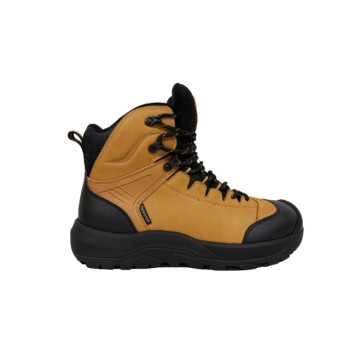
The primary role of an industrial-grade heat setting oven is to thermally activate the adhesives that have been pre-coated on the safety shoe upper and outsole. By applying a strictly controlled temperature for a specific duration, the oven alters the physical and chemical state of the adhesive, ensuring it is perfectly prepped for the subsequent pressing stage.
Achieving a structural bond in safety footwear requires more than just applying glue; the adhesive must be thermally "woken up." The heat setting oven ensures the adhesive reaches the exact viscosity and chemical reactivity needed to fuse the upper and sole into a single, inseparable unit.
The Mechanics of Adhesive Activation
Optimizing Viscosity
The adhesive applied to shoe components is effectively dormant until treated. The oven heats this layer to bring it to an optimal state of viscosity.
This change in fluidity allows the adhesive to wet the mating surfaces thoroughly. It ensures the glue flows into the microscopic textures of the materials rather than just sitting on top of them.
Maximizing Chemical Activity
Beyond simple melting, the heat treatment triggers a chemical change. The oven ensures the adhesive achieves maximum chemical activity just moments before the parts are joined.
This reactive state is essential for creating strong molecular bonds. It allows the adhesive to cross-link effectively during the pressing process, creating a permanent hold.
The Importance of Precision Control
Uniform Heat Treatment
Industrial-grade equipment is distinguished by its ability to deliver uniform heat treatment. The oven circulates air to ensure that the toe, heel, and arch areas are heated evenly.
Without this uniformity, the shoe would suffer from weak spots. Even a small area of under-heated adhesive could become a failure point where the sole begins to delaminate.
Foundation for Pressing
The heat setting process is the critical preparation for the final assembly. It ensures the bond is ready to withstand the high pressure of the attaching machine.
This leads to structural reliability, which is non-negotiable for safety shoes. The bond must be strong enough to resist the heavy wear, impact, and environmental stress typical of industrial work.
Common Pitfalls to Avoid
The Risk of Overheating
While heat is necessary, too much heat can be destructive. If the oven temperature drifts too high or the duration is too long, the adhesive can degrade.
This results in a "burnt" adhesive layer that loses its tackiness. The chemical bonds break down before they can form, rendering the glue useless.
The Danger of Under-Activation
Conversely, failing to reach the target temperature results in a "cold bond." The adhesive may remain too viscous to penetrate the material properly.
While the shoe might initially stick together, the bond lacks chemical depth. This often leads to premature separation of the sole after only minimal use.
Ensuring Bond Integrity in Production
To guarantee the safety and longevity of the footwear, you must match the equipment capabilities to the specific requirements of your adhesive system.
- If your primary focus is consistency: Calibrate the oven's temperature controls and conveyor speed strictly according to the adhesive manufacturer's technical data sheet.
- If your primary focus is durability: Invest in ovens with superior airflow management to eliminate "cold spots" that compromise the bond at critical flex points like the ball of the foot.
Ultimately, the heat setting oven acts as the critical bridge between raw components and a finished product that is safe for industrial use.
Summary Table:
| Process Element | Role in Bonding | Impact on Quality |
|---|---|---|
| Viscosity Control | Melts adhesive to a fluid state | Ensures deep penetration into material textures |
| Chemical Activation | Triggers molecular cross-linking | Creates a permanent, inseparable bond |
| Uniform Circulation | Even heat across toe, heel, and arch | Eliminates weak spots and delamination risks |
| Precision Timing | Prevents over/under heating | Protects adhesive integrity and tackiness |
Partner with 3515 for High-Performance Footwear Manufacturing
As a large-scale manufacturer serving distributors and brand owners, 3515 offers comprehensive production capabilities for all footwear types, anchored by our flagship Safety Shoes series. Our advanced industrial processes, including precision heat-setting technology, ensure that every pair meets the highest standards of structural reliability.
Our extensive portfolio covers:
- Work and Tactical Boots
- Outdoor and Training Shoes
- Sneakers and Formal Dress Shoes
Looking to scale your footwear brand with a partner who prioritizes bond integrity and durability? Contact us today to discuss your bulk requirements and see how our manufacturing expertise can drive your success.
References
- Eko Fandra Winata, Sugiyono Sugiyono. Analysis of Safety Shoes Product Quality Control at PT. BINA USAHA SEJAHTERA With Statistical Quality Control (SQC) Method Case Study of PT Bina Usaha Sejahtera (BINUSA). DOI: 10.55927/ijba.v4i1.8323
This article is also based on technical information from 3515 Knowledge Base .
Related Products
- Premium Insulated Safety Boots and Shoes for Wholesale & Bulk Orders
- Premium Lightweight Safety Shoes for Wholesale & Bulk Orders
- High Performance Fire-Retardant Waterproof Safety Boots
- Premium Suede Sport Safety Shoes for Wholesale & Bulk Orders
- Advanced KPU Athletic Safety Shoe with Steel Toe Cap Anti-Slip Rotary Lacing System
People Also Ask
- What are the recommended insulation ratings for mild winter conditions? A Guide for Active & Stationary Workers
- How does insulation thickness correlate with temperature ranges? A Guide to Choosing the Right Warmth
- What insulation level is needed for severe cold and stationary work? 1200g or Higher is Essential
- What safety advantages do insulated boots offer beyond warmth? Dielectric Protection & Superior Grip
- How does fleece lining contribute to the warmth of insulated boots? Trapping Air for Superior Cold Protection